
- Home
- »
- Communications Infrastructure
- »
-
E-commerce Market Size And Share Report, 2026-2033GVR Report cover

E-commerce Market (2026 - 2033)
Size, Share & Trends Analysis By Product (Automotive, Beauty & Personal Care, Books & Stationery, Consumer Electronics, Home Appliances, Clothing & Footwear, Healthcare), By Model (Business-to-Business), By Region, And Segment Forecasts
Market Size, 2025
$33,900.0BMarket Estimate, 2026
$39,696.3BMarket Forecast, 2033
$155,983.0BCAGR, 2026–2033
21.6%E-commerce Market Summary
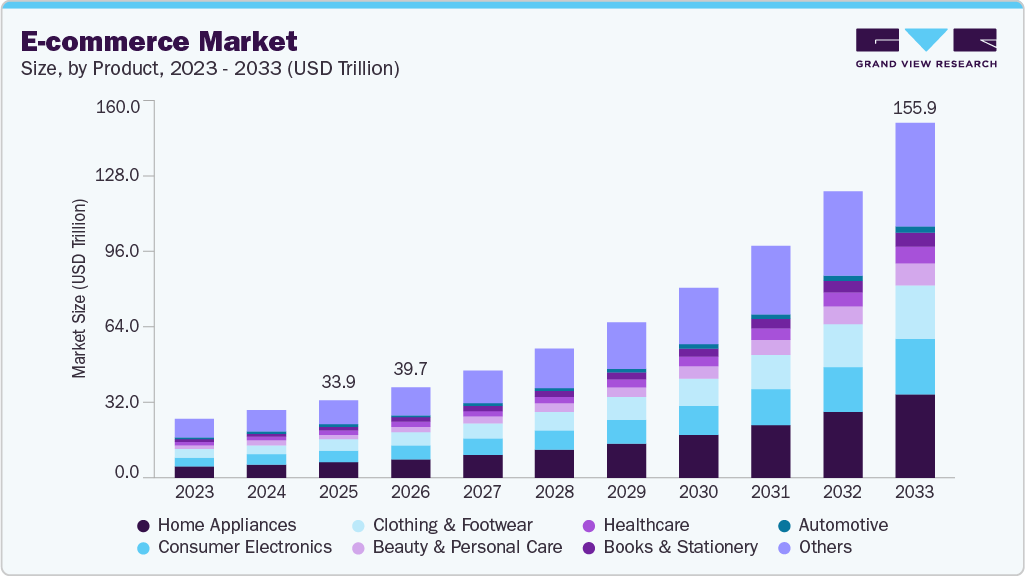
The global e-commerce market size was valued at USD 33,900.0 billion in 2025 and is projected to grow from USD 39,696.3 billion in 2026 to USD 1,55,982.6 billion by 2033, at a CAGR of 21.6% from 2026 to 2033. The market in Asia Pacific dominated with a revenue share of 45.0% in 2025. Due to the rapid expansion of internet penetration and smartphone adoption, particularly in emerging economies across the Asia Pacific, Latin America, and Africa. Affordable mobile data plans and increasing access to low-cost smartphones have enabled first-time digital consumers to participate in online retail ecosystems.
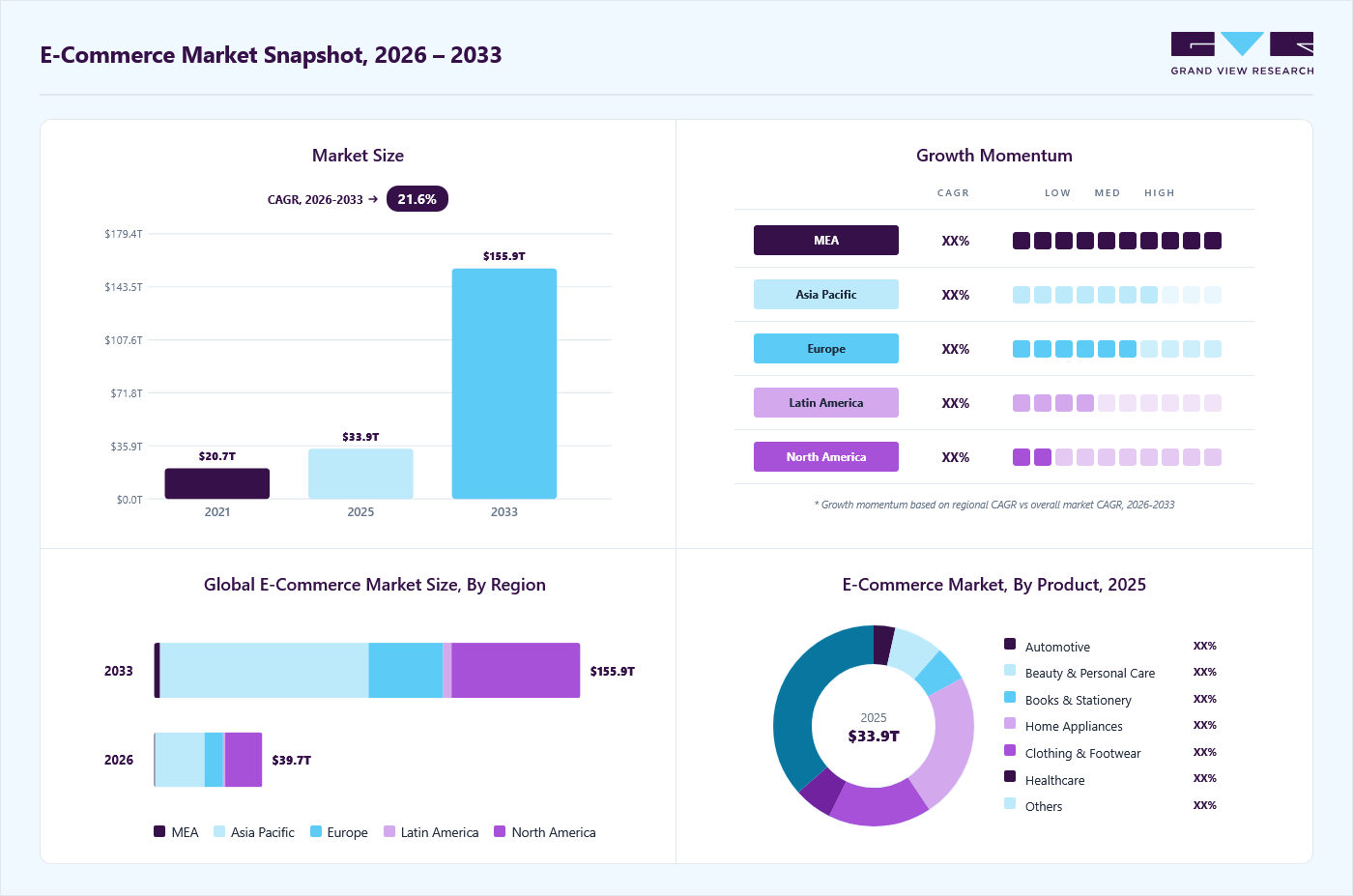 Source: Grand View Research, IR Documents, Primary Interviews, Paid DatabasesTo learn more about this report,
 Download Free Sample Report
 Key Market Trends & Insights
- By product: The home appliances segment led the market and held the largest revenue share of 20.0% in 2025.
- By model: The consumer to consumer (C2C) segment is expected to grow at the fastest CAGR from 2026 to 2033.
Regional Highlights
- Largest regional market: Asia Pacific (45.0% revenue share, 2025)
- The e-commerce industry in the China held the largest revenue share in 2025.
Market Size & Forecast
- Market size in 2025: USD 33,900.0 Billion
- Estimated market size in 2026: USD 39,696.3 Billion
- Projected market size by 2033: USD 1,55,982.6 Billion
- CAGR (2026-2033): 21.6%
Three ways to get this report
Buy it, customize it, or ask a question.Ask an Analyst
A direct answer, usually in 1 working day
- AccessReport author, directly
- Reply timeWithin 1 working day
- No sales callDirect answer only
- FormatEmail reply
- CostFree, no cost
Get the Full Report
What the study covers
- FormatsPDF · Excel · Dashboard
- Timeline2026–2033 annual, 2025 base
- Coverage20+ countries, 5 regions
- Companies10+ key players profiled
Customize the Report
20% free customization
- IncludeCountries, segments, points
- TailorTo your product definition
- ExtendDeeper competitor detail
- OrA fully bespoke study
- Turnaround5–10 working days
The evolution of digital payment infrastructure and fintech integration contributes to the growth of the e-commerce industry. The widespread adoption of digital wallets, UPI-based systems, buy-now-pay-later (BNPL) models, and embedded finance solutions has reduced friction in online transactions. Secure payment gateways, tokenization, and AI-based fraud detection mechanisms have strengthened consumer trust, thereby increasing transaction volumes and repeat purchases. Cross-border payment innovations have also enabled seamless international trade, expanding the total addressable market for online retailers. For instance, in August 2025, Zand, a UAE-based AI-driven financial services group, entered into a strategic partnership with Mastercard to strengthen its cross-border payment capabilities. Under the agreement, Zand aims to integrate Mastercard Move’s global money movement infrastructure to deliver faster, secure, and more efficient international transfers for its customers. In the initial rollout phase, the bank plans to enable services, including direct deposits into bank accounts and digital wallets across multiple markets, as well as cash pickup options, expanding its international remittance and payment offerings.Advancements in logistics, supply chain digitization, and last-mile delivery networks are significantly contributing to market expansion. Investments in automated warehouses, AI-driven inventory management, micro-fulfillment centers, and hyperlocal delivery models have improved order fulfillment speed and operational efficiency. Same-day and next-day delivery expectations are reshaping competitive dynamics, while partnerships with third-party logistics providers are enabling scalable distribution in both urban and semi-urban regions. For example, as of February 2026, Walmart is implementing large-scale supply chain automation by upgrading a significant portion of its U.S. distribution centers, with plans to modernize the entire network. A majority of its stores receive inventory from automated facilities, and a substantial share of e-commerce orders is processed through automated fulfillment centers, enabling higher operational efficiency and lower shipping costs.
 To learn more about this report, Download Free Sample Report
 The increasing penetration of omnichannel retail strategies is further propelling market growth. Traditional brick-and-mortar retailers are integrating digital storefronts, click-and-collect models, and unified commerce platforms to enhance customer engagement. The use of data analytics, personalization engines, and recommendation algorithms improves conversion rates and customer lifetime value. Social commerce and live commerce integrations across platforms such as Instagram, TikTok, and regional marketplaces are also transforming the digital retail landscape.
Product Insights
The home appliances segment dominated the market and accounted for the revenue share of 20.0% in 2025, driven by increasing urbanization, rising disposable incomes, and growing consumer preference for convenience-oriented and energy-efficient products. The expansion of smart home ecosystems integrating IoT-enabled refrigerators, washing machines, air conditioners, and kitchen appliances has accelerated online research and digital purchasing behavior, as consumers compare specifications, reviews, and prices across platforms before making high-value decisions.
The clothing & footwear segment is anticipated to grow at a notable CAGR over the forecast period, driven by fast-fashion cycles, increasing digital influence on consumer trends, and the expansion of direct-to-consumer (D2C) brands. Rapid product refresh rates, influencer-led marketing, and social media integration are accelerating purchase decisions and shortening buying cycles. Advanced sizing algorithms, virtual try-on tools, easy return policies, and detailed user-generated reviews have reduced hesitation around fit and quality, historically key barriers to online apparel purchases.
Model Insights
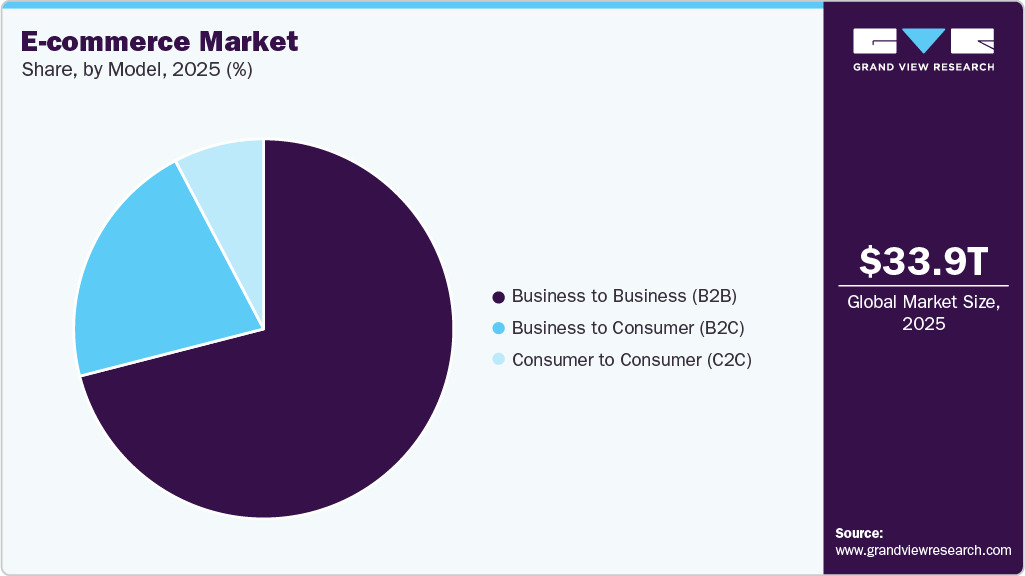
The business to business (B2B) segment dominated the market and accounted for the largest revenue share in 2025, driven by enterprise digital transformation initiatives aimed at improving procurement efficiency, cost transparency, and supply chain resilience. Organizations are increasingly adopting digital procurement platforms to streamline bulk ordering, automate invoicing, enable real-time inventory visibility, and integrate ERP systems for seamless workflow management. The shift toward centralized sourcing, data-driven vendor selection, and contract-based pricing models is accelerating online B2B transactions across industries such as manufacturing, healthcare, retail, and construction.
 To learn more about this report, Download Free Sample Report
 The consumer to consumer (C2C) segment is expected to grow at a significant CAGR during the forecast period, owing to the rapid expansion of peer-to-peer digital marketplaces that enable individuals to monetize unused assets and participate in the circular economy. Platforms have lowered entry barriers by providing built-in payment systems, user verification mechanisms, ratings, and dispute resolution frameworks that enhance transactional trust. Growing consumer preference for affordable second-hand goods, sustainability-driven purchasing behavior, and resale culture, particularly in categories like fashion, electronics, and furniture, are expanding transaction volumes.
Regional Insights
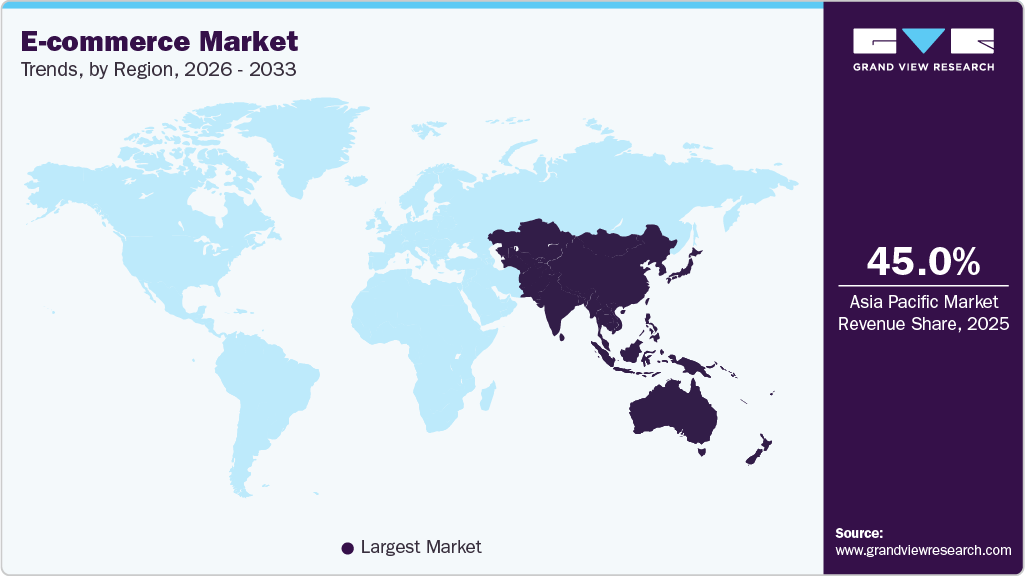
The e-commerce industry in the Asia Pacific dominated the global market with the largest revenue share of 45.0% in 2025, due to its large population base, rising middle-class consumption, and mobile-first internet ecosystem. The proliferation of super-apps integrating payments, shopping, and entertainment is reshaping digital commerce engagement.
 To learn more about this report, Download Free Sample Report
 The Japan e-commerce industry is expected to grow rapidly in the coming years, driven by the adoption of advanced mobile payments, high urban density, and strong demand for convenience-driven retail models. Consumers value precision logistics and scheduled delivery services, which enhance repeat purchasing behavior.
The e-commerce industry in China held a substantial market share in 2025, due to highly integrated digital ecosystems led by platforms such as Alibaba Group and JD.com. The dominance of live commerce, social shopping, and real-time interactive streaming significantly boosts conversion rates. Advanced digital wallets, QR-based payments, and AI-powered supply chain optimization enable high transaction velocity, while strong domestic manufacturing capacity supports rapid product turnover and competitive pricing.
North America E-commerce Market Trends
The e-commerce industry in North America held a significant share in the global market in 2025, driven by high digital maturity, widespread broadband penetration, and advanced fulfillment ecosystems that enable rapid delivery standards. Strong adoption of subscription commerce, digital marketplaces, and cross-border purchasing within the region enhances transaction frequency.
U.S. E-commerce Market Trends
The e-commerce industry in the U.S. is expected to grow significantly at a CAGR of 18.9% from 2026 to 2033, due to large-scale marketplace dominance led by platforms such as Amazon and Walmart, which continue to expand same-day delivery networks and third-party seller ecosystems. Growth is also supported by advanced digital advertising infrastructure, influencer commerce, and high credit card penetration, enabling seamless checkout experiences.
Europe E-commerce Market Trends
The e-commerce industry in Europe is anticipated to register considerable growth from 2026 to 2033, due to cross-border trade within the European Union’s single market framework, which reduces customs barriers and harmonizes digital regulations. Increasing adoption of sustainable commerce models, eco-friendly packaging, and resale platforms aligns with regional consumer preferences.
The UK e-commerce industry is expected to grow rapidly in the coming years, owing to the dense urban infrastructure and efficient parcel delivery networks. Click-and-collect services, strong fintech integration, and rapid expansion of grocery e-commerce contribute significantly to digital sales. Retailers leveraging advanced, data-driven loyalty programs and omnichannel integration are also accelerating customer retention and basket-size growth.
The e-commerce industry in Germany held a substantial market share in 2025, due to a strong consumer trust in invoice-based and open-banking payment models, which reduce friction in online purchases. The country’s robust logistics backbone and central geographic location in Europe facilitate efficient regional distribution.
Key E-commerce Company Insights
Key players operating in the e-commerce industry are Amazon.com, Inc., Alibaba.com, Walmart, Costco, Shopify, and eBay Inc. The companies are focusing on various strategic initiatives, including new product development, partnerships & collaborations, and agreements to gain a competitive advantage over their rivals. The following are some instances of such initiatives.
-
In November 2025, Amazon.com, Inc. expanded the international footprint of its value-focused e-commerce platform, Amazon Bazaar, marketed as Amazon Haul in the U.S., by rolling it out across 14 additional markets. The standalone Bazaar app mirrors the assortment strategy of the budget-oriented Haul section in the main Amazon app, offering competitively priced merchandise for cost-conscious consumers. Among the newly added markets are Hong Kong, the Philippines, Nigeria, and Taiwan. Following its initial launch in Mexico, the platform has also expanded into Saudi Arabia and the United Arab Emirates (UAE).
-
In November 2025, Alibaba.com introduced AI Mode, a new functionality that embeds agentic AI capabilities directly into the platform’s user workflow. The rollout signals a strategic shift toward AI-native global trade enablement, positioning the company to evolve from a conventional B2B marketplace into an agentic AI-powered e-commerce ecosystem designed to streamline sourcing, negotiation, and transaction processes.
-
In October 2025, Walmart announced a strategic collaboration with OpenAI to develop AI-first shopping experiences across Walmart and Sam’s Club. The partnership will enable customers and members to complete purchases directly within ChatGPT, streamlining the path from product discovery to checkout. By embedding advanced AI capabilities into the retail journey, the companies aim to transition from reactive transactions to proactive, predictive engagement that anticipates customer needs. The initiative further expands Walmart’s existing AI deployments, including product catalog optimization, faster customer service resolution, and workforce AI upskilling programs.
Key E-commerce Companies:
The following key companies have been profiled for this study on the e-commerce market.
- Alibaba.com
- Amazon.com, Inc.
- ASOS
- Costco Wholesale Corporation
- Dangdang
- eBay Inc.
- Flipkart.com
- JD.com
- Lazada
- MercadoLibre S.R.L.
- Shopee
- Shopify
- Walmart
- Wayfair LLC
- Zalando
E-commerce Market Report Scope
Report Attribute
Details
Market size in 2025
USD 33,900.0 billion
Estimated market size in 2026
USD 39,696.3 billion
Projected market size by 2033
USD 1,55,982.6 billion
Growth rate
CAGR of 21.6% from 2026 to 2033
Actual data
2021 - 2025
Forecast period
2026 - 2033
Quantitative units
Revenue in USD trillion and CAGR from 2026 to 2033
Report coverage
Revenue forecast, company share, competitive landscape, growth factors, and trends
Segments covered
Product, model, region
Regional scope
North America; Europe; Asia Pacific; Latin America; Middle East and Africa
Country scope
U.S.; Canada; Mexico; UK; Germany; France; China; India; Japan; Australia; South Korea; Brazil; UAE; Kingdom of Saudi Arabia; South Africa
Key companies profiled
Amazon.com, Inc.; Alibaba.com; ASOS; Costco Wholesale Corporation; Dangdang; eBay Inc.; Flipkart.com; JD.com; Lazada; MercadoLibre S.R.L.; Shopify; Shopee; Walmart; Wayfair LLC; Zalando
Customization scope
Free report customization (equivalent to 8 analysts working days) with purchase. Addition or alteration to country, regional & segment scope.
Pricing and purchase options
Avail customized purchase options to meet your exact research needs. Explore purchase options
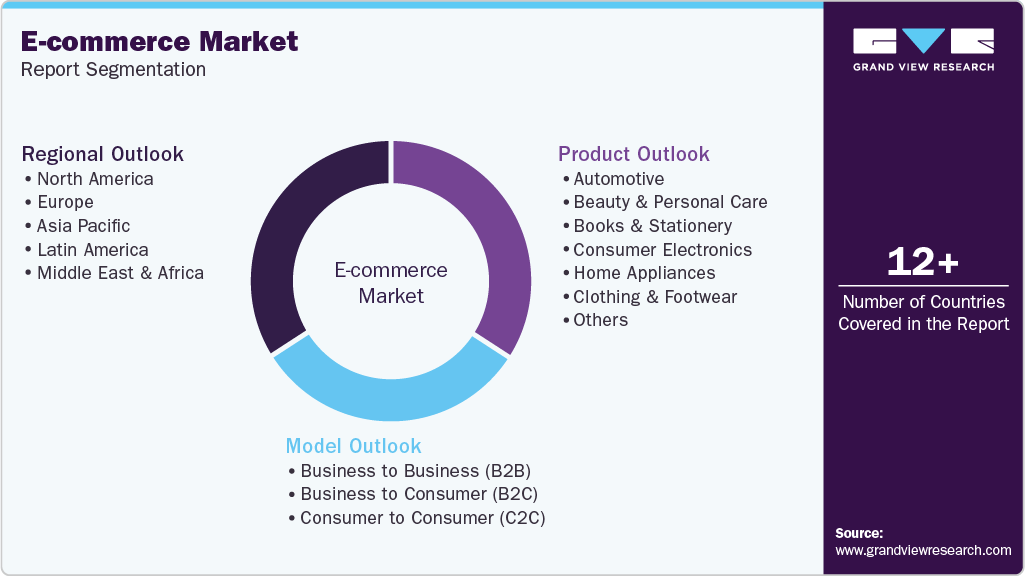
Global E-commerce Market Report Segmentation
This report forecasts revenue growth at the global, regional, and country levels and provides an analysis of the latest industry trends in each of the sub-segments from 2021 to 2033. For this study, Grand View Research has segmented the global e-commerce market report based on product, model, and region.
 To learn more about this report, Download Free Sample Report
 -
Product Outlook (Revenue, USD Billion, 2021 - 2033)
-
Automotive
-
Beauty & Personal Care
-
Books & Stationery
-
Consumer Electronics
-
Home Appliances
-
Clothing & Footwear
-
Healthcare
-
Others
-
-
Model Outlook (Revenue, USD Billion, 2021 - 2033)
-
Business to Business (B2B)
-
Business to Consumer (B2C)
-
Consumer to Consumer (C2C)
-
-
Regional Outlook (Revenue, USD Billion, 2021 - 2033)
-
North America
-
U.S.
-
Canada
-
Mexico
-
-
Europe
-
UK
-
Germany
-
France
-
-
Asia Pacific
-
China
-
India
-
Japan
-
South Korea
-
Australia
-
-
Latin America
-
Brazil
-
-
Middle East & Africa
-
UAE
-
Saudi Arabia
-
South Africa
-
-
Frequently Asked Questions About This Report
Asia Pacific dominated the market with the largest revenue share of 45.0% in 2025.
Some key players operating in the e-commerce market include Amazon.com, Inc., Alibaba.com, ASOS, Costco Wholesale Corporation, Dangdang, eBay Inc., Flipkart.com, JD.com, Lazada, MercadoLibre S.R.L., Shopify, Shopee, Walmart, Wayfair LLC, Zalando
The global e-commerce market is driven by the rapid expansion of internet penetration and smartphone adoption, particularly in emerging economies across the Asia Pacific, Latin America, and Africa. Affordable mobile data plans and increasing access to low-cost smartphones have enabled first-time digital consumers to participate in online retail ecosystems.
The home appliances segment led with a revenue share 20.0% in 2025.
Business to business (B2B) segment held the largest revenue share in 2025.
The global e-commerce market size was estimated at USD 33,900.0 billion in 2025 and is expected to reach USD 39,696.3 billion in 2026.
The global e-commerce market is expected to grow at a compound annual growth rate of 21.6% from 2026 to 2033 to reach USD 155,983.0 billion by 2033.
About the Author(s)
Communications Infrastructure Research Team
Technology · Communications InfrastructureThis report was authored by the communications infrastructure research team at Grand View Research - comprising two research analysts, one senior research analyst, and one industry expert - with specialized expertise in the communications infrastructure segment of the technology industry. All findings are based on proprietary technology databases, executive interviews, and regulatory analysis, subject to internal peer review prior to publication.
Last Updated:
Speak to Analyst

Customize this report to your needs - add regions, segments, or data points, with 20% free customization.
Or view our licence options:


ISO 9001:2015 & 27001:2022 Certified
We are GDPR and CCPA compliant! Your transaction & personal information is safe and secure. For more details, please read our privacy policy.


