
- Home
- »
- Communication Services
- »
-
Business-to-Business E-commerce Market Report 2026-2033GVR Report cover

Business-to-Business E-commerce Market (2026 - 2033)
Size, Share & Trends Analysis Report By Product Category (Home & Kitchen Appliances, Consumer Electronics), By Deployment (Intermediary-oriented, Supplier-oriented), By Region, And Segment Forecasts
Market Size, 2025
$24.1TMarket Estimate, 2026
$28.0TMarket Forecast, 2033
$105.9TCAGR, 2026–2033
20.9%Business-to-Business E-commerce Market Summary
The global business-to-business e-commerce market size was valued at USD 24.1 trillion in 2025 and is projected to grow from USD 28.0 trillion in 2026 to USD 105.9 trillion by 2033, at a CAGR of 20.9% from 2026 to 2033. Asia Pacific B2B e-commerce market dominated the global market with the largest revenue share of 39.5% in 2025. Organizations across manufacturing, wholesale, distribution, and services are replacing manual, paper-based workflows with integrated digital commerce platforms.
 Source: Grand View Research, IR Documents, Primary Interviews, Paid DatabasesTo learn more about this report,
 Download Free Sample Report
 Key Market Trends & Insights
- By product type: Home & kitchen application segment led the market and held the largest revenue share of 23.1% in 2025.
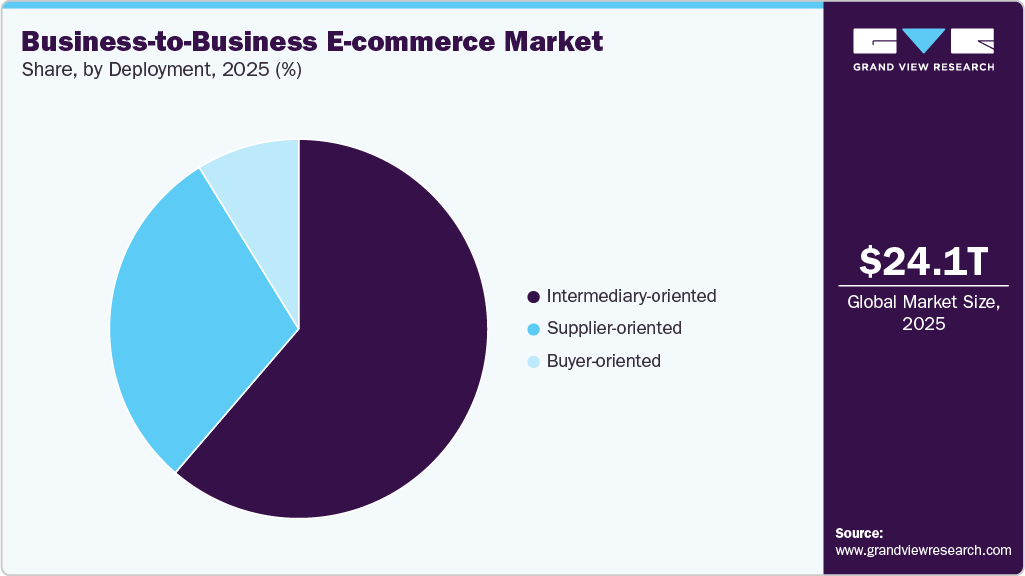
- By deployment: Intermediary-oriented segment dominated the market and accounted for the largest revenue share in 2025.
Regional Highlights
- Largest regional market: Asia Pacific (39.5% revenue share, 2025)
- Fastest-growing regional market: North America (highest CAGR, 2026-2033)
- By country: The Japan held the largest market share in 2025.
Market Size & Forecast
- Market size in 2025: USD 24.1 Trillion
- Estimated market size in 2026: USD 28.0 Trillion
- Projected market size by 2033: USD 105.9 Trillion
- CAGR (2026-2033): 20.9%
Three ways to get this report
Buy it, customize it, or ask a question.Ask an Analyst
A direct answer, usually in 1 working day
- AccessReport author, directly
- Reply timeWithin 1 working day
- No sales callDirect answer only
- FormatEmail reply
- CostFree, no cost
Get the Full Report
What the study covers
- FormatsPDF · Excel · Dashboard
- Timeline2026–2033 annual, 2025 base
- Coverage20+ countries, 5 regions
- Companies10+ key players profiled
Customize the Report
20% free customization
- IncludeCountries, segments, points
- TailorTo your product definition
- ExtendDeeper competitor detail
- OrA fully bespoke study
- Turnaround5–10 working days
The increasing demand for procurement efficiency and cost optimization contributes to the growth of the business-to-business e-commerce industry. Enterprises are under continuous pressure to reduce operational expenditure and improve working capital management. B2B e-commerce platforms support bulk purchasing, negotiated pricing, contract-based ordering, and spend analytics, allowing organizations to consolidate suppliers and optimize sourcing strategies. Digital marketplaces also improve price discovery and competitive bidding, particularly for SMEs seeking better supplier access and pricing leverage.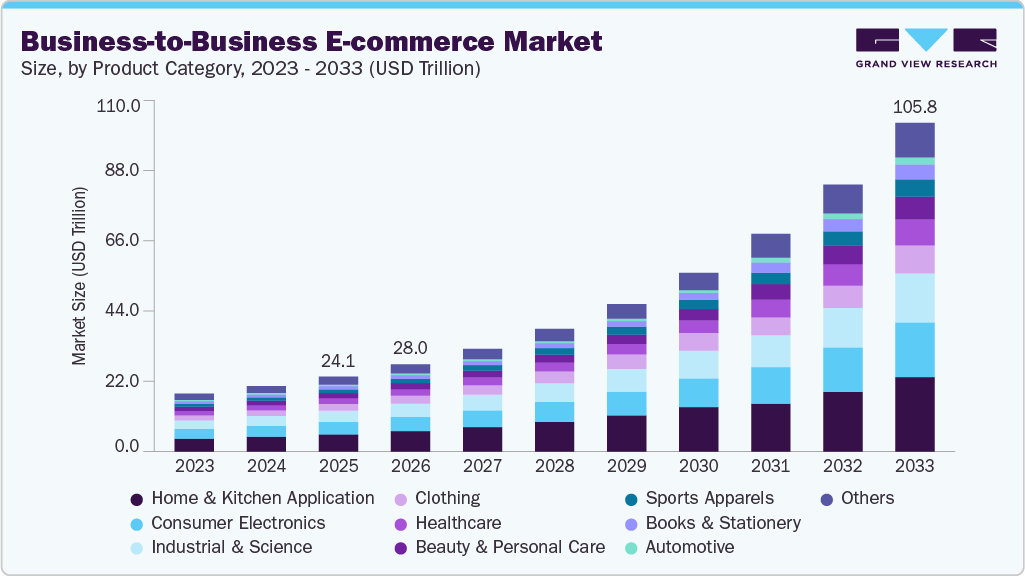 To learn more about this report, Download Free Sample Report
 The rise of artificial intelligence (AI), machine learning (ML), and the Internet of Things (IoT), along with other emerging technologies, is enabling businesses to streamline processes, gain deeper insights into customer behavior, improve operational efficiency, and enhance overall customer experiences. For instance, in November 2025, Alibaba.com introduced AI Mode, bringing agentic AI capabilities directly into the global B2B e-commerce experience. The feature allows users to interact with the platform using natural language queries, while the AI analyzes technical specifications, compares suppliers on pricing, logistics, certifications, and production capabilities, and delivers personalized recommendations in seconds.
The proliferation of B2B marketplaces and platform-based ecosystems is another key catalyst. Large digital marketplaces such as Alibaba, Amazon Business, and regional vertical-specific platforms are aggregating suppliers and buyers into centralized ecosystems. These platforms offer advanced search capabilities, AI-driven product recommendations, supplier verification, logistics integration, and value-added services such as financing and insurance. Network effects increase liquidity and trust within these ecosystems, attracting both large enterprises and SMEs.
Market Dynamics
The increasing adoption of digital procurement platforms, online wholesale marketplaces, and enterprise digital commerce solutions is a major factor driving the growth of the business-to-business (B2B) e-commerce market. Organizations across industries, including manufacturing, retail, healthcare, automotive, industrial equipment, food & beverages, and consumer goods, are increasingly transitioning from traditional procurement processes to digital purchasing ecosystems to improve operational efficiency, supply chain visibility, and procurement transparency. The growing need for automated order management, real-time inventory visibility, bulk purchasing capabilities, supplier collaboration, and seamless payment processing has significantly accelerated the demand for advanced B2B e-commerce platforms across global enterprises and SMEs.
In addition, enterprises are increasingly adopting AI-enabled procurement analytics, cloud-based commerce platforms, digital payment systems, and omnichannel B2B marketplaces to improve purchasing efficiency and customer experience. The rapid expansion of cross-border trade, mobile commerce, and self-service procurement portals has further strengthened market demand. Several major technology providers and digital commerce vendors are also expanding investments in AI-powered recommendation engines, automated supply chain management, personalized buyer experiences, and integrated enterprise commerce ecosystems to accelerate digital trade transformation. For instance, in April 2026, Shopify announced the expansion of its native B2B commerce capabilities to merchants across all Shopify plans, extending features previously limited to Shopify Plus users. The new rollout includes company profiles, custom pricing catalogs, volume discounts, payment terms, purchase order functionality, and self-service wholesale purchasing tools designed to help businesses manage both direct-to-consumer (DTC) and B2B operations within a unified commerce platform.
Restraints: Complex integration requirements and cybersecurity concerns are limiting market adoption
The B2B e-commerce market faces significant challenges due to complex enterprise integration requirements, cybersecurity risks, and operational complexities associated with large-scale digital commerce ecosystems. Many B2B e-commerce platforms must integrate with enterprise resource planning (ERP) systems, customer relationship management (CRM) software, warehouse management systems, procurement platforms, and legacy supply chain infrastructures, which may increase deployment complexity, implementation timelines, and operational costs. Inconsistent data standards, interoperability limitations, and vendor lock-in across cloud- and on-premises environments further complicate platform integration and scalability.
In addition, B2B e-commerce platforms frequently handle sensitive financial information, enterprise procurement data, pricing agreements, and customer records, making them attractive targets for cyberattacks, payment fraud, ransomware incidents, and unauthorized access attempts. Enterprises operating across multiple regions must also comply with evolving data privacy regulations, tax compliance requirements, trade policies, and cross-border commerce regulations, increasing compliance burdens and operational risks.
Market Concentration & Characteristics
The business-to-business (B2B) e-commerce market is moderately concentrated, with the presence of global digital commerce platform providers, enterprise software companies, online marketplace operators, and SaaS-based procurement solution vendors. Leading companies maintain strong market positions through integrated commerce ecosystems, cloud-based deployment models, AI-powered sales and procurement analytics, and extensive integration capabilities with enterprise resource planning (ERP), customer relationship management (CRM), supply chain, payment, and inventory management systems. Major vendors offer comprehensive solutions, including digital product catalogs, automated procurement workflows, bulk order management, omnichannel commerce, supplier management, payment processing, logistics tracking, and customer self-service portals. Competitive advantages are driven by scalability, customization capabilities, multi-currency and multi-language support, cybersecurity, and seamless integration with enterprise infrastructure. Market entry barriers stem from the need for continuous technological innovation, enterprise-grade security, regulatory compliance, and the increasing demand for highly scalable and customizable B2B commerce platforms.
 To learn more about this report, Download Free Sample Report
 In terms of market characteristics, the B2B e-commerce industry is highly technology-driven, with rapid innovation in artificial intelligence, automation, cloud computing, API-based integrations, and advanced analytics. Growing digital transformation initiatives across manufacturing, wholesale, healthcare, automotive, industrial, and retail sectors are major factors supporting market growth. The shift from traditional offline procurement processes to digital purchasing platforms, along with rising cross-border trade and the adoption of omnichannel commerce, is accelerating global market expansion. Moreover, the market is characterized by rising demand for real-time inventory visibility, personalized buyer experiences, automated procurement and invoicing, digital payment solutions, and enhanced supply chain transparency.
Product Category Insights
The home & kitchen application segment dominated the market and accounted for the revenue share of 23.1% in 2025 due to rising demand from small and medium-sized retailers, hospitality businesses, and institutional buyers seeking streamlined procurement of appliances, furnishings, and kitchenware at competitive prices. Businesses are increasingly leveraging online platforms to source bulk quantities with transparent pricing, faster delivery, and access to diverse suppliers across regions.
The books & stationery segment is anticipated to grow at the fastest CAGR during the forecast period as educational institutions, corporate offices, and training centers increasingly shift to online procurement for efficiency and cost savings. Bulk ordering capabilities, centralized catalog management, and streamlined logistics offered by B2B platforms enable organizations to maintain consistent supply of textbooks, office supplies, and learning materials.
Deployment Insights
The intermediary-oriented segment dominated the market and accounted for the largest revenue share in 2025 as distributors, wholesalers, and procurement agencies increasingly rely on digital platforms to streamline supply chain operations and manage multiple client accounts efficiently. By leveraging cloud-based deployment models and integrated order management systems, intermediaries can reduce manual processing, enhance transparency across transactions, and rapidly scale operations to serve diverse buyer networks.
 To learn more about this report, Download Free Sample Report
 The supplier-oriented segment is expected to grow at a significant CAGR during the forecast period as manufacturers, wholesalers, and distributors seek platforms that enhance their visibility, expand market reach, and directly connect with buyers. By adopting supplier-centric systems, businesses can manage catalogs, pricing, and order fulfillment more efficiently while leveraging data analytics to forecast demand and optimize supply chains. This approach reduces dependency on intermediaries, accelerates transaction cycles, and strengthens supplier-buyer relationships, making supplier-oriented deployment a critical growth driver in the B2B e-commerce ecosystem.
Regional Insights
North America Business-to-Business E-commerce Market Trends
North America business-to-business e-commerce market held a significant share in the global market in 2025, driven by the widespread adoption of digital procurement solutions among large enterprises and SMEs, coupled with advanced logistics infrastructure. Businesses increasingly prioritize automated order processing, AI-powered supply chain management, and seamless integration with ERP systems, which streamline operations and reduce procurement costs.
U.S. Business-to-Business E-commerce Market Trends
The B2B e-commerce market in the U.S. is expected to grow significantly at a CAGR of 18.5% from 2026 to 2033, due to the increasing use of mobile commerce and cloud-based procurement platforms, allowing companies to place bulk orders anytime and anywhere. The focus on operational efficiency, real-time inventory visibility, and personalized pricing models attracts large distributors and retailers to B2B marketplaces.
Europe Business-to-Business E-commerce Market Trends
The business-to-business e-commerce market in Europe is anticipated to register considerable growth from 2026 to 2033 due to cross-border trade facilitation, with platforms enabling businesses to source goods across multiple countries while complying with varying regional regulations. Sustainability requirements and digital invoicing mandates encourage companies to adopt standardized e-commerce solutions.
The UK B2B e-commerce industry is expected to grow rapidly in the coming years, owing the government initiatives promoting digital transformation for SMEs. Businesses are adopting e-procurement platforms to enhance supply chain transparency, reduce manual order errors, and implement faster payment cycles.
The Germany business-to-business e-commerce industry held a substantial market share in 2025 due to industrial automation and the integration of Industry 4.0 principles into procurement. Manufacturers and suppliers increasingly rely on B2B platforms to digitally manage industrial components, machinery, and raw materials. Emphasis on precision, process optimization, and digital compliance standards drives the adoption of supplier-managed e-commerce solutions in the manufacturing sector.
Asia Pacific Business-to-Business E-commerce Market Trends
Asia Pacific business-to-business e-commerce market dominated the global market with the largest revenue share of 39.5% in 2025, due to the expansion of small and medium-sized enterprises, rising internet penetration, and government-backed digital initiatives. Platforms that offer multilingual support, mobile-first interfaces, and flexible payment solutions cater to a highly fragmented and diverse business ecosystem, making online procurement more accessible across urban and semi-urban regions.
 To learn more about this report, Download Free Sample Report
 The Japan business-to-business e-commerce market is expected to grow rapidly in the coming years, driven by the adoption of AI-driven procurement tools and automation in traditional industries. Businesses focus on reducing operational inefficiencies through predictive inventory management and supplier performance analytics. Strong emphasis on quality control and supplier reliability encourages companies to leverage digital marketplaces for sourcing high-precision products.
The China B2B e-commerce market held a substantial market share in 2025, due to dominance of large-scale online marketplaces, the widespread use of mobile payments, and integration with logistics networks that ensure rapid order fulfillment. Small and medium enterprises benefit from easy access to manufacturers and wholesalers, while data-driven platforms enable dynamic pricing, bulk discounts, and demand forecasting, accelerating B2B adoption.
Key Business-to-Business E-commerce Company Insights
Key players operating in the business-to-business e-commerce industry are Alibaba.com, Amazon.com, Inc., Flipkart.com, Walmart, and Zalando The companies are focusing on various strategic initiatives, including new product development, partnerships & collaborations, and agreements to gain a competitive advantage over their rivals. The following are some instances of such initiatives.
-
In September 2025, TreviPay partnered with Walmart Business to enhance the retailer’s Pay By Invoice program, enabling eligible business customers to access 30-day net terms on a line of credit. Leveraging TreviPay’s advanced payments and accounts receivable automation technology, the offering is now available across Walmart’s online platform, mobile app, and physical stores, streamlining B2B transactions and providing greater flexibility for business buyers.
-
In June 2025, Amazon.com, Inc. launched Amazon Business in Australia, aiming to streamline B2B purchasing for companies of all sizes. The platform offers business-only pricing, quantity discounts on eligible products, single or multi-user accounts, Business Prime membership, and dedicated customer support. Australian businesses can access a broad range of products, including office supplies, electronics, and furniture, all backed by Amazon’s reliable delivery network and competitive pricing, simplifying procurement and enhancing operational efficiency.
Key Business-to-Business E-commerce Companies:
The following key companies have been profiled for this study on the business-to-business e-commerce market
- Amazon.com, Inc.
- Alibaba.com
- Costco Wholesale Corporation
- IndiaMART InterMESH Limited
- eBay Inc.
- Flipkart.com
- JD.com
- Lazada
- MercadoLibre S.R.L.
- Shopify
- Shopee
- Walmart
- Wayfair LLC
- Zalando
Competitive Benchmarking
Operating Strategies
Competitive Edge
Weakness
Mature Players: Alibaba.com; Amazon.com, Inc.; Flipkart.com; Walmart; Zalando
- Expanding AI-enabled procurement automation, personalized product recommendation engines, and cloud-based B2B commerce platforms.
- Investing in integrations with ERP, CRM, accounting, payment, logistics, and supply chain management platforms such as SAP, Oracle, Salesforce, Stripe, and Microsoft Dynamics.
- Strengthening omnichannel commerce, cross-border trade management, and digital supplier ecosystem capabilities.
- Strong enterprise customer base and global digital commerce infrastructure.
- Broad end-to-end B2B commerce ecosystems integrating procurement, payments, fulfillment, logistics, and supplier management.
- Strong brand recognition and extensive global seller, distributor, and partner ecosystems.
- High scalability, advanced analytics capabilities, and multi-region operational support for large enterprises.
- Complex pricing structures and enterprise-grade implementations may reduce adoption among SMEs.
- Dependence on third-party logistics and supply chain networks may create operational inefficiencies.
- Legacy enterprise integrations may increase deployment complexity and implementation timelines.
- Large organizational structures may slow innovation cycles and platform customization.
Emerging Players: Shopify; Wayfair LLC
- Focusing on lightweight SaaS-based deployment models, mobile-first B2B commerce platforms, and flexible commission-based pricing strategies.
- Developing AI-driven product discovery, procurement automation, and digital payment capabilities.
- Expanding integrations with fintech, logistics, inventory management, and SME-focused business applications.
- Targeting SMEs, wholesalers, distributors, retailers, and regional suppliers with simplified digital commerce and procurement solutions.
- Faster innovation cycles and greater flexibility in addressing evolving SME and regional trade requirements.
- Strong specialization in niche B2B marketplaces, digital procurement workflows, and localized supply chain ecosystems.
- Easier onboarding, lower implementation costs, and simplified user experiences supporting SME adoption.
- Strong focus on customer-centric commerce experiences, embedded finance, and localized logistics support.
- Limited enterprise-scale infrastructure and smaller global support ecosystems compared to major global commerce platforms.
- Lower brand recognition among multinational enterprises and highly regulated sectors.
- Dependence on third-party cloud, payment, and logistics providers for ecosystem expansion.
- Limited financial resources for large-scale international expansion, acquisitions, and advanced AI development initiatives.
Business-to-Business E-commerce Market Report Scope
Report Attribute
Details
Market size in 2025
USD 24.1 trillion
Estimated Market size in 2026
USD 28.0 trillion
Projected Market size by 2033
USD 105.9 trillion
Growth rate
CAGR of 20.9% from 2026 to 2033
Actual data
2021 - 2025
Forecast period
2026 - 2033
Quantitative units
Revenue in USD trillion and CAGR from 2026 to 2033
Report enterprise size
Revenue forecast, company share, competitive landscape, growth factors, and trends
Segments covered
Product category, deployment, and region
Regional scope
North America; Europe; Asia Pacific; Latin America; MEA
Country scope
U.S.; Canada; Mexico; UK; Germany; France; China; India; Japan; Australia; South Korea; Brazil; UAE; Saudi Arabia; South Africa
Key companies profiled
Amazon.com, Inc.; Alibaba.com; Costco Wholesale Corporation; IndiaMART InterMESH Limited; eBay Inc.; Flipkart.com; JD.com; Lazada; MercadoLibre S.R.L.; Shopify; Shopee; Walmart; Wayfair LLC; Zalando
Customization scope
Free report customization (equivalent to 8 analysts working days) with purchase. Addition or alteration to country, regional & segment scope.
Pricing and purchase options
Avail customized purchase options to meet your exact research needs. Explore purchase options
Global Business-to-Business E-commerce Market Report Segmentation
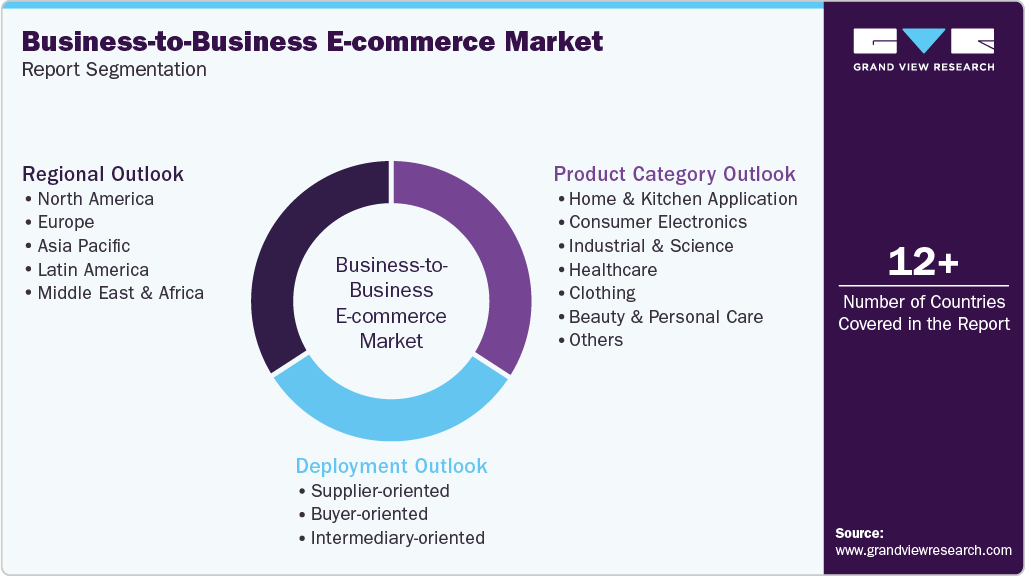
This report forecasts revenue growth at the global, regional, and country levels and provides an analysis of the latest industry trends in each of the sub-segments from 2021 to 2033. For this study, Grand View Research has segmented the global business-to-business e-commerce market report based on product category, deployment, and region.
 To learn more about this report, Download Free Sample Report
 -
Product Category Outlook (Revenue, USD Trillion, 2021 - 2033)
-
Home & Kitchen Application
-
Consumer Electronics
-
Industrial & Science
-
Healthcare
-
Clothing
-
Beauty & Personal Care
-
Sports Apparels
-
Books & Stationery
-
Automotive
-
Others
-
-
Deployment Outlook (Revenue, USD Trillion, 2021 - 2033)
-
Supplier-oriented
-
Buyer-oriented
-
Intermediary-oriented
-
-
Regional Outlook (Revenue, USD Trillion, 2021 - 2033)
-
North America
-
U.S.
-
Canada
-
Mexico
-
-
Europe
-
UK
-
Germany
-
France
-
-
Asia Pacific
-
China
-
India
-
Japan
-
South Korea
-
Australia
-
-
Latin America
-
Brazil
-
-
Middle East & Africa
-
UAE
-
Saudi Arabia
-
South Africa
-
-
Delivered Customizations
This report has been delivered with the following In-depth customizations
Client Request
Customization Delivered
Value Adds
Supply chain digitization and logistics ecosystem assessment
- Analysis of warehouse automation, fulfillment technologies, inventory management platforms, and logistics integration trends supporting B2B e-commerce operations.
- Evaluation of third-party logistics (3PL) and supply chain technology partnerships.
- Supported supply chain optimization and operational efficiency strategies.
- Identified logistics bottlenecks and fulfillment innovation opportunities.
- Highlighted opportunities for integrated supply chain ecosystems.
Regulatory and cybersecurity landscape assessment
- Analysis of digital trade regulations, data privacy laws, taxation frameworks, e-invoicing mandates, and cybersecurity standards affecting B2B e-commerce operations.
- Evaluation of compliance requirements across major regions.
- Supported regulatory risk management and compliance planning.
- Identified region-specific legal and operational barriers.
- Highlighted cybersecurity and data governance requirements for enterprise adoption.
B2B e-commerce opportunities in omnichannel commerce and cross-border trade ecosystems
- Assessment of digital commerce opportunities linked to omnichannel distribution, cross-border B2B trade, supplier digitization, and SME marketplace expansion.
- Analysis of enterprise investments in cloud-based procurement platforms, digital payment solutions, AI-powered product discovery, and logistics automation technologies.
- Identified emerging revenue streams in digital procurement and global trade ecosystems.
- Supported expansion into SME commerce platforms, embedded finance, and supply chain digitization markets.
- Highlighted strategic opportunities in AI-driven procurement automation, digital payments, and supplier collaboration platforms.
Frequently Asked Questions About This Report
The global business-to-business e-commerce market size was estimated at USD 24.1 trillion in 2025 and is expected to reach USD 28.0 trillion in 2026.
Key factors that are driving the business-to-business e-commerce market adoption are the digital transformation of enterprise procurement and sales processes. Organizations across manufacturing, wholesale, distribution, and services are replacing manual, paper-based workflows with integrated digital commerce platforms.
The North America is the fastest-growing region over the forecast period.
The global business-to-business e-commerce market is expected to grow at a compound annual growth rate of 20.9% from 2026 to 2033 to reach USD 105.9 trillion by 2033.
The Asia Pacific business-to-business e-commerce market dominated with a share of 39.5% in 2025.
Home & kitchen application segment led the market and held the largest revenue share of 23.1% in 2025.
Intermediary-oriented segment dominated the market and accounted for the largest revenue share in 2025.
Some key players operating in the B2B e-commerce market include Amazon.com, Inc., Alibaba.com, Costco Wholesale Corporation, IndiaMART InterMESH Limited, eBay Inc., Flipkart.com, JD.com, Lazada, MercadoLibre S.R.L, Shopify, Shopee, Walmart, Wayfair LLC, Zalando
About the Author(s)
Communication Services Research Team
Technology · Communication ServicesThis report was authored by the communication services research team at Grand View Research - comprising two research analysts, one senior research analyst, and one industry expert - with specialized expertise in the communication services segment of the technology industry. All findings are based on proprietary technology databases, executive interviews, and regulatory analysis, subject to internal peer review prior to publication.
Last Updated:
Speak to Analyst

Customize this report to your needs - add regions, segments, or data points, with 20% free customization.
Or view our licence options:


ISO 9001:2015 & 27001:2022 Certified
We are GDPR and CCPA compliant! Your transaction & personal information is safe and secure. For more details, please read our privacy policy.


