
- Home
- »
- Digital Media
- »
-
Anime Merchandising Market Size, Share Report, 2026-2033GVR Report cover

Anime Merchandising Market (2026 - 2033)
Size, Share & Trends Analysis Report By Product (Figurine, Clothing, Books, Board Games & Toys, Posters), By Distribution Channel (Online, Offline), By Region (North America, Europe, Asia Pacific), And Segment Forecasts
Market Size, 2025
$12.0BMarket Estimate, 2026
$13.3BMarket Forecast, 2033
$23.9BCAGR, 2026–2033
8.8%Anime Merchandising Market Summary
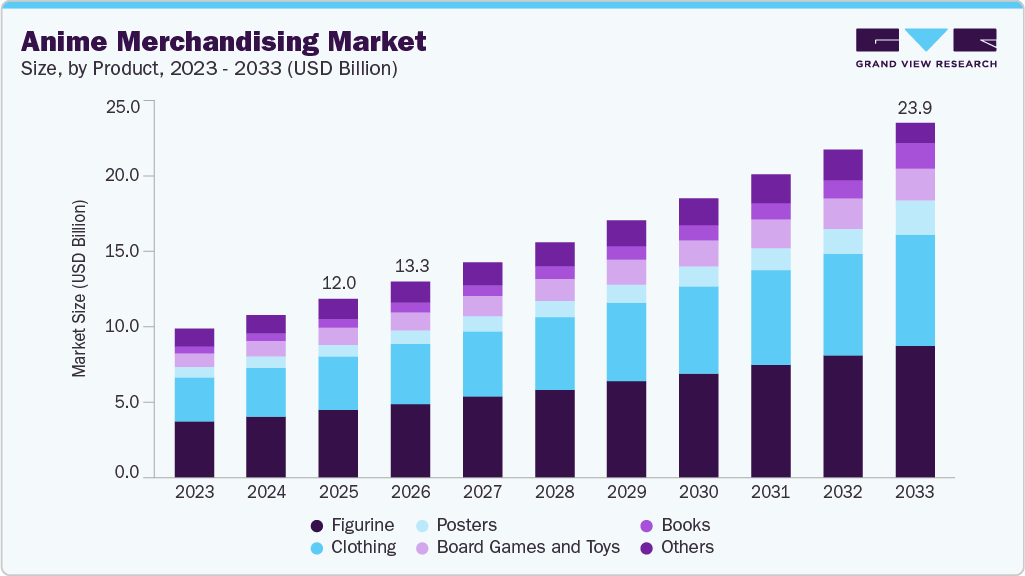
The global anime merchandising market size was valued at USD 12.0 billion in 2025 and is projected to grow from USD 13.3 billion in 2026 to USD 23.9 billion by 2033, at a CAGR of 8.8%% from 2026 to 2033. The market in Japan dominated with a revenue share of 59% in 2025. The growth is driven by the rising influence of cosplay culture, fan conventions, and online fandom communities. The continuous release of new anime films, series, and spin-off content is also creating recurring opportunities for merchandise innovation and seasonal product campaigns.
 Source: Grand View Research, IR Documents, Primary Interviews, Paid DatabasesTo learn more about this report,
 Download Free Sample Report
 Key Market Trends & Insights
- By product: Figurine segment held the largest market share of 37% in 2025.
- By distribution channel: Online segment held the largest market share in 2025.
Regional Highlights
- Largest market: Japan (59% revenue share, 2025)
- Fastest-growing regional market: North America (highest CAGR, 2026-2033)
Market Size & Forecast
- Market size in 2025: USD 12.0 Billion
- Estimated market size in 2026: USD 13.3 Billion
- Projected market size by 2033: USD 23.9 Billion
- CAGR (2026-2033): 8.8%%
Three ways to get this report
Buy it, customize it, or ask a question.Ask an Analyst
Analyst response in 1 business day
- AccessReport author, directly
- Reply timeWithin 1 working day
- No sales callDirect answer only
- FormatEmail reply
- CostFree, no cost
Get the Full Report
What the study covers
- FormatsPDF · Excel · Dashboard
- Timeline2026–2033 annual, 2025 base
- Coverage20+ countries, 5 regions
- Companies10+ key players profiled
Customize the Report
20% free customization
- IncludeCountries, segments, points
- TailorTo your product definition
- ExtendDeeper competitor detail
- OrA fully bespoke study
- Turnaround5–10 working days
The growth is driven by rapid advancements in digital commerce and content distribution, including the expansion of global streaming platforms, AI-driven personalization in online retail, and the growing integration of augmented reality (AR) and virtual experiences, which are enhancing fan engagement and purchasing behavior. The increasing shift toward direct-to-consumer (DTC) models, combined with the development of limited-edition and digitally authenticated collectibles such as NFTs, is enabling more targeted and high-value merchandise offerings. Additionally, the rising collaboration between anime studios and global fashion, gaming, and lifestyle brands is creating cross-industry product innovations, thereby accelerating the overall expansion of the industry.
The rising expansion of global anime streaming ecosystems is anticipated to significantly boost content accessibility, broaden international fanbases, and drive merchandise demand across multiple regions. The increasing availability of simulcast releases, multilingual dubbing, and region-specific content libraries is strengthening fan engagement and accelerating consumption cycles. This growing digital exposure, combined with rising demand for character-based products, limited-edition collectibles, and franchise-driven merchandise, is fueling the global expansion of the anime merchandising industry. The expansion of global streaming partnerships with regional distributors is improving product awareness and strengthening cross-border merchandise sales channels.
 To learn more about this report, Download Free Sample Report
 In addition, the rapid evolution of e-commerce infrastructure and direct-to-consumer (DTC) sales models is transforming merchandise distribution and accessibility. The increasing integration of AI-driven recommendation engines, personalized marketing strategies, and influencer-led promotions is improving customer targeting and conversion rates for anime merchandise retailers. The growing demand for exclusive product drops, subscription-based merchandise boxes, and online fan communities is enhancing consumer engagement. The advancements in supply chain automation and inventory management technologies are enabling faster order fulfillment and improved customer satisfaction in the anime merchandising industry.
Moreover, the increasing collaboration between anime studios and global fashion, gaming, and lifestyle brands is driving product innovation and premiumization in the market. The rising adoption of sustainable materials, high-quality manufacturing techniques, and limited-edition co-branded merchandise is elevating product value and strengthening brand differentiation. The growing focus on experiential retail formats, themed pop-up stores, and large-scale anime conventions is further enhancing consumer interaction with licensed products and encouraging impulse purchases. The emergence of digital collectibles, augmented reality merchandise experiences, and blockchain-authenticated products is creating new revenue streams for intellectual property owners. These developments are accelerating long-term growth and strengthening the commercial ecosystem of the market.
Market Dynamics
Anime conventions serve as hubs for fans to come together, celebrate their shared interests, and engage in their fandom. These events provide a unique and immersive experience where attendees can interact with like-minded individuals, fostering a sense of community. The strong emotional connections formed during conventions contribute to an increased demand for anime merchandise as fans seek tangible reminders of their experiences and shared passion.
Several anime conventions host exclusive merchandise releases, featuring limited-edition items that are only available at the event. These exclusive products create a sense of urgency and excitement among attendees, driving them to purchase rare and unique items that serve as both collectibles and status symbols within the fan community. The scarcity of these convention-specific releases enhances their desirability and value.
Anime conventions are renowned for their vibrant cosplay culture, where attendees dress up as their favorite characters. This practice adds a dynamic visual element to the events and fuels the demand for cosplay-related merchandise. Fans often seek specific accessories, costumes, and props related to their favorite characters, contributing to the overall growth of the Anime Merchandising Market.
Anime conventions provide a platform for independent artists and creators to showcase and sell their work in dedicated spaces known as Artist Alleys. This trend supports a diverse range of merchandise, including fan art, handmade crafts, and unique creations inspired by anime themes. Attendees are drawn to these personalized and often one-of-a-kind items, contributing to the overall variety and innovation within the merchandising landscape.
Major anime studios, distributors, and merchandisers recognize the significance of conventions as marketing opportunities. They often have a strong presence at these events, promoting upcoming releases, conducting panel discussions, and offering convention-exclusive promotions. This direct engagement with fans creates a positive feedback loop, driving interest in anime content and associated merchandise.
Anime conventions go beyond traditional retail settings by offering interactive merchandising experiences. The booths and displays are designed to immerse attendees in the worlds of their favorite anime series, enhancing the overall shopping experience. Interactive elements, such as demo areas, themed photo opportunities, and virtual reality displays, contribute to the excitement and make purchasing merchandise a memorable and enjoyable activity.
The growth of anime conventions is not limited to specific regions; it is a global phenomenon. As conventions continue to expand to new locations, they introduce anime culture to diverse audiences worldwide. This global reach contributes to the sustained growth of the anime merchandising market by tapping into previously untapped markets and broadening the overall consumer base.
The implementation of 3D printing technology requires a substantial upfront investment in specialized equipment, software, and materials. This high initial cost serves as a barrier for smaller merchandisers and independent creators who may not have the financial resources to adopt this advanced printing technology. Consequently, the market may be limited to larger players or those with significant capital.
3D printing equipment for producing intricate anime merchandise can be complex and requires skilled operators. The complexity of the machinery and the need for trained personnel contribute to the set-up cost. This complexity also means that maintenance and repairs can be costly, adding to the overall financial burden for businesses looking to incorporate 3D printing into their merchandising processes.
Furthermore, specialized materials are often required for 3D printing, and these materials can be expensive. The cost of acquiring high-quality materials suitable for creating detailed and durable anime merchandise adds to the overall set-up cost. Additionally, the variety of materials available for 3D printing can affect the overall cost structure, and finding the right balance between cost and quality can be challenging.
Creating 3D models of anime characters and scenes requires skilled designers and advanced software tools. The costs associated with hiring or training designers proficient in 3D modeling, as well as acquiring licenses for the necessary software, contribute significantly to the overall set-up cost. The intricacy of anime designs further increases the demand for skilled professionals, amplifying the associated expenses.
Achieving the desired level of detail and quality in 3D-printed anime merchandise often involves a process of testing and iteration. Fine-tuning the printing parameters, adjusting designs, and ensuring the final product meets quality standards can be time-consuming and resource intensive. This testing and iteration process adds to the overall set-up cost as it requires both time and materials.
The initial set-up cost and complexity of 3D printing technology may limit the scalability of the production process. For mass production of anime merchandise, traditional manufacturing methods might be more cost-effective and efficient. This limitation in scalability can hinder the ability of businesses to meet the demand for popular anime merchandise in a timely and cost-efficient manner. Thus, the high set-up cost of 3D anime merchandise printing is a significant impediment to market growth due to the substantial investments required in technology, equipment, skilled personnel, materials, and design software.
Market Concentration & Characteristics
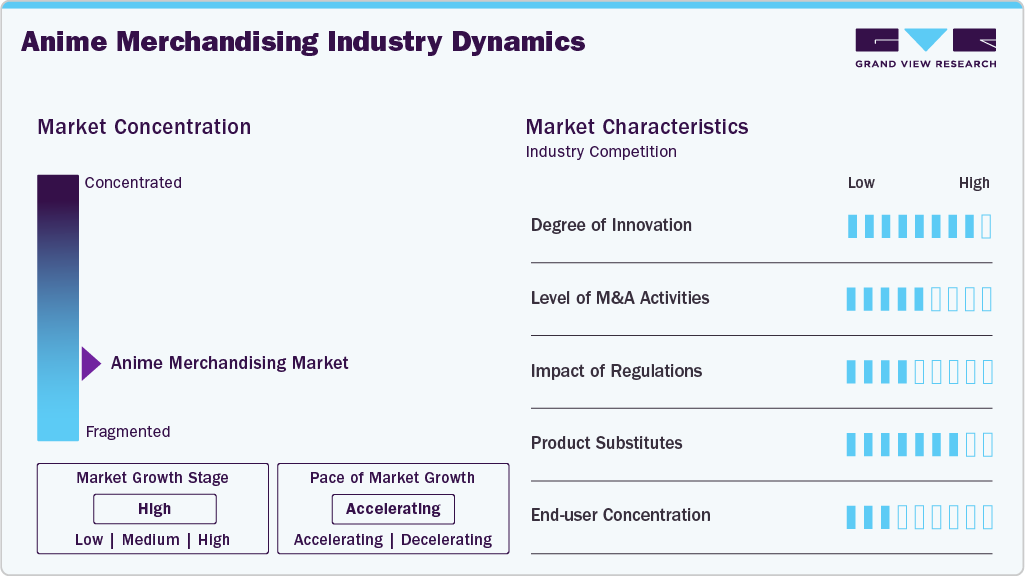
The anime merchandising market is fragmented, with strong IP-level concentration and a widely dispersed production, licensing, and retail ecosystem across global markets. The market shows medium to high innovation driven by experimentation in collectibles, figures, apparel collaborations, blind-box formats, and digital merchandise tied to streaming and gaming. Additionally, M&A activity is moderate, mainly focused on distribution consolidation and IP acquisition by entertainment groups, strengthening anime portfolios.
 To learn more about this report, Download Free Sample Report
 Furthermore, regulatory impact is low to medium, owing to IP protection, licensing, and cross-border trade rules, with varying enforcement across regions. Substitution risk is high as consumer spending competes with gaming, streaming, and digital entertainment, limiting exclusivity in merchandise demand. End-user concentration is low to medium, with globally distributed demand but stronger spending in key anime markets like Japan, North America, and parts of Asia. Overall, the market is characterized by high innovation intensity, moderate M&A activity, medium regulatory influence, high substitute pressure, and low-to-moderate end-user concentration, with the industry currently in a globally expanding, franchise-driven growth phase supported by strong pop-culture adoption and digital ecosystem integration.
Product Insights
The figurine segment accounted for the largest revenue share of over 37% in 2025, driven by increasing demand for high-quality, limited-edition collectibles and advancements in manufacturing technologies. The rising popularity of premium figurines, scale models, and articulated action figures is attracting dedicated collectors and enthusiasts willing to invest in high-value products. The growing influence of franchise-based merchandising, pre-order culture, and exclusive releases through conventions is enhancing product scarcity. The integration of digital authentication and collaborations between anime studios is further strengthening the appeal of figurines, thereby accelerating segment growth in the market.
The books segment is projected to register the highest CAGR of 10% from 2026 to 2033, driven by rising demand for manga volumes, light novels, and official art books among both casual readers and avid anime fans. Growth is further supported by the expansion of bookstore chains, e-commerce platforms, and subscription-based reading services, which are enabling wider accessibility and steady sales. In addition, the increasing adoption of premium print formats and visually engaging content is contributing to the continued growth of the books segment within the market.
Distribution Channel Insights
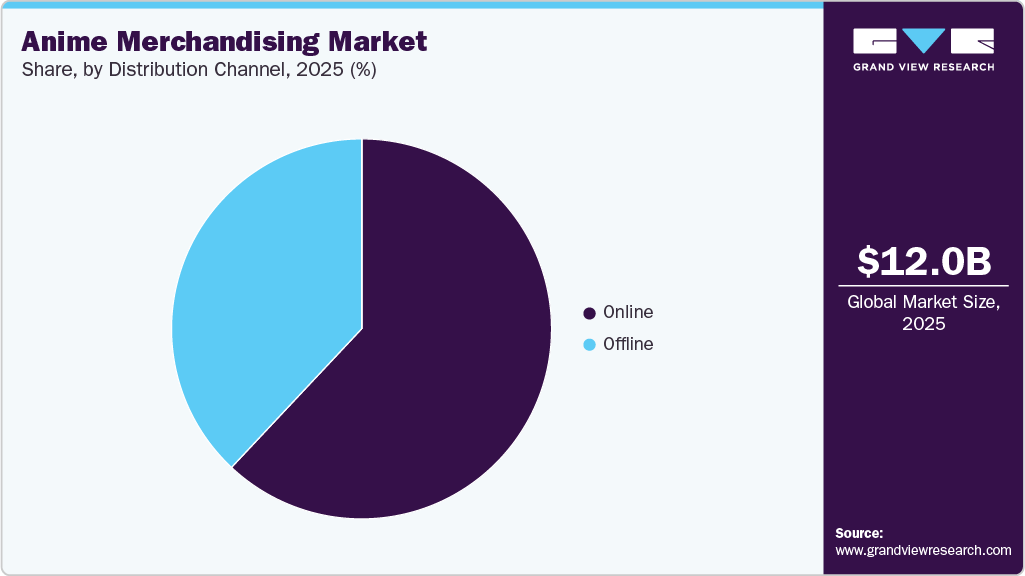
The online segment accounted for the largest revenue share in 2025. This growth is primarily driven by the rapid expansion of e-commerce platforms, increasing global accessibility to anime products, and the growing adoption of direct-to-consumer (DTC) sales models. Online channels enable consumers to access a wide range of licensed merchandise, which enhances purchasing convenience and product availability. The integration of AI-driven recommendation systems, targeted digital marketing, and influencer-led promotions, along with the rise of pre-order systems and global shipping capabilities, is supporting the sustained dominance of the segment.
 To learn more about this report, Download Free Sample Report
 The offline segment is projected to register a significant CAGR from 2026 to 2033. The growth is owing to the increasing popularity of experiential retail and the strong presence of anime conventions, specialty stores, and pop-up outlets. Physical retail channels allow consumers to engage directly with products, ensuring authenticity and enhancing the overall shopping experience. The growing number of fan events, exhibitions, and cosplay conventions is accelerating footfall and boosting sales. The expansion of dedicated anime retail chains is further supporting the growth of the offline segment.
Regional Insights
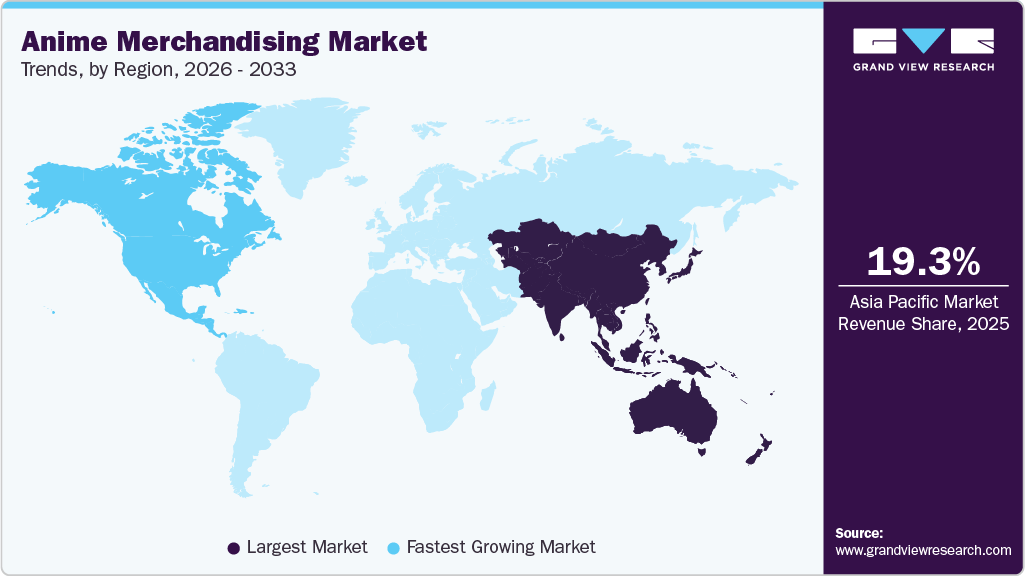
The North America anime merchandising market is expected to grow at the highest CAGR of over 17% from 2026 to 2033. This expansion is largely driven by strong consumer demand for licensed products, the growing popularity of anime streaming platforms, and increasing collaborations between anime studios and global retail brands. The presence of major distributors and licensing companies, along with the expansion of anime conventions and fan events, is accelerating market growth. The rising demand for collectibles, apparel, and figurines, coupled with the integration of e-commerce platforms and direct-to-consumer sales models, is strengthening the anime merchandising ecosystem in the region.
U.S. Anime Merchandising Market Trends
The anime merchandising market in the U.S. held a revenue share of over 62% in 2025. Growth in the country is driven by rising consumer spending on pop culture merchandise and the widespread adoption of anime content among younger audiences. The market is supported by a well-established network of entertainment companies and licensing partnerships, which are expanding both accessibility and distribution channels. In addition, the increasing influence of anime conventions, along with growing demand for limited-edition collectibles, cosplay items, and themed apparel, is further fueling market growth in the U.S.
Europe Anime Merchandising Market Trends
The anime merchandising market in Europe is expected to grow at a CAGR of over 11% from 2026 to 2033. This growth is driven by increasing anime viewership, expanding licensing agreements, and rising demand for themed merchandise across multiple countries. The region’s growing number of anime conventions and fan communities, along with the expansion of localized streaming platforms, is supporting market development. Additionally, collaborations between Japanese content creators and European retailers, coupled with rising demand for sustainable and premium-quality merchandise, are contributing to consistent growth across Europe.
The UK anime merchandising market is expected to grow at a significant rate in the coming years, supported by the increasing popularity of Japanese pop culture, rising participation in cosplay and fan events, and expanding retail presence of anime-themed products. Events such as MCM Comic Con play a crucial role in boosting merchandise sales and brand visibility. The growing demand for character-based collectibles, apparel, and home décor products, combined with the increasing penetration of online retail platforms, is driving market expansion in the country.
The anime merchandising market in Germany is expanding rapidly, driven by strong demand for collectibles, figurines, and manga-related merchandise, along with a well-established fan base for Japanese animation. The country’s organized retail structure and the popularity of events such as Gamescom are accelerating product visibility and sales. The increasing adoption of anime merchandise among younger consumers, coupled with growing partnerships between distributors and local retailers, is reinforcing Germany’s position as a key market in Europe.
Asia-Pacific Anime Merchandising Market Trends
The anime merchandising market in Asia-Pacific accounted for a share of over 19% in 2025, fueled by the strong cultural presence of anime, an expanding middle-class population, and high consumer engagement with entertainment franchises. The region’s robust production ecosystem, increasing investments in intellectual property (IP) development, and widespread adoption of mobile commerce platforms are driving market growth. The rising demand for character merchandise, toys, and digital collectibles, along with strong government and industry support for creative sectors, is positioning Asia-Pacific as a high-growth region.
The China anime merchandising market is witnessing robust expansion, fueled by increasing domestic animation production, strong digital commerce infrastructure, and the rising popularity of anime among younger audiences. The presence of major platforms such as Bilibili is accelerating content consumption and merchandise demand. Additionally, rapid urbanization, growing disposable income, and increasing collaborations between local brands and international anime franchises are driving the strong growth of anime merchandising in China.
Japan Anime Merchandising Market Trends
The anime merchandising market in Japan dominated the global market with a share of over 59% in 2025. The market is shaped by a long-standing animation heritage and a dynamic otaku culture that fuels strong consumer demand. Distinctive purchasing behavior among fans encourages deep brand loyalty, with consumers showing a strong willingness to spend on premium merchandise linked to their favorite franchises. Japanese companies are increasingly forming partnerships with global brands to develop exclusive product lines that cater to both domestic and international audiences, thereby broadening their reach and reinforcing the country’s leadership in the anime merchandising industry.
 To learn more about this report, Download Free Sample Report
 Key Anime Merchandising Companies Insights
Some of the key players operating in the market include Crunchyroll (Sony Pictures Entertainment, Inc.) and The Walt Disney Company, among others.
-
In April 2026, Crunchyroll partnered with Lisandro Martínez (Manchester United player) to launch a limited-edition anime capsule merchandise collection. This apparel line, available exclusively on the Crunchyroll Store in markets including the US, UK, France, Germany, and other EU countries, featured T-shirts, hoodies, sweatshirts, and accessories blending Martínez's fierce persona with anime aesthetics. This celebrity crossover highlights the growing trend of sports-anime fusion to attract diverse global fanbases.
-
In March 2026, Bioworld Merchandising, Inc. launched official apparel collections tied to the Super Mario Galaxy Movie, featuring hats, socks, and boxer briefs designed to celebrate the film's release. This tie-in capitalizes on blockbuster media hype to drive impulse purchases in casual anime and gaming merchandise.
Atomic Flare and Good Smile Company, Inc., are some of the emerging market players in the anime merchandising market.
-
Atomic Flare is a company dedicated to providing hard-to-find video games, anime, and pop culture merchandise at affordable prices. The company features a diverse range of officially licensed products from popular franchises such as Final Fantasy, Pokémon, and My Hero Academia, among others. The company emphasizes local shipping and personalized customer service, ensuring a memorable shopping experience.
-
Good Smile Company, Inc. is a prominent Japanese firm dedicated to the planning, development, production, and sale of figures, toys, and related goods. The company has expanded its operations internationally, including establishing locations in the USA, which allows it to better cater to local fans and collectors. By collaborating with various animation studios and creators, the company aims to promote popular anime franchises and to support the creators behind them, ensuring that their work reaches a broader audience.
Key Anime Merchandising Companies:
The following key companies have been profiled for this study on the anime merchandising market.
- Studio Ghibli, Inc.
- Bandai Namco Filmworks Inc.
- Crunchyroll (Sony Pictures Entertainment Inc.)
- Good Smile Company, Inc.
- Sentai Holdings, LLC (AMC Networks)
- Ufotable Co., Ltd.
- Atomic Flare
- MegaHouse (Bandai Namco Filmworks Inc.)
- MAX FACTORY, INC.
- Alter Co., Ltd.
- BANDAI SPIRITS CO., LTD.
- Bioworld Merchandising, Inc.
- Stronger Co., Ltd.
- Aniplex Inc. (Sony Pictures Entertainment Inc.)
- Medicom Toy Co., Ltd.
Competitive Benchmarking
Operating Strategies
Competitive Edge
Weaknesses
Mature Players: Crunchyroll, Bandai Namco Filmworks Inc., Studio Ghibli, Inc.
- Focus on increasing their market by licensing popular anime and officially providing merchandising it.
- Expand franchise monetization through premium collectibles, collaborations, and limited-edition launches.
- Strong brand recognition and established relationships with major anime IP holders
- Large-scale manufacturing, merchandising expertise, and wider retail penetration.
- High dependence on expensive licensing agreements and franchise renewals
- Greater exposure to inventory risks and slower adaptation to rapidly changing fan trends.
Emerging Players: Stronger Co., Ltd., Atomic Flare, Good Smile Company, Inc.
- Leverage niche fandoms, digital-first sales channels, and social media-driven marketing
- Focus on customizable, small-batch, and trend-based merchandise offerings
- Higher flexibility in responding to evolving consumer preferences and viral trends
- Ability to innovate quickly in product formats and fan engagement models.
- Limited access to major licensed IPs and smaller distribution capabilities
- Lower brand visibility and financial resources compared to established competitors.
Recent Developments
-
In March 2026, Good Smile Company expanded its figurine lineup with new Nendoroid Doll product variations tied to popular franchises. This continuous product innovation strengthens its portfolio and supports growing global demand for high-quality anime collectibles, thereby reinforcing the company’s competitive positioning and contributing to the sustained growth of the anime merchandising market.
-
In March 2026, Studio Ghibli expanded its official merchandise distribution through international retail partnerships and online platforms, introducing new product categories such as home décor, lifestyle goods, and limited-edition collectibles inspired by classic films. This expansion broadens its consumer base and reinforces its global merchandising presence.
-
In November 2025, Bandai Namco Holdings launched a cross-industry collaboration featuring the One Piece and NBA merchandise line, combining anime intellectual property with global sports branding. This initiative enhances product diversification and attracts new consumer segments by blending anime culture with mainstream entertainment, thereby accelerating innovation and revenue generation in the anime merchandising industry.
Anime Merchandising Market Report Scope
Report Attribute
Details
Market size in 2025
USD 12.0 billion
Estimated market size in 2026
USD 13.3 billion
Projected market size by 2033
USD 23.9 billion
Growth rate
CAGR of 8.8% from 2026 to 2033
Base year for estimation
2025
Historical data
2021 - 2024
Forecast period
2026 - 2033
Quantitative units
Revenue in USD million/billion and CAGR from 2026 to 2033
Report coverage
Revenue forecast, company ranking, competitive landscape, growth factors, and trends
Segments covered
Product, distribution channel, region
Regional scope
North America; Europe; Asia Pacific; Latin America; and Middle East & Africa; Japan
Country scope
U.S.; Canada; UK; Germany; France; China; Australia; India; South Korea; Brazil; Mexico; UAE; Saudi Arabia
Key companies profiled
Studio Ghibli, Inc.; Bandai Namco Filmworks Inc.; Crunchyroll (Sony Pictures Entertainment Inc.); Good Smile Company, Inc.; Sentai Holdings; LLC (AMC Networks); Ufotable Co., Ltd.; Atomic Flare; MegaHouse (Bandai Namco Filmworks Inc.); MAX FACTORY, INC.; Alter Co., Ltd.; BANDAI SPIRITS CO., LTD.; Bioworld Merchandising, Inc.; Stronger Co., Ltd.; Aniplex Inc. (Sony Pictures Entertainment Inc.); Medicom Toy Co., Ltd
Customization scope
Free report customization (equivalent to up to 8 analyst’s working days) with purchase. Addition or alteration to country, regional & segment scope.
Pricing and purchase options
Avail customized purchase options to meet your exact research needs. Explore purchase options
Global Anime Merchandising Market Report Segmentation
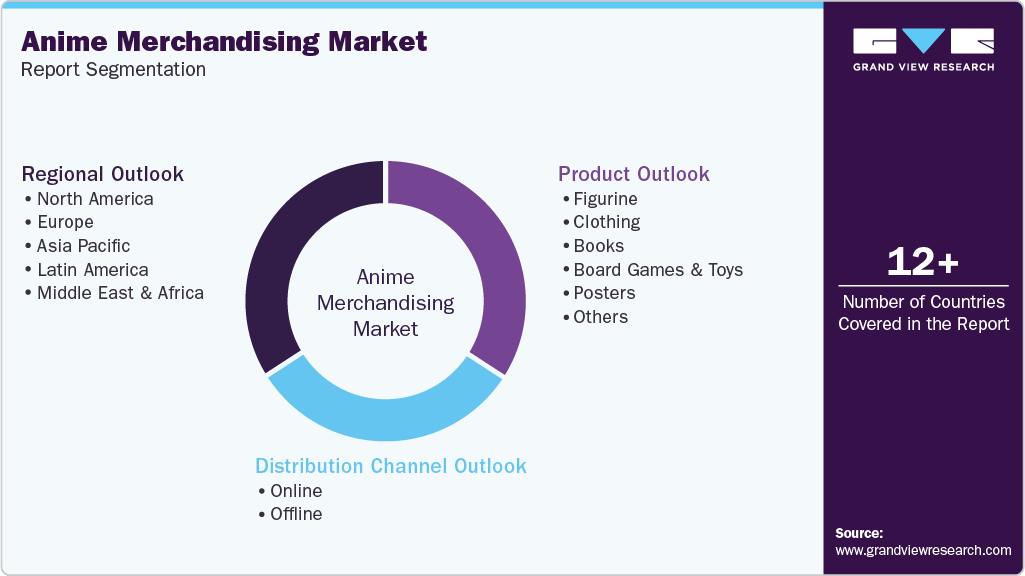
This report forecasts revenue growth at global, regional, and country levels and provides an analysis of the latest technology trends in each of the sub-segments from 2021 to 2033. For this study, Grand View Research has segmented the global anime merchandising market report based on product, distribution channel, and region:
 To learn more about this report, Download Free Sample Report
 -
Product Outlook (Revenue, USD Million, 2021 - 2033)
-
Figurine
-
Clothing
-
Books
-
Board Games & Toys
-
Posters
-
Others
-
-
Distribution Channel Outlook (Revenue, USD Million, 2021 - 2033)
-
Online
-
Offline
-
-
Regional Outlook (Revenue, USD Million, 2021 - 2033)
-
North America
-
U.S.
-
Canada
-
-
Europe
-
UK
-
Germany
-
France
-
-
Asia Pacific
-
China
-
India
-
South Korea
-
Australia
-
-
Latin America
-
Brazil
-
Mexico
-
-
Middle East & Africa
-
Saudi Arabia
-
UAE
-
-
Japan
-
Delivered Customizations
This report has been delivered with the following In-depth customizations
Client Request
Customization Delivered
Value Adds
Market Entry & Expansion Assessment
Regional demand sizing & forecasting across key anime markets
Customer segmentation & buying behavior analysis of fan groups
Competitive landscape benchmarking across licensed merch players
Regulatory & distribution channel assessment (IP, retail, online, conventions)
High-growth opportunity identification in premium collectibles and collaborations
Go-to-market strategy support across regions and channels
Investment priorities & risk identification in IP and supply chain
Data-driven expansion planning into emerging anime markets
Product Positioning & Competitive Intelligence
Product benchmarking and feature comparison
Pricing and value proposition analysis
Brand perception and customer preference study
Competitor strategy evaluation
Improved product differentiation strategy
Supported pricing optimization
Identified unmet customer needs
Enhanced competitive positioning
Frequently Asked Questions About This Report
Japan dominated with a 59% revenue share in 2025.
North America is the fastest-growing region over the forecast period.
The figurine segment led with a 37% revenue share in 2025, while the books segment is the fastest-growing.
The online segment held the largest revenue share in 2025, while the offline segment is the fastest-growing.
The global anime merchandising market size was valued at USD 12.0 billion in 2025 and is expected to reach USD 13.3 billion in 2026.
Some key players operating in the anime merchandising market include Studio Ghibli, Inc., Bandai Namco Filmworks Inc., Crunchyroll (Sony Pictures Entertainment Inc.), Good Smile Company, Inc., Sentai Holdings, LLC (AMC Networks), Ufotable Co., Ltd., Atomic Flare, MegaHouse (Bandai Namco Filmworks Inc.), MAX FACTORY, INC., Alter Co., Ltd., BANDAI SPIRITS CO., LTD., Bioworld Merchandising, Inc., Stronger Co., Ltd., Aniplex Inc. (Sony Pictures Entertainment Inc.), and Medicom Toy Co., Ltd
The significant growth of the anime merchandising market is attributed to the increasing global popularity of anime, the rise of digital streaming platforms, which have made anime more accessible to diverse audiences, and the subsequent demand for merchandise that allows fans to engage with their favorite series and characters
The global anime merchandising market is expected to grow at a compound annual growth rate of 8.8% from 2026 to 2033 to reach USD 23.9 billion by 2033.
The figurine segment dominated the anime merchandising market with a share of over 37% in 2025. This is attributable to the rising popularity of anime series and the growing collector culture among fans.
About the Author(s)
Digital Media Research Team
Technology · Digital MediaThis report was authored by the digital media research team at Grand View Research - comprising two research analysts, one senior research analyst, and one industry expert - with specialized expertise in the digital media segment of the technology industry. All findings are based on proprietary technology databases, executive interviews, and regulatory analysis, subject to internal peer review prior to publication.
Last Updated:
Speak to Analyst

Customize this report to your needs - add regions, segments, or data points, with 20% free customization.
Or view our licence options:


ISO 9001:2015 & 27001:2022 Certified
We are GDPR and CCPA compliant! Your transaction & personal information is safe and secure. For more details, please read our privacy policy.


