
- Home
- »
- Nanoparticles
- »
-
Nanocellulose Market Size, Growth Report, 2026-2033GVR Report cover

Nanocellulose Market (2026 - 2033)
Size, Share & Trends Analysis Report By Type (Cellulose Nanofibers, Bacterial Cellulose, Crystalline Nanocellulose), By Application, By Region, And Segment Forecasts
Market Size, 2025
$0.9BMarket Estimate, 2026
$1.0BMarket Forecast, 2033
$2.9BCAGR, 2026–2033
15.9%Nanocellulose Market Summary
The global nanocellulose market size was valued at USD 0.9 billion in 2025 and is projected to grow from USD 1.0 billion in 2026 to USD 2.9 billion by 2033, at a CAGR of 15.9% from 2026 to 2033. Europe dominated the market with the largest revenue share of more than 35.0% in the global market in 2025. The growth is attributable to rising demand across various applications and the shift toward bio-based goods, which are driving demand for the product.
Key Market Trends & Insights
- By type: The cellulose nanofibers (CNF) segment held the largest market share of more than 50% in 2025.
- By application: The pulp & paperboard segment held the largest market share of over 25% in 2025.
Regional Highlights
- Largest regional market: Europe (35.0% revenue share, 2025)
- By country: The U.S. held the largest market share in 2025.
Market Size & Forecast
- Market size in 2025: USD 0.9 Billion
- Estimated market size in 2026: USD 1.0 Billion
- Projected market size by 2033: USD 2.9 Billion
- CAGR (2026-2033): 15.9%
Three ways to get this report
Buy it, customize it, or ask a question.Ask an Analyst
Analyst response in 1 business day
- AccessReport author, directly
- Reply timeWithin 1 working day
- No sales callDirect answer only
- FormatEmail reply
- CostFree, no cost
Get the Full Report
What the study covers
- FormatsPDF · Excel · Dashboard
- Timeline2026–2033 annual, 2025 base
- Coverage20+ countries, 5 regions
- Companies10+ key players profiled
Customize the Report
20% free customization
- IncludeCountries, segments, points
- TailorTo your product definition
- ExtendDeeper competitor detail
- OrA fully bespoke study
- Turnaround5–10 working days
Due to its various qualities, such as increased paper machine efficiency, better filler content, lighter base mass, and higher freeness, nanocellulose is suitable for producing a wide range of products. The paper industry uses nanocellulose as a prominent sustainable nanomaterial additive owing to its high strength, strong oxygen barrier performance, low density, mechanical qualities, and biocompatibility among the available bio-based resources.Moreover, the construction of materials, aqueous coating, and other applications are among the major uses of nanocellulose composite materials. The U.S. accounted for the largest nanocellulose industry in North America, contributing significantly to global revenue. People in the U.S. are concerned about their health, which has greatly driven the use of MFC (microfibrillated cellulose) and CNF (Cellulose nanofibers) in the production of functional food products, thereby increasing the demand for nanocellulose in the country.
 Source: Grand View Research, IR Documents, Primary Interviews, Paid DatabasesTo learn more about this report,
 Download Free Sample Report
 The food & beverage and paper & pulp industries are majorly driving product growth in the country. Demand in the country is primarily driven by increasing awareness and demand for highly advanced, sustainable products, alongside paper-based packaging, in the food & beverage industry.
The pulp & paper industry heavily uses nanocellulose as an ingredient in the production of light, white paper, further accelerating market growth. Owing to its benign qualities, it is used in healthcare applications such as biomedicines and personal hygiene products. In addition, owing to its superior adsorption abilities, Nanocellulose is a suitable constituent for sanitary napkins and wound dressings. The market has been further stimulated by expanding product research activity.
Market Dynamics
The growing demand for sustainable, eco-friendly materials is driving the nanocellulose industry. The increasing number of regulations banning single-use plastics is further boosting the market’s growth. But the high production costs pose major barriers to market growth. Rising investments in bioplastics are expected to create new growth opportunities in the near future.
As consumers and industries shift toward circular economies and reduce their carbon footprint, nanocellulose serves as a high-performing, biodegradable, and renewable alternative to synthetic materials. Nanocellulose is widely replacing single-use plastics and traditional paper additives. It produces lightweight, recyclable films and coatings with excellent barrier properties against oxygen and moisture. Companies such as UPM and Melodea Ltd. are producing nanocellulose-based packaging solutions to meet eco-friendly demands. For instance, in May 2026, UPM, Michelman, and BOBST introduced two bio-based paper packaging concepts across Europe, designed to comply with EU packaging regulations, including the Single-Use Plastics Directive (SUPD). In addition, nanocellulose helps reduce dependence on fossil-fuel-based raw materials while supporting corporate sustainability goals and regulatory compliance. Its strength-to-weight ratio enables manufacturers to produce durable products with less material, thereby improving resource efficiency and reducing overall emissions.
The material is gaining popularity in the automotive, construction, textile, and electronics sectors, where companies are seeking environmentally responsible alternatives that maintain high performance standards. Furthermore, increasing government initiatives to promote bio-based materials and stricter regulations on plastic waste are encouraging investment in nanocellulose production and commercialization. As sustainability becomes a key purchasing criterion across industries, the adoption of nanocellulose is expected to accelerate, creating significant growth opportunities for market participants worldwide.
One of the main constraints faced by the nanocellulose industry is the high cost and the complexity of scaling up production. Producing nanocellulose is highly energy-intensive and requires specialized equipment, making it more expensive than traditional materials. Due to the high costs involved, the use of the material is hampered, especially in price-sensitive sectors such as packaging and consumer goods. The high cost of nanocellulose may create a barrier for downstream industries, as many manufacturers find it difficult to replace lower-cost conventional materials with a more expensive alternative, even though nanocellulose offers better performance and environmental benefits. Small-scale companies often face difficulties due to the substantial investment required for production equipment, processing facilities, and product development. In addition, transportation and storage costs can be higher for nanocellulose products. These cost-related challenges limit the widespread adoption of nanocellulose across various industrial applications.
Analyst Perspective
The nanocellulose market is expected to witness growth over the forecast period, driven by increasing demand for sustainable, high-performance materials across the packaging, automotive, construction, healthcare, and electronics industries. Growing environmental regulations and the shift toward bio-based alternatives are encouraging manufacturers to adopt nanocellulose due to its lightweight nature, strength, biodegradability, and barrier properties. The packaging sector is expected to remain a key application area, while emerging uses in biomedical products, advanced composites, and electronic devices will create additional growth opportunities.
Type Insights
The cellulose nanofibers (CNF) segment led the market with the largest revenue share of more than 50.0% in 2025. The product's high market share is attributable to its easy availability and improved tensile properties. MFC and NFC (Nano Fibrillated Cellulose) are generally made from wood through mechanical and chemical processing of the cellulose bulk. The availability of wood-based pulp simplifies the manufacturing of these products.
Varied characteristics, such as lighter basic mass, improved paper machine efficiency, increased filler content, and higher freeness, make it suitable for a wide range of commodities. Positive government involvement in promoting the use of biodegradable nanocellulose and rising awareness among enterprises across the industries will be beneficial for the market growth.
Bacterial cellulose, produced by bacterial metabolism and devoid of lignin and other extractives, is a three-dimensional network with high crystallinity. This structure gives the product distinctive qualities, such as high crystallinity, greater purity, high water retention capacity, non-toxicity, increased mechanical strength, and antibacterial properties, which are useful in many industries.
Application Insights
The pulp & paperboard segment led the market with the largest revenue share of over 25.0% in 2025. This is attributed to growing customer demand for packaging items with minimal processing and no preservatives. The paper industry uses nanocellulose as a prominent sustainable nanomaterial additive owing to its high strength, strong oxygen barrier performance, low density, mechanical qualities, and biocompatibility among the available bio-based resources.
Due to the enormous mass of paper products, paper and board are the most promising sectors. In the paper industry, nanocellulose can be used in a dry or wet form for coating paper, manufacturing paper, packing, and making hygienic and absorbent products. In addition, it creates smooth paper surfaces for printing, enhancing print quality.
Transparent nanocellulose paper has drawn significant interest in the electronics sector, including mobile phones, TVs, computers, solar cells, touch sensors, paper-based generators, and others, owing to its optical, biodegradable, lightweight, affordable, and recyclable qualities.
Regional Insights
Europe dominated the global nanocellulose market with the largest revenue share of more than 35.0% in 2025. This is attributable to the growing demand for pulp and paper, combined with prohibitions on single-use plastic packaging, which is anticipated to drive demand for nanocellulose packaging materials. Due to its high consumption potential, rising manufacturing capacity, increasing economic development rate, increasing need for lightweight passenger cars, and desire for environmentally friendly food and beverage packaging.
 To learn more about this report, Download Free Sample Report
 The nanocellulose market in the UK is expected to grow exponentially as customer demand for plant-based ingredients shifts across food & beverages, medicinal products, electronics, and other applications. Facility expansions, acquisitions, collaborations, and R&D expenditures are among the key factors expected to drive demand for the product.
Asia Pacific Nanocellulose Market Trends
The nanocellulose market in the Asia Pacific is anticipated to grow at a significant CAGR during the forecast period. In developing economies of the Asia Pacific, such as South Korea, India, and others, owing to the rapid uptake of environmentally friendly coatings, composites, and paints, the demand for light-weight and heavy-duty vehicles is increasing, further anticipated to propel demand in the region.
Key Nanocellulose Company Insights
The global nanocellulose industry is consolidated, with a few major players including CelluForce, FiberLean, Kruger Inc., and others. Manufacturers operating in the market engage in strategic mergers & acquisitions, geographical expansion, product development, and innovation to strengthen their positions, increase profitability, and drive innovation and advancement.
Key Nanocellulose Companies
The following key companies have been profiled for this study on the nanocellulose market.
-
CelluForce
-
FiberLean
-
Nippon Paper Industries Co., Ltd.
-
Kruger Inc.
-
Borregaard AS
-
CelluComp Ltd.
-
Melodea
-
BLUE GOOSE BIOREFINERIES INC.
-
GranBio
-
Stora Enso
Recent Development
-
In July 2025, ITOCHU Corporation, in collaboration with FamilyMart, SANKO, and Kyoto University, launched a pilot project in Japan to evaluate cellulose nanofiber (CNF)-reinforced plastic logistics containers across approximately 80 retail stores. The initiative aims to commercialize CNF-based materials by improving container strength and reducing weight and thickness.
-
In October 2024, UPM Biomedicals launched FibGel, which was introduced into the market. It is a nanocellulose hydrogel that can be used for various medical devices and as permanent implants. It is composed of nanofibrillar wood-based cellulose and can be used in regenerative medicines.
Nanocellulose Market Report Scope
Report Attribute
Details
Market size in 2025
USD 0.9 Billion
Estimated market size in 2026
USD 1.0 Billion
Projected market size by 2033
USD 2.9 Billion
Growth rate
CAGR of 15.9% from 2026 to 2033
Base year for estimation
2025
Historical data
2021 - 2024
Forecast period
2026 - 2033
Quantitative units
Revenue in USD million/billion, Volume in tons, and CAGR from 2026 to 2033
Report coverage
Revenue forecast, company ranking, competitive landscape, growth factors, and trends
Segments covered
Type, application, region
Regional Scope
North America; Europe; Asia Pacific; Latin America; Middle East & Africa
Country scope
U.S.; Canada; Mexico; UK; Germany; The Netherlands; Finland; France; Norway; Sweden; Switzerland; Spain; China; India; Japan; South Korea; Australia; Thailand; Malaysia; Singapore; Brazil; Colombia; Chile; Israel; Saudi Arabia; Iran; South Africa
Key companies profiled
CelluForce; FiberLean; Nippon Paper Industries Co., Ltd.; Kruger Inc.; Borregaard AS; CelluComp Ltd.; Melodea ; BLUE GOOSE BIOREFINERIES INC.; GranBio ; Stora Enso Biomaterials
Customization scope
Free report customization (equivalent up to 8 analysts working days) with purchase. Addition or alteration to country, regional & segment scope.
Pricing and purchase options
Avail of customized purchase options to meet your exact research needs. Explore purchase options
Global Nanocellulose Market Report Segmentation
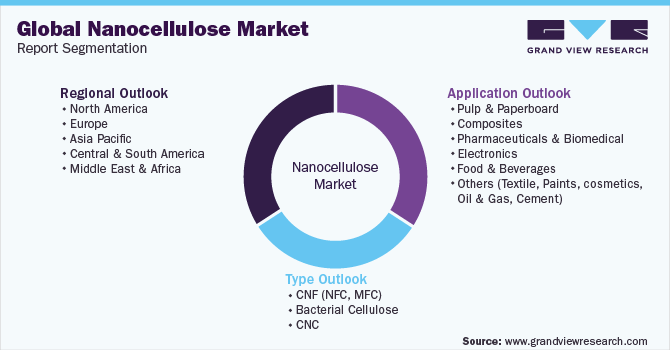
This report forecasts revenue growth at a global, regional & country level and provides an analysis of the latest industry trends in each of the sub-segments from 2021 to 2033. For this study, Grand View Research has segmented the global nanocellulose market report based on the type, application, and region:
 To learn more about this report, Download Free Sample Report
 -
Type Outlook (Revenue, USD Million; Volume, Kilotons; 2021 - 2033)
-
CNF (NFC, MFC)
-
Bacterial Cellulose
-
CNC
-
-
Application Outlook (Revenue, USD Million; Volume, Kilotons; 2021 - 2033)
-
Pulp & Paperboard
-
Composites
-
Pharmaceuticals & Biomedical
-
Electronics
-
Food & Beverages
-
Others (Textile, Paints, cosmetics, Oil & Gas, Cement)
-
-
Regional Outlook (Revenue, USD Million; Volume, Kilotons; 2021 - 2033)
-
North America
-
U.S.
-
Canada
-
Mexico
-
-
Europe
-
U.K.
-
Germany
-
Netherlands
-
France
-
Finland
-
Norway
-
Sweden
-
Switzerland
-
Spain
-
-
Asia Pacific
-
China
-
India
-
Japan
-
South Korea
-
Australia
-
Thailand
-
Malaysia
-
Singapore
-
-
Central & South America
-
Brazil
-
Colombia
-
Chile
-
-
Middle East & Africa
-
Saudi Arabia
-
South Africa
-
Israel
-
Iran
-
-
Frequently Asked Questions About This Report
The global nanocellulose market size was valued at USD 0.9 billion in 2025 and is estimated at USD 1.0 billion for 2026.
The global nanocellulose market is expected to grow at a CAGR of 15.9% from 2026 to 2033, reaching USD 2.9 billion.
Cellulose nanofibers segment dominated the nanocellulose market with a share of 50% in 2025, while pulp & paperboard is the fastest-growing segment.
Key players include CelluForce; FiberLean; Nippon Paper Industries Co., Ltd.; Kruger Inc.; Borregaard AS; CelluComp Ltd.; Melodea ; BLUE GOOSE BIOREFINERIES INC.; GranBio ; Stora Enso Biomaterials.
Europe dominated with a 35.0% revenue share in 2025.
About the Author(s)
Nanoparticles Research Team
Advanced Materials · NanoparticlesThis report was authored by the nanoparticles research team at Grand View Research - comprising two research analysts, one senior research analyst, and one industry expert - with specialized expertise in the nanoparticles segment of the advanced materials industry. All findings are based on proprietary advanced materials databases, executive interviews, and regulatory analysis, subject to internal peer review prior to publication.
Last Updated:
Speak to Analyst

Customize this report to your needs - add regions, segments, or data points, with 20% free customization.
Or view our licence options:


ISO 9001:2015 & 27001:2022 Certified
We are GDPR and CCPA compliant! Your transaction & personal information is safe and secure. For more details, please read our privacy policy.


