
- Home
- »
- Next Generation Technologies
- »
-
Machine Vision Market Size And Share Report, 2026-2033GVR Report cover

Machine Vision Market (2026 - 2033)
Size, Share & Trends Analysis Report By Offering (Hardware, Software), By Product (PC Based, Smart Camera-Based), By Application (Quality Assurance & Inspection, Identification), By End-use, By Region, And Segment Forecasts
Market Size, 2025
$22.6BMarket Estimate, 2026
$25.3BMarket Forecast, 2033
$61.0BCAGR, 2026–2033
13.4%Machine Vision Market Summary
The global machine vision market size was valued at USD 22.6 billion in 2025 and is projected to grow from USD 25.3 billion in 2026 to USD 61.0 billion by 2033, at a CAGR of 13.4% from 2026 to 2033. Asia Pacific dominated the global market, accounting for a revenue share of 43.7% in 2025. The market is characterized by a growing emphasis on industrial automation and operational efficiency, encouraging manufacturers to adopt advanced imaging systems and AI-enabled inspection technologies to enhance product quality, enable real-time process accuracy, and minimize defects across the production environment.
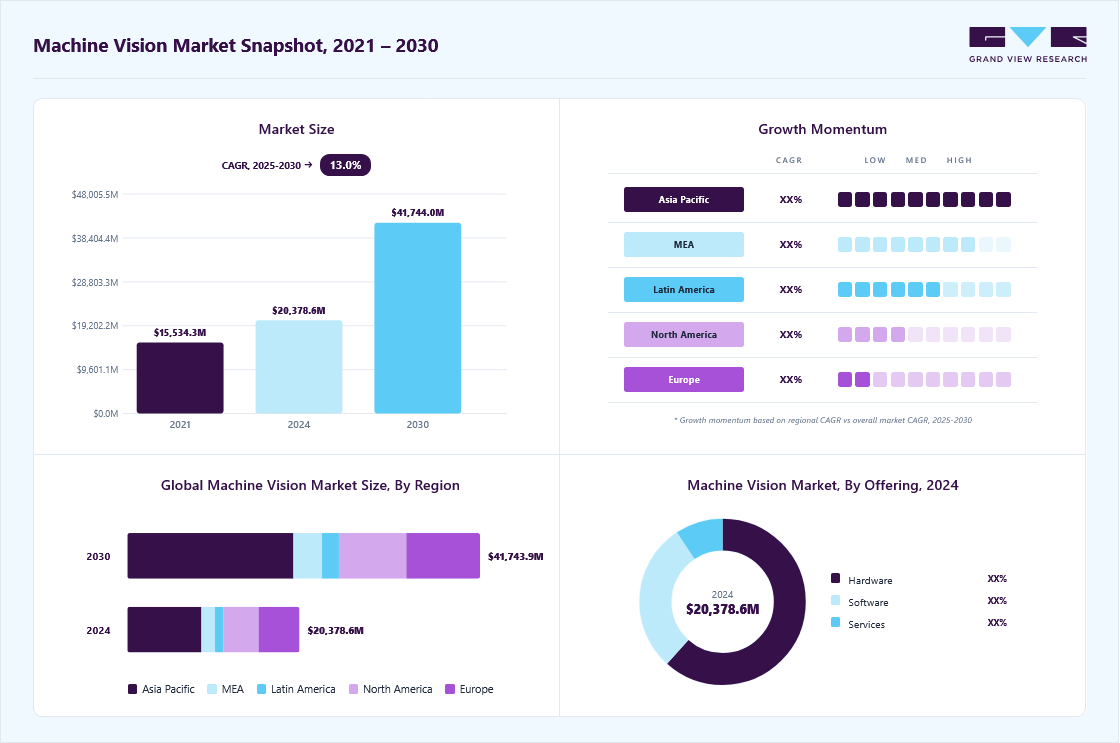 Source: Grand View Research, IR Documents, Primary Interviews, Paid DatabasesTo learn more about this report,
 Download Free Sample Report
 Key Market Trends & Insights
- By offering: Hardware segment dominated the market, with a share of 62.0% in 2025.
- By product: PC-based segment accounted for the largest market share of 55.0% in 2025.
- By application: Quality assurance and inspection segment held the largest market share of 44.0% in 2025.
- By end use: Automotive segment accounted for the largest revenue share of 20.1% in 2025.
Regional Highlights
- Largest regional market: Asia Pacific (43.7% revenue share, 2025)
- By country: Japan held the largest market share in 2025
Market Size & Forecast
- Market size in 2025: USD 22.6 Billion
- Estimated market size in 2026: USD 25.3 Billion
- Projected market size by 2033: USD 61.0 Billion
- CAGR (2026-2033): 13.4%
Three ways to get this report
Buy it, customize it, or ask a question.Ask an Analyst
Analyst response in 1 business day
- AccessReport author, directly
- Reply timeWithin 1 working day
- No sales callDirect answer only
- FormatEmail reply
- CostFree, no cost
Get the Full Report
What the study covers
- FormatsPDF · Excel · Dashboard
- Timeline2026–2033 annual, 2025 base
- Coverage20+ countries, 5 regions
- Companies10+ key players profiled
Customize the Report
20% free customization
- IncludeCountries, segments, points
- TailorTo your product definition
- ExtendDeeper competitor detail
- OrA fully bespoke study
- Turnaround5–10 working days
Key Takeaways from the Report
-
The machine vision market is shaped by strong reliance on hardware and PC-based systems, alongside rapid growth in software and smart camera-based solutions. Manufacturers increasingly deploy AI-powered imaging, deep learning, and 3D vision technologies to shift from basic rule-based inspection toward intelligent, adaptive visual analysis. This reflects a broader shift toward integrated visual intelligence ecosystems that enhance production accuracy, efficiency, and automation.
-
The revenue contribution from the hardware segment was the highest in 2025, driven by continued launches of advanced cameras, sensors, processors, and lighting systems built for durability, versatility, and the processing power needed to run complex vision algorithms in demanding industrial environments.
-
The sales of PC-based machine vision systems were the largest in 2025, owing to their high processing power, adaptability, and scalability for complex inspection tasks requiring advanced image processing and AI-driven algorithms, particularly across manufacturing and automation.
-
The smart camera-based systems are poised for the fastest growth, driven by their compact, standalone design, built-in processing capabilities, and suitability for space-constrained industrial applications requiring simplified installation.
-
The quality assurance and inspection remains the key application area, as industries increasingly rely on machine vision to detect defects and contamination and ensure regulatory compliance, from pharmaceuticals to manufacturing, while the identification segment is expected to grow fastest, fueled by rising adoption of barcode scanning, pattern recognition, and traceability across supply chains.
-
The demand for machine vision systems was highest in the automotive industry in 2025, supported by machine vision's role in vehicle perception, driver assistance systems, robotic guidance, and parts traceability, while the pharmaceuticals & chemicals segment is expected to register the fastest growth, driven by strict regulatory compliance and rising demand for automated defect detection and label verification.
-
Asia Pacific remains an attractive investment market, driven by rapid industrialization and manufacturing expansion across China, Japan, South Korea, Taiwan, and India, with Japan holding the largest share within the region on the back of high-precision automotive, electronics, and semiconductor manufacturing.
-
Key players include Cognex Corporation, OMRON Corporation, Keyence Corporation, Basler AG, and Sick AG. These players continue to invest in AI-powered imaging and 3D vision innovation to strengthen their competitive positioning.
The growing emphasis on quality inspection, operational efficiency, and productivity is accelerating the adoption of machine vision technologies across industries. Manufacturers are increasingly integrating advanced imaging and automation solutions into production environments to improve inspection accuracy, reduce defects, and optimize manufacturing processes. The integration of machine vision systems with vision-guided robotic controllers is further expanding their role in automated operations, particularly across automotive, aerospace, electronics, and other precision-driven industries. By enabling robots to perceive and respond to their surroundings, these systems support more accurate material handling, assembly, inspection, and positioning while reducing manual intervention.
 To learn more about this report, Download Free Sample Report
 The broader shift toward industrial automation is also supporting market expansion. As manufacturers seek higher throughput, consistency, and process accuracy, machine vision systems provide real-time visual inspection, dimensional measurement, defect detection, and production monitoring capabilities. Advanced imaging technologies enable rapid identification of product and process deviations, helping manufacturers minimize errors, improve quality control, and maintain consistent production standards. The increasing deployment of automated production lines across diverse industries is therefore creating additional opportunities for machine vision solutions.
Advancements in artificial intelligence (AI), machine learning, and image processing are further expanding the capabilities of machine vision systems. Modern software solutions increasingly incorporate sophisticated pattern recognition, deep learning, and AI-based image analysis, allowing systems to address complex inspection and classification requirements that were previously difficult to automate. These capabilities are broadening the applicability of machine vision across manufacturing, healthcare, automotive, logistics, and autonomous systems while improving precision, adaptability, and processing efficiency.
The increasing deployment of industrial robots is also strengthening the need for vision-guided robotic systems. Automotive and consumer electronics manufacturers are expanding the use of robotic automation for assembly, material handling, inspection, and other production activities. Machine vision enables these robots to identify objects, determine their positions and orientations, and adapt their movements based on real-time visual information, thereby improving operational flexibility and accuracy.
Meanwhile, machine vision companies are focusing on product innovation and application-specific solutions to strengthen their market positions. Key strategies include the development of smart camera systems, improvements in imaging and processing capabilities, integration of AI and deep learning, expansion of product portfolios, and the formation of strategic partnerships and licensing agreements. Companies are also emphasizing customer training, technical support, and a deeper understanding of application-specific requirements to improve solution deployment across diverse industries. These initiatives are expected to broaden the applicability of machine vision technologies and support continued market development over the coming years.
Market Dynamics
Machine vision systems are gaining traction across industrial environments by enabling automated quality inspection, defect detection, object recognition, precision measurement, and real-time process monitoring. These capabilities help manufacturers improve production efficiency, minimize human errors, and maintain consistent product quality while supporting high-speed operations. The increasing adoption of industrial automation and Industry 4.0 initiatives, combined with advances in AI-powered visual inspection, smart manufacturing, and industrial robotics, is creating favorable conditions for continued market growth.
Machine vision is becoming an integral component of smart manufacturing environments as manufacturers prioritize precision, consistency, and operational efficiency. Automated inspection, measurement, identification, and process verification enable machine vision systems to detect production deviations, maintain quality standards, and reduce reliance on manual inspection. Their ability to operate continuously at high speeds with minimal human intervention makes them particularly well-suited to high-volume manufacturing environments where accuracy and throughput are critical.
The shift toward digitally enabled manufacturing is further expanding the deployment of machine vision across production facilities. Integration with industrial robots, sensors, connected equipment, and artificial intelligence enables real-time analysis and supports faster decision-making and process optimization. As manufacturers seek to improve throughput, minimize material waste, and maintain product uniformity, the adoption of advanced visual inspection systems is expanding across automotive, electronics, food and beverage, pharmaceuticals, and other automated production environments.
The implementation of machine vision systems can involve considerable technical complexity due to the need to integrate cameras, lighting, sensors, software, and processing equipment with existing production machinery and workflows. Differences in lighting conditions, product characteristics, production speeds, and operating environments can affect system performance and require application-specific configuration and calibration. These requirements can extend implementation timelines and increase costs, particularly during system installation and commissioning.
Maintaining consistent inspection accuracy under changing production conditions can also require continuous system optimization, software updates, and performance validation. In addition, the limited availability of professionals with expertise in machine vision, imaging technologies, and industrial automation can create implementation challenges for organizations with limited technical capabilities. These factors may constrain adoption, particularly among manufacturers seeking to modernize legacy production infrastructure.
The integration of artificial intelligence into machine vision systems is creating opportunities to move beyond conventional rule-based inspection toward more adaptive and intelligent visual analysis. AI-enabled systems can identify complex patterns, recognize subtle product variations, and detect defects that may be difficult to capture using traditional inspection methods. These capabilities are expanding the applicability of machine vision to more complex quality control and process monitoring requirements.
Advancements in deep learning, edge computing, and high-performance imaging are further enhancing the capabilities of intelligent vision systems. Machine vision is increasingly being integrated into predictive maintenance, robotic guidance, warehouse automation, and real-time industrial analytics, enabling faster analysis and localized decision-making. As manufacturers seek flexible systems that adapt to variable production conditions and increasingly complex inspection requirements, AI-enabled visual intelligence is expected to create significant opportunities for market expansion.
Market Concentration & Characteristics
The machine vision market is moderately concentrated, comprising established industrial automation providers, machine vision and imaging companies, software developers, sensor manufacturers, and emerging AI-driven inspection solution providers. Market expansion is supported by the increasing adoption of industrial automation, growing demand for precision-based quality inspection, and broader implementation of smart manufacturing systems. Strategic collaborations between camera manufacturers, robotics providers, software developers, and industrial automation companies are becoming increasingly prevalent as market participants seek to strengthen inspection capabilities and expand integrated solutions. Investments in AI-enabled image processing, 3D vision, smart cameras, edge computing, and advanced analytics are emerging as key areas of competitive differentiation.
 To learn more about this report, Download Free Sample Report
 The market exhibits a very high degree of innovation, supported by advances in deep learning, real-time visual analytics, intelligent defect detection, and vision-guided robotic systems. Merger and acquisition activity remains moderate, with technology providers pursuing acquisitions and partnerships to strengthen imaging and software capabilities and broaden their automation portfolios. Competition from conventional inspection and basic sensing technologies remains relatively limited, particularly for complex applications requiring high accuracy, consistency, and scalability. Meanwhile, increasing investments in semiconductor manufacturing, warehouse automation, autonomous systems, and AI-enabled visual intelligence are creating additional avenues for technology development and market expansion.
Analyst Perspective
The machine vision market is benefiting from the convergence of industrial automation, smart manufacturing, and the growing need for real-time quality assurance, process optimization, and operational intelligence. From a competitive standpoint, long-term differentiation is likely to favor providers capable of integrating advanced imaging hardware, AI-powered analytics, 3D vision, edge computing, and robotics into unified visual intelligence platforms. Such integrated capabilities can enable more autonomous decision-making, enhance production efficiency, and support scalable applications across manufacturing, logistics, and other industrial environments worldwide.
Offering Insights
The hardware segment led the machine vision industry, with a revenue share of 62.0% in 2025. The segment’s leading position is supported by continued advancements in cameras, sensors, processors, lighting systems, and other vision components. Increasing demand for durable and versatile hardware capable of operating under challenging conditions, including exposure to dust, dirt, vibration, and temperature variations, is further supporting adoption. In addition, improvements in processing capabilities enable hardware components to support complex vision algorithms and advanced industrial applications, thereby reinforcing their importance in reliable, high-performance machine vision systems.
The software segment is expected to grow at the fastest CAGR of 14.2% from 2026 to 2033. Growth is driven by the increasing need for accurate, consistent quality inspection, defect detection, and process automation across industries. Advanced machine vision software enables reliable error detection over extended operating periods and supports applications such as high-speed production inspection, cleanroom operations, microscopic analysis, closed-loop process control, and non-contact measurement. The growing adoption of AI, advanced image processing, and automated inspection workflows is further expanding the role of software in machine vision applications.
Product Insights
The PC-based segment led the machine vision market with the largest revenue share of 55.0% in 2025, driven by its high processing power, speed, and adaptability in handling complex machine vision tasks. PC-based systems offer advanced image processing and AI-driven algorithms, enabling precise defect detection and quality control. Their customizability and scalability make them ideal for industries requiring sophisticated vision solutions, such as manufacturing and automation. As demand for high-performance, flexible vision systems grows, PC-based machine vision continues to lead the market, ensuring accurate detection of product variances and enhancing operational efficiency.
The smart camera-based segment is expected to grow at the fastest CAGR of 13.7% from 2026 to 2033, driven by its compact design, built-in processing capabilities, and automation efficiency. These standalone systems enhance industrial decision-making by reading labels, directing products, and reducing human errors. Their ability to streamline inspections and improve accuracy is fueling adoption across various industries, making smart camera-based machine vision a key trend in automation and quality control.
Application Insights
The quality assurance and inspection segment dominated the machine vision industry, accounting for a revenue share of 44.0% in 2025, driven by the growing use of machine vision for automated, precise quality control. Industries are increasingly deploying vision systems to identify defects, contamination, dimensional inconsistencies, and other production issues while maintaining product safety and regulatory compliance. Applications across pharmaceuticals, manufacturing, and other quality-sensitive industries are benefiting from the ability of machine vision to deliver consistent, high-speed inspection with minimal human intervention. The growing emphasis on automated quality control and production accuracy is expected to sustain demand for machine vision-based inspection solutions.
 To learn more about this report, Download Free Sample Report
 The identification segment is expected to grow at the fastest CAGR of 14.4% from 2026 to 2033, supported by increasing adoption of machine vision for barcode scanning, pattern recognition, object identification, and automated tracking. These capabilities help businesses improve product traceability, inventory management, sorting, and logistics operations. As supply chains become increasingly automated and organizations prioritize operational efficiency, machine vision-based identification solutions are gaining importance across manufacturing, warehousing, and logistics applications.
End-use Insights
The automotive segment accounted for the largest market share of 20.1% in 2025, supported by the widespread adoption of machine vision across vehicle manufacturing, component inspection, and advanced driver assistance applications. Automakers and suppliers are increasingly deploying AI-enabled vision systems to improve inspection accuracy, enhance parts traceability, and increase operational visibility across production processes. Machine vision also supports precision-intensive applications such as assembly verification, dimensional inspection, and defect detection. In addition, computer vision technologies for object detection, lane tracking, and gesture recognition are contributing to the advancement of advanced driver assistance systems (ADAS) and autonomous driving technologies.
The food & beverage segment is expected to grow at the fastest CAGR of 15.5% during the forecast period, supported by increasing demand for automated quality inspection, product sorting, packaging verification, and label inspection. Machine vision systems enable food and beverage manufacturers to identify foreign particles, product defects, incorrect packaging, fill-level variations, and labeling errors at high production speeds. Technology also supports compliance with stringent food safety and quality standards while reducing reliance on manual inspection. Growing investments in automated processing and packaging lines, along with the increasing emphasis on product consistency, traceability, and production efficiency, are expected to accelerate the adoption of machine vision across the food & beverage industry.
Regional Insights
The Asia Pacific machine vision market accounted for the largest revenue share of 43.7% in 2025 and is expected to maintain its leading position during the forecast period. Growth is supported by rapid industrialization, manufacturing expansion, and increasing automation across automotive, electronics, pharmaceuticals, packaging, and other industrial sectors. China, Japan, South Korea, Taiwan, and India represent major manufacturing hubs where machine vision is increasingly used for surface inspection, defect detection, color verification, dimensional measurement, product identification and traceability, sorting, classification, and assembly verification. The growing deployment of industrial robots and automated production lines is further supporting regional demand.
 To learn more about this report, Download Free Sample Report
 The Japan machine vision market led Asia Pacific, accounting for a revenue share of 25.6% in 2025. The country has strong adoption across high-precision manufacturing industries, including automotive, electronics, semiconductors, and robotics. Demand is supported by the need to maintain stringent product quality standards, improve production efficiency, and reduce manufacturing costs. Labor shortages and demographic challenges are also encouraging manufacturers to automate repetitive and precision-intensive tasks, reducing dependence on manual labor. Government support for advanced technology research and development through funding programs, grants, and incentives further supports innovation and adoption.
North America Machine Vision Market Trends
North America accounted for around 21.0% of the global machine vision industry in 2025, supported by the region’s advanced manufacturing base, increasing automation, and rapid adoption of AI-enabled quality control. In the U.S., NIST identifies AI, robotics, and automated quality control as important technologies for improving manufacturing productivity, with manufacturers increasingly adopting AI to address labor shortages, improve quality, and automate production processes. The U.S. government-backed Manufacturing USA ecosystem is also supporting the deployment of advanced sensing, robotics, and 3D inspection technologies. For example, an AI-driven 3D inspection system developed through the Advanced Robotics for Manufacturing Institute has been implemented at Stellantis and is being expanded across additional parts and plants.
The U.S. machine vision market accounted for a revenue share of over 67.0% of North America in 2025, supported by the presence of leading machine vision and automation companies investing in advanced 3D vision systems, imaging technologies, and AI-enabled inspection solutions. The growing integration of machine vision with robotics and industrial automation is also creating opportunities across manufacturing and other precision-intensive applications.
Europe Machine Vision Market Trends
The Europe machine vision industry is expected to grow at a CAGR of 10.8% from 2026 to 2033. The region benefits from extensive use of machine vision in industrial automation, supported by government initiatives that promote advanced robotics, digitalization, and smart manufacturing. The increasing adoption of 2D and 3D measurement technologies reflects the broader transition toward digitally enabled and highly automated manufacturing environments across Europe. Germany is expected to remain a key growth market in Europe, supported by continued technological advancements and strong demand from precision-oriented industries. The integration of digital technologies, automation, and data analytics into manufacturing processes is further expanding the application scope of machine vision across the country.
Key Machine Vision Company Insights
The machine vision market is moderately concentrated and highly technology-driven, with competition centered on imaging performance, AI capabilities, software functionality, 3D vision, integration with industrial automation, and application-specific support. Strategic partnerships, product launches, portfolio expansion, and selective acquisitions remain important competitive strategies. Companies are seeking to strengthen capabilities across imaging, AI, robotics, software, and industrial connectivity rather than competing solely on individual hardware components. At the same time, the availability of open-source AI and machine vision technologies is lowering some entry barriers, increasing competitive pressure from software developers, system integrators, and specialized regional suppliers.
Key Machine Vision Companies:
The following key companies have been profiled for this study on the machine vision market.
-
Allied Vision Technologies GmbH
-
Basler AG
-
Cognex Corporation
-
Keyence Corporation
-
LMI Technologies, Inc. (A subsidiary of TKH Group NV)
-
Stemmer Imaging
-
NI (formerly National Instruments Corporation)
-
OMRON Corporation
-
Sick AG
-
Tordivel AS
Competitive Benchmarking
Operating Strategies
Competitive Edge
Weakness
Mature Players: Cognex Corporation; Keyence Corporation; OMRON Corporation
- Focus on expanding integrated machine vision portfolios through automation and robotics integration.
- Increase investments in AI-powered inspection, advanced imaging, and global service capabilities.
- Strong global presence, established customer relationships, and extensive machine vision expertise.
- Broad portfolios enable integrated solutions for inspection, measurement, identification, and vision-guided automation
- Large and established product portfolios may limit flexibility in adopting emerging technologies.
- Complex organizational structures can reduce agility in addressing specialized applications and niche market requirements.
Emerging Players: LMI Technologies, Inc.; STEMMER IMAGING; Tordivel AS.
- Focus on developing specialized AI-enabled inspection and imaging solutions for niche industrial applications.
- Expand market presence through strategic partnerships, customized solutions, and technology-focused innovation.
- Specialized expertise in advanced imaging, 3D vision, and AI supports differentiated solutions.
- Leaner organizational structures enable faster product development and greater customization for specific customer requirements.
- More limited geographic reach, customer base, and distribution networks compared with established players.
- Smaller financial resources may constrain large-scale expansion, acquisitions, and investments in advanced technologies.
Recent Developments
-
In July 2026, Keyence launched the VS-G Series AI-Powered High-Performance Vision System, designed for high-speed and heavy-duty inspections and featuring built-in vision storage and simplified setup. This development strengthens Keyence's position in AI-enabled automated inspection and high-speed machine vision.
-
In June 2025, Cognex launched OneVision, a cloud platform designed to help manufacturers build, train, and scale AI-powered machine vision applications. This development expands Cognex's capabilities in AI-based visual inspection and scalable machine vision software categories.
Value Chain Analysis
The machine vision value chain comprises component and semiconductor suppliers, imaging and hardware manufacturers, software and IP providers, system integrators, and application solution providers. At the upstream level, chip, processor, sensor, imager, lens, and other component manufacturers provide the core technologies required for machine vision systems. Companies such as National Instruments contribute imaging and processing subsystems, while software providers develop platforms for image processing, automation, communication, and data analysis.
At the midstream level, machine vision manufacturers such as Cognex and OMRON integrate hardware and software into complete vision systems for applications including quality inspection, identification, measurement, and process control. System integrators subsequently customize, install, and integrate these solutions with robotics, production equipment, and enterprise systems based on end-user requirements. The downstream ecosystem includes manufacturers across automotive, electronics, food & beverage, pharmaceuticals, logistics, and other industries. Across the value chain, technological innovation, strategic partnerships, acquisitions, and integration of AI, 3D vision, and robotics are strengthening solution capabilities and creating greater value for end users.
Machine Vision Market Report Scope
Report Attribute
Details
Market size in 2025
USD 22.6 billion
Estimated market size in 2026
USD 25.3 billion
Projected market size by 2033
USD 61.0 billion
Growth rate
CAGR of 13.4% from 2026 to 2033
Base year for estimation
2025
Historical data
2021 – 2024
Forecast period
2026 – 2033
Quantitative units
Revenue in USD billion and CAGR from 2026 to 2033
Report coverage
Revenue forecast, company ranking, competitive landscape, growth factors, and trends
Segments covered
Offering, product, application, end use, region
Regional scope
North America; Europe; Asia Pacific; Latin America; Middle East & Africa
Country scope
U.S.; Canada; Mexico; UK; Germany; France; Italy; China; Australia; Japan; India; South Korea; Singapore; Brazil; Israel; South Africa; Saudi Arabia; UAE
Key companies profiled
Allied Vision Technologies; Basler AG; Cognex Corporation; Keyence Corporation; LMI Technologies; Stemmer Imaging; NI (formerly National Instruments Corporation); OMRON Corporation; Sick AG; Tordivel AS
Customization scope
Free report customization (equivalent to 8 analyst working days) with purchase. Addition or alteration to country, regional & segment scope.
Pricing and purchase options
Avail of customized purchase options to meet your exact research needs. Explore purchase options
Global Machine Vision Market Report Segmentation
This report forecasts revenue growth at the global, regional & country levels and provides an analysis of the latest technology trends in each of the sub-segments from 2021 to 2033. For this study, Grand View Research has segmented the global machine vision market report based on offering, product, application, end use, and region:
-
Offering Outlook (Revenue, USD Million, 2021 - 2033)
-
Hardware
-
Camera
-
2D
-
3D
-
-
Frame Grabber
-
Optics/Lenses
-
LED Lighting
-
Processor
-
-
Software
-
Barcode Reading
-
Standard Algorithm
-
Deep Learning Software
-
-
Services
-
Integration
-
Solution Management
-
-
-
Product Outlook (Revenue, USD Million, 2021 - 2033)
-
PC Based
-
Smart Camera Based
-
-
Application Outlook (Revenue, USD Million, 2021 - 2033)
-
Quality Assurance and Inspection
-
Positioning and Guidance
-
Measurement
-
Identification
-
Predictive Maintenance
-
-
End-use Outlook (Revenue, USD Million, 2021 - 2033)
-
Automotive
-
Pharmaceuticals & Chemicals
-
Electronics & Semiconductor
-
Pulp & Paper
-
Printing & Labeling
-
Food & Beverage (Packaging and Bottling)
-
Glass & Metal
-
Postal & Logistics
-
Others
-
-
Regional Outlook (Revenue, USD Million, 2021 - 2033)
-
North America
-
U.S.
-
Canada
-
Mexico
-
-
Europe
-
UK
-
Germany
-
France
-
Italy
-
-
Asia Pacific
-
China
-
Japan
-
India
-
South Korea
-
Australia
-
Singapore
-
-
Latin America
-
Brazil
-
-
Middle East & Africa
-
Israel
-
Saudi Arabia
-
South Africa
-
UAE
-
-
Research Methodology
The machine vision market figures in this report are based on a proven research process that combines executive interviews with secondary research from proprietary databases, company filings, and recognized regulatory and institutional sources. Market size is built through value-chain sizing - reconciling supply-side and demand-side estimates - and triangulated with bottom-up and top-down approaches. Every estimate passes multiple levels of expert validation before publication, with each machine vision segment quantified using the revenue-capture definitions in the table below.
Scope & Research Methodology
The market study on the air purifier market has been developed using a structured, multi-stage research framework designed to ensure accuracy, consistency, and reliability of the market size estimates and forecasts. The methodology combines quantitative modeling techniques with qualitative validation to arrive at a defensible view of market size, segmentation, and growth trends.
The machine vision market comprises hardware, software, and services used to enable automated visual inspection, quality control, and decision-making in industrial and commercial environments. It includes cameras, sensors, frame grabbers, lighting systems, and processors, combined with image-processing software, AI-driven analytics, and deep learning algorithms, to perform tasks such as defect detection, measurement, positioning, guidance, and identification. These systems are deployed across manufacturing, automotive, electronics, pharmaceuticals, food & beverage, and logistics to improve production accuracy, reduce human error, and support the integration of automation and robotics.
The global machine vision market has been segmented into offering, product, application, end use, and region.
For the first level, the market has been segmented by Offering into:
• Hardware:Revenue is generated through sales of cameras, sensors, processors, lighting systems, frame grabbers, lenses, and embedded vision components. This segment forms the foundation of machine vision deployments, as manufacturers invest in high-performance imaging equipment to support automated inspection, measurement, identification, and process control.
• Software:Revenue is captured through machine vision software licenses, AI-based image processing platforms, analytics tools, deep learning applications, and vision system management solutions. Demand is driven by the growing need for intelligent defect detection, image analysis, pattern recognition, and real-time decision-making capabilities across automated production environments.
• Services:Revenue is generated through system integration, installation, maintenance, training, consulting, technical support, and software upgrade services. Organizations increasingly rely on specialized service providers to optimize machine vision performance, ensure seamless deployment, and maximize operational efficiency throughout the system lifecycle.
For the second level, the market has been segmented by Product into:
• PC Based:Revenue is generated through machine vision systems that utilize external computers for image processing, analytics, and control functions. These solutions are widely adopted for complex inspection tasks requiring advanced processing power, high-speed data handling, and integration with broader industrial automation platforms.
• Smart Camera Based:Revenue is captured through compact machine vision systems that integrate image capture, processing, and communication capabilities within a single device. Adoption is increasing due to simplified installation, lower infrastructure requirements, reduced deployment costs, and suitability for space-constrained industrial applications.
For the third level, the market has been segmented by Application into:
• Quality Assurance & Inspection:Revenue is generated through machine vision solutions used for defect detection, surface inspection, product verification, and quality control processes. This segment represents a major revenue contributor as manufacturers increasingly automate inspection activities to improve consistency, reduce waste, and maintain strict quality standards.
• Positioning & Guidance:Revenue is captured through vision-guided robotics and automated positioning systems that support assembly, picking, sorting, and material handling operations. Growing automation requirements are driving demand for accurate object detection and real-time navigation capabilities.
• Measurement:Revenue is generated through machine vision technologies used for dimensional analysis, precision measurement, calibration, and tolerance verification. These systems help organizations improve manufacturing accuracy, maintain product specifications, and reduce production errors.
• Identification:Revenue is captured through barcode reading, optical character recognition, product tracking, serialization, and labeling verification applications. Increasing traceability requirements and supply chain visibility initiatives continue to support adoption across multiple operational environments.
• Predictive Maintenance:Revenue is generated through machine vision systems that monitor equipment conditions, detect abnormalities, and identify early signs of component wear. These solutions help reduce unplanned downtime, improve asset utilization, and support proactive maintenance strategies.
For the fourth level, the market has been segmented by End Use into:
• Automotive: Revenue is generated through machine vision deployment in assembly operations, component inspection, robotic guidance, welding verification, and quality control processes. Increasing automation across vehicle manufacturing facilities continues to support demand for advanced visual inspection technologies.
• Pharmaceuticals & Chemicals: Revenue is captured through applications involving packaging inspection, label verification, product authentication, compliance monitoring, and contamination detection. Strict quality requirements and regulatory standards contribute to sustained adoption within production facilities.
• Electronics & Semiconductor: Revenue is generated through wafer inspection, component placement verification, micro-defect detection, circuit board analysis, and precision manufacturing processes. The need for high-accuracy, miniaturized component inspection makes this a key end-use segment.
• Pulp & Paper: Revenue is captured through surface inspection, print quality verification, defect detection, and process monitoring applications. Manufacturers utilize machine vision systems to improve product consistency and reduce material waste during production.
• Printing & Labeling: Revenue is generated through print inspection, color verification, barcode validation, text recognition, and packaging quality assessment solutions. Demand is driven by increasing requirements for accuracy, traceability, and brand protection.
• Food & Beverage (Packaging and Bottling): Revenue is captured through fill-level inspection, packaging verification, label checking, contamination detection, and product sorting applications. Machine vision systems help improve food safety, operational efficiency, and packaging quality throughout production lines.
• Glass & Metal: Revenue is generated through surface inspection, crack detection, dimensional measurement, coating verification, and manufacturing quality control processes. High-precision requirements and defect-reduction initiatives support continued adoption.
• Postal & Logistics: Revenue is captured through parcel sorting, barcode reading, package identification, tracking verification, and warehouse automation applications. Growing e-commerce activity and investments in logistics automation continue to drive demand for machine vision solutions.
• Others: Revenue is generated through applications across aerospace, consumer goods, medical devices, renewable energy, textiles, and industrial manufacturing environments. Expanding automation initiatives are creating new opportunities for machine vision deployment across diverse operational sectors.
Based on region, the market has been further segmented into North America, Europe, Asia Pacific, Latin America, and the Middle East & Africa.
• North America includes the U.S., Canada, and Mexico.
• Europe includes Northern Europe, Southern European countries (Spain, Portugal, Italy, etc.), Western Europe (the UK, Germany, France, etc.), and Central & Eastern European countries (including CIS). For this study, Türkiye has been considered a part of Europe.
• Asia Pacificincludes South Asian countries (India, etc.), Eastern Asia (China, Japan, South Korea, et al.), Southeast Asia (Indonesia, Singapore, Malaysia, Thailand, the Philippines, Vietnam, et al.), and Oceania (Australia and New Zealand).
• Latin Americaincludes Central American countries (excluding Mexico), Countries of the South American continent (Brazil, Argentina, etc.), and the Caribbean.
• Middle East & Africaincludes Western Asia (GCC Countries, Israel, etc.) and countries of the African continent
The study began with extensive secondary research to build a foundational understanding of the market landscape, historical trends, and competitive dynamics. Sources reviewed included company annual reports, investor presentations, and regulatory filings of publicly listed machine vision component and systems manufacturers; industrial automation and robotics association publications; government manufacturing and industrial output databases; technical standards and imaging technology publications (covering CMOS/CCD sensors, 2D/3D vision, and embedded vision systems); paid industry databases; and reputable trade publications. This phase supported historical data mapping (2021 onward), the identification of key technology trends (such as deep learning-based inspection and smart camera adoption), the mapping of key hardware and software vendors, and the preliminary development of hypotheses regarding segment shares and regional trends, which were subsequently tested during primary research.
Building on the secondary research findings, market sizing was conducted using a combination of top-down and bottom-up approaches, with results triangulated to arrive at a converged, validated estimate.
Under the top-down approach, the overall parent markets, including industrial automation, robotics, and factory/process control systems, were first sized using available industry and government manufacturing-output data. The machine vision-specific market was then estimated using relevant automation penetration rates, technology adoption ratios, and application-specific weightings derived from secondary research and expert input.
Under the bottom-up approach, market size was built by aggregating revenues of key machine vision hardware and software providers, system integrators, and camera/sensor manufacturers across offerings (hardware, software, services), product types (PC-based, smart camera-based), and end-use industries such as automotive, electronics & semiconductor, and food & beverage. This involved mapping company-level revenues, unit shipment volumes, and average selling prices (ASPs), then aggregating upward to arrive at segment- and region-level estimates. The two methods were then compared to assess consistency. Any significant differences were investigated by reviewing the underlying assumptions, data sources, and segment definitions, with the final estimates based on the most appropriate and well-supported inputs.
To validate and refine the preliminary estimates derived from secondary research and modeling, structured primary interviews were conducted with a cross-section of industry stakeholders, including C-level executives and senior management at machine vision hardware and software companies, automation and quality-control engineers at end-user manufacturing facilities, system integrators and channel partners, and independent industry consultants and imaging technology experts. These interviews served to validate market size estimates and growth assumptions, confirm segment- and region-level share distributions, and identify emerging technology trends (such as AI-enabled 3D vision and edge processing). The primary data collected was then cross-checked with secondary sources and model outputs. Additional datasets were collected where significant differences were identified, ensuring that the final estimates are both reliable and aligned with market conditions.
Delivered Customizations
This report has been delivered with the following In-depth customizations
Client Request
Customization Delivered
Customization Delivered
Machine Vision Adoption, Automation Trends & Industrial Deployment Analysis
Conducted a focused analysis of machine vision adoption across manufacturing facilities, covering automated inspection systems, smart cameras, AI-enabled imaging solutions, robotic integration, quality control applications, warehouse automation, and regional deployment patterns across major industrial sectors.
Help stakeholders identify high-opportunity application areas, evaluate automation maturity levels, and assess investment opportunities across inspection systems, intelligent imaging platforms, and industrial digitalization initiatives. AI-Driven Inspection Technologies, Visual Intelligence Strategy & Operational Efficiency Trends
Evaluated market trends related to AI-powered defect detection, 3D vision technologies, predictive maintenance applications, vision-guided robotics, edge-based image processing, intelligent analytics platforms, and advanced machine learning capabilities
Provides insights into emerging technology adoption trends, operational optimization strategies, and commercially attractive automation models that support long-term technology leadership. Imaging Infrastructure, Automation Ecosystem & Market Expansion Opportunity Assessment
Assessed demand for industrial cameras, sensors, lighting systems, vision software, system integration services, regional manufacturing investments, and expansion opportunities across developed and emerging industrial markets
Support investment and expansion strategies by identifying underserved markets, evaluating technology readiness levels, assessing automation infrastructure requirements, and strengthening long-term opportunities. Frequently Asked Questions About This Report
The global machine vision market size was valued at USD 22.6 billion in 2025 and is expected to reach USD 25.3 billion in 2026.
The global machine vision market is expected to advance at a compound annual growth rate of 13.4% from 2026 to 2033 to reach USD 61.0 billion by 2033.
The hardware segment accounted for the largest share, 62.0%, in 2025, while the software segment is the fastest-growing area.
The PC-based segment accounted for the largest market share, 55.0%, in 2025, while the smart-camera-based segment is the fastest-growing.
The quality assurance and inspection segment accounted for the largest market share in 2025, while the identification segment is the fastest growing model.
Asia Pacific dominated the global market with the largest revenue share of 43.7% in 2025.
The automotive segment held the largest market share of 19.7% in 2025, while the food & beverage segment is the fastest growing segment.
Key players operating in the market include Allied Vision Technologies; Basler AG; Cognex Corporation; Keyence Corporation; LMI Technologies; Stemmer Imaging; National Instruments Corporation; OMRON Corporation; and Sick AG.
About the Author(s)
Next Generation Technologies Research Team
Technology · Next Generation TechnologiesThis report was authored by the next generation technologies research team at Grand View Research - comprising two research analysts, one senior research analyst, and one industry expert - with specialized expertise in the next generation technologies segment of the technology industry. All findings are based on proprietary technology databases, executive interviews, and regulatory analysis, subject to internal peer review prior to publication.
Last Updated:
Speak to Analyst

Customize this report to your needs - add regions, segments, or data points, with 20% free customization.
Or view our licence options:


ISO 9001:2015 & 27001:2022 Certified
We are GDPR and CCPA compliant! Your transaction & personal information is safe and secure. For more details, please read our privacy policy.


