
- Home
- »
- Next Generation Technologies
- »
-
Digital Transformation Market Size And Share Report, 2026-2033GVR Report cover

Digital Transformation Market (2026 - 2033)
Size, Share, & Trend Analysis Report By Type (Solution, Service), By Deployment (Hosted, On-premise), By Enterprise Size, By End Use, By Region, And Segment Forecasts
Market Size, 2025
$1,302.9BMarket Estimate, 2026
$1,583.2BMarket Forecast, 2033
$5,493.1BCAGR, 2026–2033
19.4%Digital Transformation Market Summary
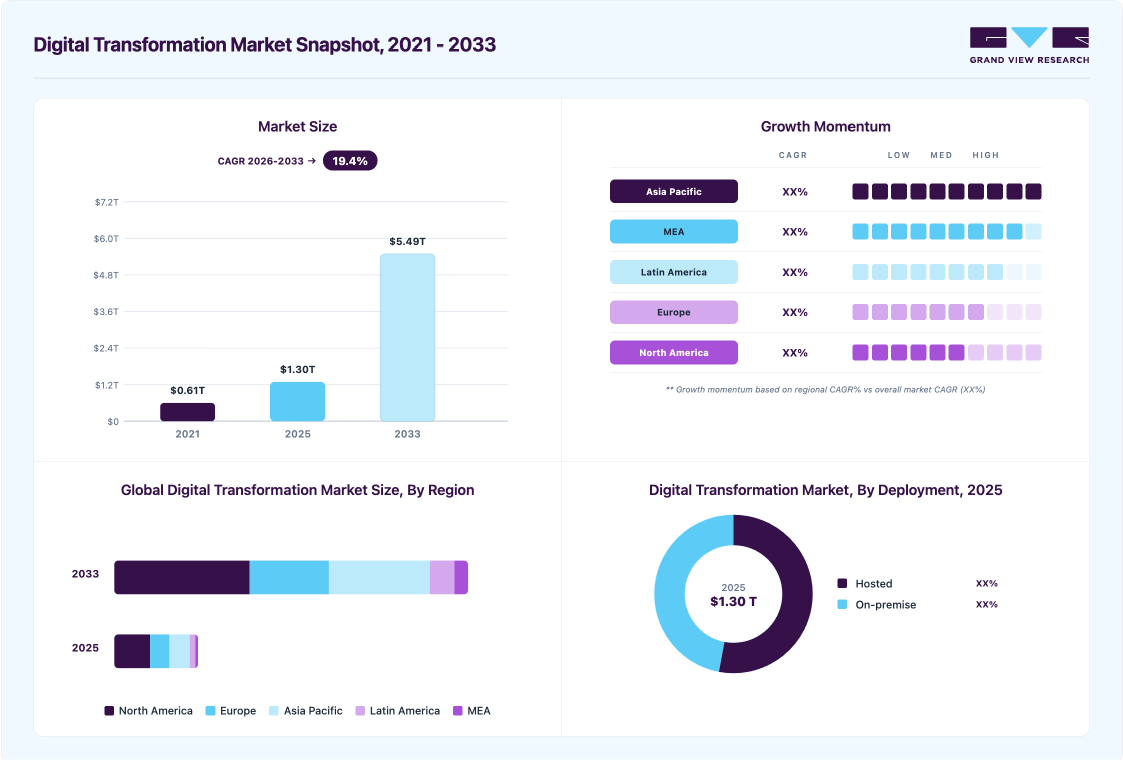
The global digital transformation market size was valued at USD 1,302.9 billion in 2025 and is projected to grow from USD 1,583.2 billion in 2026 to USD 5,493.1 billion by 2033, at a CAGR of 19.4% from 2026 to 2033. The North America market held the largest share of 42.7% of the global market in 2025. The market involves the widespread integration of advanced technologies into business operations to improve efficiency and adaptability.
 Source: Grand View Research, IR Documents, Primary Interviews, Paid DatabasesTo learn more about this report,
 Download Free Sample Report
 Key Market Trends & Insights
- By type: The solution segment accounted for the largest revenue share of 67.6% in the global digital transformation market in 2025.
- By deployment: The hosted segment accounted for the largest market share in 2025.
- By enterprise size: The large size enterprise segment accounted for the largest market share in 2025.
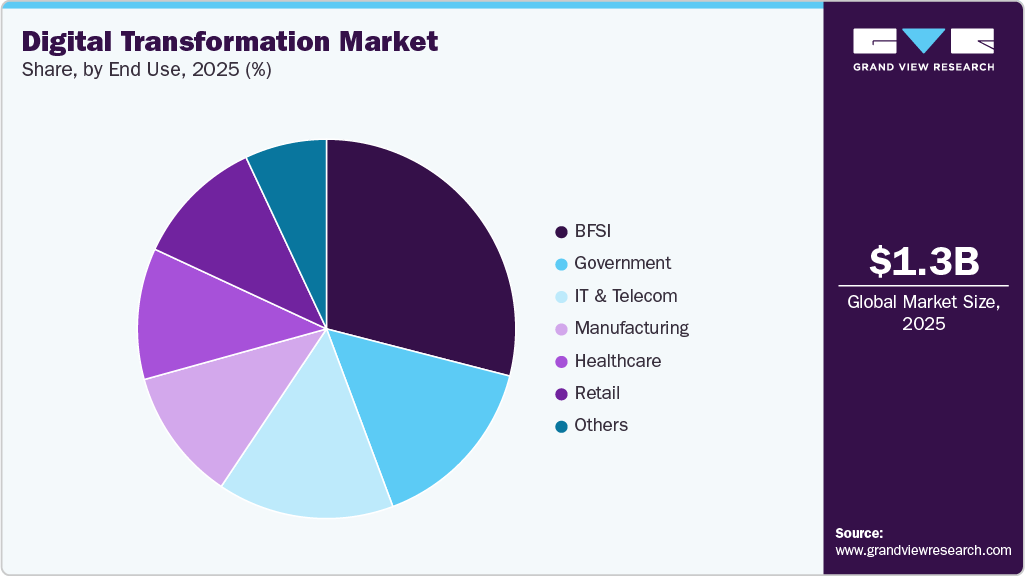
- By end use: The BFSI segment accounted for the largest market share in 2025.
Regional Highlights
- Largest regional market: North America (42.7% revenue share, 2025)
- Fastest-growing regional market: Asia Pacific (highest CAGR, 2026-2033)
- By country: The U.S.held the largest market share in 2025.
Market Size & Forecast
- Market size in 2025: USD 1,302.9 Billion
- Estimated market size in 2026: USD 1,583.2 Billion
- Projected market size by 2033: USD 5,493.1 Billion
- CAGR (2026-2033): 19.4%
Three ways to get this report
Buy it, customize it, or ask a question.Ask an Analyst
Analyst response in 1 business day
- AccessReport author, directly
- Reply timeWithin 1 working day
- No sales callDirect answer only
- FormatEmail reply
- CostFree, no cost
Get the Full Report
What the study covers
- FormatsPDF · Excel · Dashboard
- Timeline2026–2033 annual, 2025 base
- Coverage20+ countries, 5 regions
- Companies10+ key players profiled
Customize the Report
20% free customization
- IncludeCountries, segments, points
- TailorTo your product definition
- ExtendDeeper competitor detail
- OrA fully bespoke study
- Turnaround5–10 working days
Companies across industries are shifting from outdated systems to digital platforms that enable quicker decision-making and better customer engagement. This market focuses on tools such as cloud computing, artificial intelligence, and data analytics to reshape how organizations function daily. Key driving factors include the push for greater operational flexibility amid fierce competition, as businesses seek ways to respond swiftly to market shifts. Rising customer expectations for personalized, seamless interactions also fuel this trend, encouraging firms to innovate continuously. In addition, the emphasis on sustainability prompts companies to use digital solutions for smarter resource management. Regulatory changes further drive adoption by requiring more secure and transparent processes.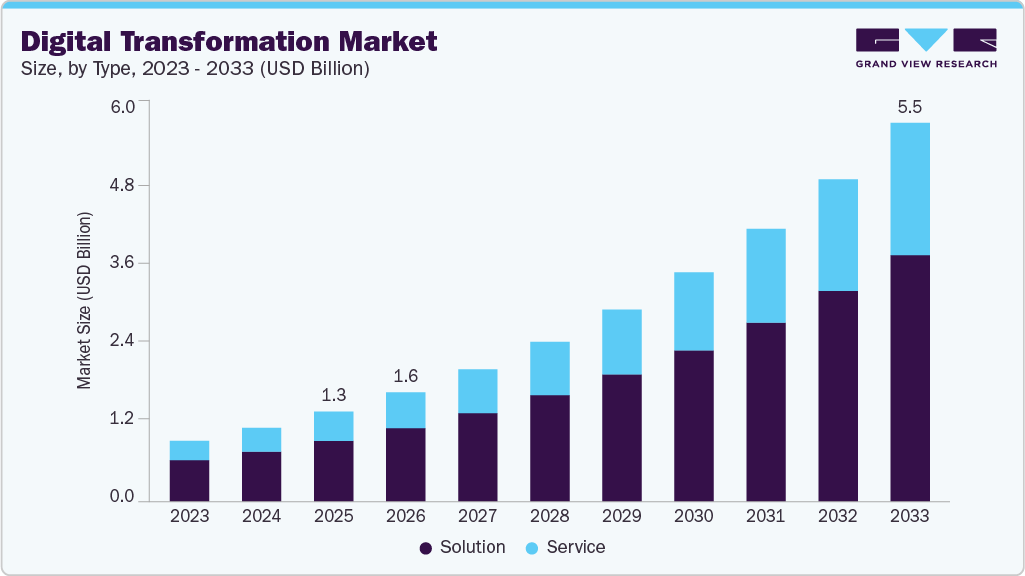 To learn more about this report, Download Free Sample Report
 The digital transformation market continues to advance as organizations seek practical, secure, and scalable ways to modernize their operations. For instance, in October 2025, Masorange, S.L. and Kyndryl collaborated to offer comprehensive digital transformation services built around artificial intelligence, cloud platforms, cybersecurity, and modern workplace solutions. This expanded alliance focuses on delivering secure, scalable offerings to both public-sector bodies and private companies, helping them modernize operations and stay competitive in a fast-changing market. By combining Orange’s strong telecom and connectivity expertise with Kyndryl’s deep experience in managed infrastructure and technology services, the two firms can address end-to-end client needs more effectively. The collaboration directly supports Spanish organizations in adopting advanced technologies faster while maintaining high standards of data protection and regulatory compliance. This move also reinforces Spain’s position within the wider European digital transformation landscape, where demand for integrated, trustworthy solutions continues to grow rapidly.
Market Dynamics
The digital transformation market is being driven by the increasing need for organizations to modernize their operations, improve customer experiences, and strengthen data security. Businesses across industries such as banking, healthcare, manufacturing, retail, and government are adopting cloud computing, artificial intelligence, automation, blockchain, and advanced cybersecurity solutions to improve efficiency and support faster decision-making. Companies are also focusing on digital platforms that can manage complex operations, support remote connectivity, and ensure compliance with evolving regulations. As enterprises continue shifting toward digital-first business models, the demand for integrated and secure digital transformation solutions is growing rapidly.
For instance, in October 2025, IBM Corporation launched the Digital Asset Haven platform, developed in collaboration with Dfns, to help financial institutions, governments, and regulated enterprises manage digital asset lifecycles securely. The platform supports more than 40 public and private blockchains and includes features such as multi-party authorization, programmable governance, and quantum-safe cryptography to improve security and compliance. This development highlights how technology providers are increasingly introducing advanced digital platforms that combine automation, security, and scalability to support enterprise digital transformation initiatives.
One of the major restraining factors affecting the growth of the digital transformation market is the integration of advanced digital technologies with existing legacy systems. Many organizations still operate on old IT infrastructure and traditional software platforms that were not designed to support modern technologies such as cloud computing, artificial intelligence (AI), automation, and Internet of Things (IoT) solutions. As a result, companies often face technical difficulties while upgrading their systems, transferring data, and maintaining smooth business operations during the transition process.
In addition, replacing or modernizing legacy systems requires high investment, a skilled workforce, and long implementation timelines, which can increase the overall operational cost for businesses. Many small and medium-sized enterprises are hesitant to adopt digital transformation solutions due to concerns related to system downtime, cybersecurity risks, and disruptions in daily operations. These integration and cost-related challenges can slow down the adoption of digital transformation technologies across various industries.
The digital transformation market is creating significant growth opportunities due to rising investments in artificial intelligence, cloud infrastructure, data centers, and digital connectivity projects across developing and developed economies. Governments and private organizations are increasingly supporting digital infrastructure development to strengthen economic growth, improve public services, and accelerate technology adoption across industries. The growing use of AI-powered analytics, automation, cloud computing, and smart connectivity solutions is encouraging enterprises to modernize their operations and expand digital capabilities. In addition, increasing collaboration between technology providers, telecom companies, and infrastructure developers is further supporting large-scale digital transformation initiatives globally.
For instance, in October 2025, Google LLC announced a USD 15 billion investment to establish its first AI hub in Andhra Pradesh, India, as part of the country’s “Viksit Bharat 2047” vision. The project includes gigawatt-scale data center operations, a new international subsea gateway, and upgraded energy infrastructure to support advanced AI and cloud services. Through partnerships with AdaniConnex and Airtel, the initiative aims to accelerate AI-driven digital transformation across India. This development highlights how large-scale investments in AI infrastructure and digital connectivity are creating long-term opportunities for the digital transformation market by enabling faster technology adoption, improved digital access, and scalable enterprise innovation.
Market Concentration & Characteristics
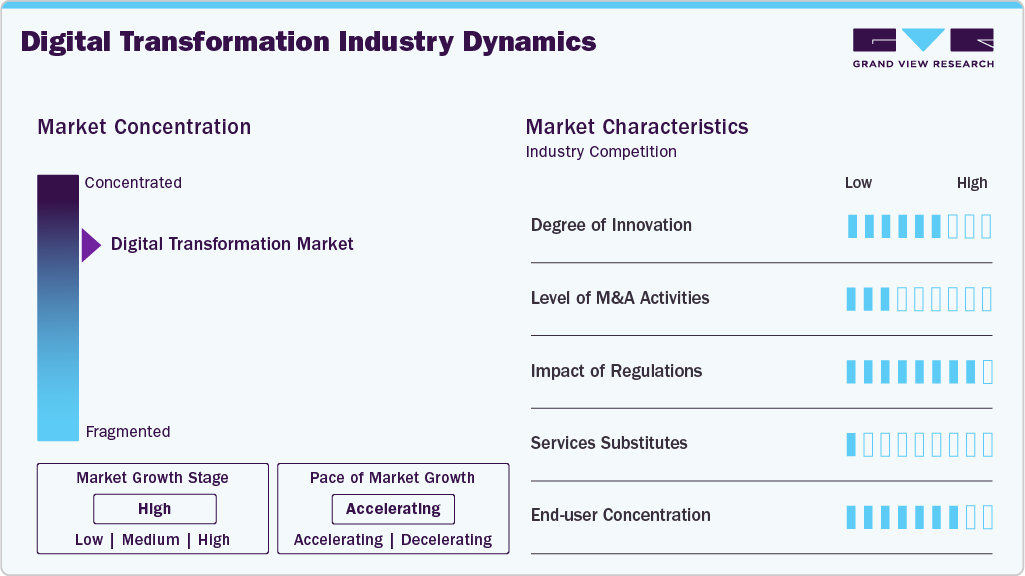
The digital transformation market is concentrated, with a few major global technology companies holding a significant share of the market due to their extensive cloud infrastructure, advanced AI capabilities, broad software portfolios, and strong global customer networks. Leading companies such as Microsoft, Amazon Web Services, Google LLC, IBM Corporation, and Oracle Corporation dominate the market through integrated offerings across cloud computing, cybersecurity, artificial intelligence, automation, data analytics, and enterprise software solutions. Their strong financial capabilities, continuous investments in innovation, and long-term enterprise partnerships create high competitive barriers for smaller players. In addition, the increasing preference for end-to-end digital transformation platforms and managed services further strengthens the position of established technology providers in the market.
 To learn more about this report, Download Free Sample Report
 In terms of market characteristics, the industry is highly innovation-driven and rapidly evolving, supported by increasing adoption of artificial intelligence, cloud migration, Internet of Things (IoT), blockchain, and advanced cybersecurity technologies across industries. The market is experiencing high growth, and the pace of growth is accelerating as organizations continue shifting toward digital-first business models to improve operational efficiency, customer engagement, and decision-making capabilities. Demand is further supported by rising investments in smart infrastructure, digital workplace solutions, automation technologies, and government-led digitalization initiatives globally. Additionally, the market is characterized by strong strategic partnerships, high research and development spending, and increasing demand for scalable and secure digital ecosystems, which continue to drive long-term market expansion.
Type Insights
The solution segment accounted for the largest revenue share of 67.6% in the global digital transformation market in 2025, the hosted software and platforms component is gaining strong momentum as enterprises seek scalable, subscription-based solutions that eliminate heavy upfront infrastructure investment. Key trends include a shift toward SaaS and cloud-native architectures, the integration of IoT and real-time data platforms, and the embedding of analytics and AI capabilities within application layers. Organizations are also prioritizing unified platforms that offer enterprise-grade visibility, device management, and analytics across distributed deployments. A recent development in the market highlights how vendors are enhancing hosted platforms to deliver greater operational intelligence. For instance, in October 2025, Datalogic introduced “Datalogic Connect,” a comprehensive IoT platform designed to manage its device fleet from a single hub and deliver remote monitoring, configuration, and predictive analytics. The platform’s core capabilities including device visibility, remote configuration, and analytics demonstrate that hosted solutions are evolving into intelligent digital ecosystems that drive efficiency, scalability, and data-led transformation across industries.
The service segment is expected to grow at the highest CAGR during the forecast period from 2026 to 2033, as organizations increasingly rely on specialized expertise to modernize their operations and implement advanced technologies. Businesses are seeking consulting, integration, and managed services that help them navigate complex cloud migrations, adopt AI-driven tools, and strengthen cybersecurity frameworks. Service providers play a central role in aligning technology investments with business goals, ensuring smooth deployment, and enabling continuous optimization of digital environments. This rising demand is also driven by the need for ongoing support, real-time monitoring, and scalable service models that reduce operational burdens on internal teams. As companies prioritize agility and long-term resilience, the service segment continues to expand as a critical enabler of successful digital transformation initiatives. A recent development in the services-led digital transformation market highlights how strategic collaborations are enhancing customer engagement and operational innovation. For instance, in September 2024, NTT DATA and Arsenal launched a digital transformation partnership in the UK, leveraging advanced data, machine learning, and real-time integrations to enhance supporter engagement and strengthen the club’s global digital ecosystem within the expanding services-led digital transformation market.
Deployment Insights
The hosted segment accounted for the largest market share in 2025 in the digital transformation market, and continued to gain traction in the digital transformation market as organizations seek solutions that deliver agility, scalability, and rapid time-to-value. Businesses are increasingly migrating from traditional on-premise systems to cloud-based architectures to reduce upfront capital expenditure and leverage elastic resources on demand. Significant trends supporting this growth include the adoption of multi-cloud strategies, platform-as-a-service models, unified data analytics stacks, and composable architectures that enable real-time innovation. In Addition, providers of hosted solutions are rising to the challenge by embedding advanced operational capabilities such as continuous model deployment, lifecycle automation, and service-integration layers into their platforms. For instance, in 2025, Amazon SageMaker announced its MLOps capabilities for hosted model development, enabling enterprises to automate, govern, and scale machine learning workflows within their cloud environment. This instance highlights that hosted platforms are evolving beyond simply providing infrastructure; they now deliver full-stack orchestration, model governance, and production-ready analytics as part of their service offering.
The on-premises segment is expected to experience significant growth during the forecast period from 2026 to 2033, driven by organizations that prioritize control, security, and regulatory compliance in their technology environments. Many enterprises, particularly in industries such as BFSI, healthcare, and government, rely on on-premises infrastructure to manage sensitive data and maintain strict governance standards. This deployment model allows businesses to customize systems to their operational needs while ensuring high performance and low-latency processing for critical workloads. Although cloud adoption is rising, on-premises solutions remain essential for companies with complex legacy systems, stringent data residency requirements, or specialized application dependencies. As digital transformation accelerates, enterprises increasingly adopt hybrid strategies in which on-premises platforms serve as the foundation for integrating advanced tools such as AI, automation, and analytics. Enterprises are increasingly upgrading on-premises architectures to boost local processing efficiency and support faster, data-driven decision-making. For instance, in May 2025, QNAP introduced its Edge AI Storage Server, an integrated on-premises solution combining storage, virtualization, GPU acceleration, and container deployment capabilities to support AI-driven applications across manufacturing, retail, and surveillance sectors. This launch demonstrates an increasing emphasis on strengthening local compute infrastructure to support advanced analytics and digital transformation initiatives.
Enterprise Size Insights
The large size enterprise segment accounted for the largest market share of 56.8% in 2025, driven by the increasing focus of large enterprises on modernizing legacy systems, optimizing large-scale operations, and accelerating enterprise-wide innovation. These organizations are investing heavily in advanced technologies such as artificial intelligence, cloud computing, analytics, and automation to improve operational efficiency, customer engagement, and business agility. The growing emphasis on end-to-end digital integration, data-driven decision-making, and continuous innovation is shaping the transformation strategies of large enterprises across industries, including BFSI, manufacturing, and retail. Several leading technology providers have introduced comprehensive platforms to support these ambitious goals. For instance, in October 2025, Mphasis launched NeoIP, a unified AI platform designed to enable continuous enterprise transformation by integrating modernization, application development, IT operations, and business process management within a single framework. The platform enhances automation, predictive capabilities, and operational visibility, allowing enterprises to accelerate transformation while maintaining governance and efficiency.
The Small and Medium-Sized Enterprise (SMEs) segment is expected to grow at the highest CAGR during the forecast period from 2026 to 2033, driven by the need to enhance operational efficiency, strengthen customer engagement, and remain competitive in an increasingly digital economy. SMEs are adopting cloud-based solutions, AI-driven analytics, and automation tools that offer scalability, flexibility, and cost efficiency. Also, the growing availability of subscription-based and modular digital platforms is enabling smaller businesses to access enterprise-grade capabilities without significant upfront investment. The growing availability of subscription-based and modular digital platforms is enabling smaller businesses to access enterprise-grade capabilities without significant upfront investment. For instance, in October 2025, Liquid Intelligent Technologies launched an SME Portal in Zambia, providing small and medium enterprises with integrated connectivity, cloud storage, and collaboration tools to enhance digital capabilities, streamline operations, and support growth within the country’s evolving digital transformation market.
End Use Insights
The BFSI segment accounted for the largest market share in 2025 in the global digital transformation market, as institutions focus on enhancing operational efficiency, regulatory compliance, and customer experience. The increasing digitization of financial services, the growing adoption of AI and advanced analytics, and the rapid shift toward cloud-based infrastructure are key factors driving transformation in this segment. Financial organizations are investing in data modernization, automation, and digital platforms to improve decision-making, enable real-time transactions, and mitigate security risks. Financial services firms are also collaborating with technology partners to modernize their data ecosystems and accelerate transformation through scalable digital infrastructure. For instance, in July 2025, NatWest Group announced a five-year collaboration with Accenture and Amazon Web Services (AWS) aimed at accelerating its bank-wide data and AI transformation. The initiative will consolidate multiple data streams into a unified platform, enhance personalization for its 20 million customers, accelerate onboarding, improve fraud detection, and automate key risk and regulatory reporting functions.
 To learn more about this report, Download Free Sample Report
 The healthcare segment is expected to register the fastest growth in the global digital transformation market during the forecast period, driven by the urgent need to improve patient care, operational efficiency, and data management. Healthcare organizations are increasingly adopting digital technologies such as electronic health records, telemedicine platforms, AI-powered diagnostics, and cloud-based solutions to enhance service delivery and streamline workflows. The integration of analytics and predictive tools allows providers to make data-driven decisions, optimize resource allocation, and anticipate patient needs more effectively. Regulatory compliance, patient data security, and interoperability between systems are also key factors shaping digital initiatives in this sector. For instance, in July 2025, CIMB GROUP HOLDINGS BERHAD signed an MOU with Remedi in Malaysia to develop digital health solutions for healthcare SMEs, embedding financial services within Remedi’s cloud-based platforms to enhance clinic operations, patient care, and accelerate the country’s health-tech digital transformation market. This initiative will enable SMEs to access integrated digital and financial solutions, operational efficiency, and broader adoption of technology in healthcare services.
Regional Insights
North America accounted for the largest market share of 42.7% in 2025 in the global digital transformation market, driven by the rapid integration of emerging technologies such as artificial intelligence (AI), cloud computing, Internet of Things (IoT), and analytics across industries. Enterprises in the region are increasingly prioritizing digital initiatives to enhance operational efficiency, customer experience, and business resilience. The U.S. and Canada are at the forefront of adopting advanced cloud infrastructures, AI-powered automation, and data-driven decision-making models. Major industry gatherings played a pivotal role in promoting collaboration and showcasing cutting-edge solutions. For instance, TechEx North America united eight co-located events covering AI, cybersecurity, IoT, digital transformation, automation, edge, cloud, and data centers, delivering U.S. enterprises a strategic platform to accelerate innovation and digital competitiveness. This initiative is expected to further stimulate the market by enabling companies to adopt emerging technologies faster, drive competitiveness, and foster cross-industry collaboration.
 To learn more about this report, Download Free Sample Report
 U.S. Digital Transformation Market Trends
The U.S. digital transformation market is driven by the rapid integration of artificial intelligence (AI), machine learning (ML), Internet of Things (IoT), and advanced analytics across industries. Organizations are increasingly focusing on modernizing legacy IT systems, automating workflows, and enhancing customer experiences through data-driven solutions. The adoption of cloud computing, edge technologies, and enterprise mobility platforms is accelerating as companies aim to improve agility and resilience. The market expansion is also supported by international partnerships and government-led initiatives aimed at advancing digital infrastructure and strengthening technology ecosystems. For instance, in January 2025, the United States announced its support for Ecuador’s digital transformation through an agreement with Google Cloud, focused on promoting secure cloud adoption, strengthening cybersecurity capabilities, and expanding digital infrastructure.
Europe Digital Transformation Market Trends
The digital transformation market in Europe is anticipated to register significant growth from 2026 to 2033, driven by accelerated technology adoption, strong regulatory frameworks, and increasing enterprise investment in innovation. Organizations across sectors such as manufacturing, healthcare, energy, and financial services are rapidly transitioning toward data-driven, cloud-enabled, and AI-powered operations. The region’s emphasis on sustainability, data sovereignty, and ethical AI deployment is shaping its digital agenda, supported by initiatives such as the EU Digital Strategy and the European Data Act. Furthermore, the strategic governmental and legislative efforts are consistently backed by concrete, cross-border investment in key technological infrastructure. For instance, in October 2025, the European Commission announced the expansion of its network of AI Factories through the addition of six new sites across the Czech Republic, Lithuania, the Netherlands, Romania, Spain, and Poland.
The digital transformation market in Germany accounted for the largest share in 2025, driven by the country’s strong industrial foundation, advanced engineering capabilities, and accelerating adoption of Industry 4.0 technologies. Enterprises are increasingly integrating artificial intelligence (AI), Internet of Things (IoT), and cloud-based systems to optimize manufacturing efficiency, enhance predictive maintenance, and strengthen supply chain transparency. The automotive, logistics, and industrial machinery sectors are at the forefront of this transformation, leveraging digital twin technology, edge computing, and data analytics to enable smart production and real-time decision-making. The concerted national focus on digitalizing the industrial base is strongly supported by major strategic investments from both technology providers and governmental organizations. For instance, in October 2025, Deutsche Telekom and NVIDIA launched Germany’s Industrial AI Cloud, a USD 1.16 billion investment initiative designed to accelerate the industrial AI revolution across Germany and Europe. The platform, featuring SAP integration and the “Made 4 Germany” initiative, aimed to support businesses, government, and research while fostering innovation and a sovereign AI ecosystem.
The digital transformation market in France is poised for accelerated growth from 2026 to 2033. The market is evolving swiftly, underpinned by rising enterprise investment in cloud computing, artificial intelligence (AI), data analytics, and automation across sectors such as manufacturing, finance, healthcare and public services. Businesses are increasingly embracing digital-first strategies to enhance agility, productivity and customer experience, while also navigating complex regulatory environments around data sovereignty and cybersecurity. The national agenda anchored by initiatives such as France 2030 places strong emphasis on infrastructure build-out (5G, fiber, data centers), digital skills development and supporting a robust innovation ecosystem. For instance, in May 2025, Kyndryl announced a USD 111.6 million investment in France over three years to enhance data, AI and cyber-resilience capabilities, including hiring up to 300 experts, launching an AI private cloud for French customers and establishing a new digital hub in Sophia-Antipolis.
Asia Pacific Digital Transformation Market Trends
Asia Pacific is expected to register the fastest CAGR from 2026 to 2033, driven by the strong rise of mobile connectivity, cloud adoption, AI integration and IoT deployments across diverse economies from highly developed markets to emerging ones. Enterprises and governments alike are prioritizing digital inclusion, platform-based services, and scalable infrastructure to support sectors such as retail, manufacturing, healthcare and financial services. The region’s young population, growing consumer digitalization and aggressive 5G rollouts are creating favorable conditions for digital business models and ecosystem-based innovation. The widespread drive toward digital maturity is significantly supported by multi-national public-private partnerships focusing on infrastructure and policy development. For instance, in July 2025 the Asian Development Bank (ADB) and the GSMA signed a multi-year cooperation agreement to drive digital development across Asia-Pacific, focusing on mobile connectivity, policy reform, public-private collaboration and capacity building in sectors such as health, education, finance and disaster resilience.
The digital transformation market in China held a dominant share in 2025. The market is primarily driven by the government’s “Digital China” strategy, which focuses on integrating digital technologies across public administration, education, manufacturing, and finance. The country is prioritizing the development of smart manufacturing hubs, AI-enabled industrial parks, and digital public services to enhance productivity and governance efficiency. Rapid adoption of 5G networks, advancements in autonomous systems, and the expansion of digital platforms for trade and logistics are accelerating China’s progress toward a data-driven economy. Moreover, the market momentum is further strengthened by education-focused digitalization programs designed to cultivate future-ready talent and align the workforce with the evolving digital economy. For instance, in June 2023, the Ministry of Education of the People’s Republic of China (MOE) launched an initiative to accelerate the digital transformation of higher education institutions, introducing online platforms that connect graduates with employers and enhance career services through data integration and AI analytics. This initiative highlights China’s commitment to merging education reform with digital development to strengthen innovation capacity and employment outcomes.
The digital transformation market in India is poised for rapid expansion from 2026 to 2033, driven by rapid digital infrastructure expansion, widespread adoption of cloud and AI technologies, and the government’s push for inclusive e-governance. Key sectors such as BFSI, retail, education, and healthcare are embracing digital platforms to enhance service delivery and operational efficiency. India’s thriving startup ecosystem, coupled with strong public-sector digital initiatives, is fostering a robust environment for innovation and transformation. Global technology leaders are making substantial commitments to support and accelerate this momentum. For instance, in January 2025, Microsoft announced a USD 3 billion investment in India to expand cloud and AI infrastructure, establish new datacenters, and train 10 million people. The initiative aimed to accelerate AI adoption, and strengthen India’s digital transformation and AI-driven economy.
Key Digital Transformation Company Insights
Key players operating in the bare metal cloud industry are Accenture, Adobe, Broadcom and others. Companies are focusing on various strategic initiatives, including new product development, partnerships & collaborations, and agreements to gain a competitive advantage over their rivals. The following are some instances of such initiatives.
-
In September 2025, Globant announced a multi-year strategic collaboration agreement with AWS to accelerate global client adoption of generative AI and cloud solutions. The partnership focused on industry-specific innovations in sectors such as media, banking, and automotive. This alliance is anticipated to drive expansion in the digital transformation market through enhanced AI-integrated cloud migrations.
-
In January 2025, PwC and Microsoft announced a strategic collaboration to deploy advanced AI agents across industries. The partnership equipped organizations with autonomous systems to enhance operational efficiency, drive innovation, and support decision-making. This initiative is expected to accelerate growth in the global digital transformation market by enabling widespread adoption of intelligent automation.
-
In July 2024, Lumen Technologies and Microsoft announced a strategic partnership to advance Lumen's digital transformation using the Microsoft Cloud. Microsoft selected Lumen to expand network capacity for AI-driven datacenter demands. This collaboration is expected to bolster growth by delivering scalable, AI-ready infrastructure.
Key Digital Transformation Companies:
The following key companies have been profiled for this study on the digital transformation market.
- Accenture
- Adobe
- Broadcom
- Cisco Systems, Inc.
- Dell Inc.
- Dempton Consulting Group
- Google LLC
- Happiest Minds
- Hewlett Packard Enterprise Development LP
- IBM Corporation
- Kellton
- phoenixNAP
- Microsoft
- Salesforce, Inc.
- SAP SE
- TIBCO
Competitive Benchmarking
Operating Strategies
Competitive Edge
Weaknesses
Mature Players: Microsoft; IBM Corporation; Accenture; SAP SE; and Cisco Systems, Inc.
- Focus on AI, cloud computing, cybersecurity, and automation-driven transformation services.
- Expand market presence through strategic partnerships, acquisitions, and enterprise consulting services.
- Strong global customer base with high enterprise trust and recurring revenue streams.
- Broad product ecosystems integrating cloud, analytics, AI, ERP, and cybersecurity solutions.
- High implementation and consulting costs for small and mid-sized businesses.
- Complex legacy systems and slower decision-making due to large organizational structures.
Emerging Players: Happiest Minds; Kellton; Dempton Consulting Group; phoenixNAP; TIBCO
- Focus on niche digital transformation services such as cloud migration, analytics, DevOps, and managed services.
- Target mid-sized enterprises with flexible pricing and customized deployment models.
- Faster implementation capabilities and agile service delivery models.
- Strong specialization in specific technologies such as analytics, cloud hosting, and digital engineering.
- Limited global presence and lower brand recognition compared to large technology firms.
- Smaller R&D budgets and lower capability for handling very large enterprise-scale projects.
Digital Transformation Market Report Scope
Report Attribute
Details
Market size in 2025
USD 1,302.9 billion
Market size in 2026
USD 1,583.2 billion
Revenue forecast in 2033
USD 5,493.1 billion
Growth rate
CAGR of 19.4% from 2026 to 2033
Actual data
2021 - 2025
Forecast period
2026 - 2033
Quantitative units
Revenue in USD Billion and CAGR from 2026 to 2033
Report Coverage
Revenue forecast, company share, competitive landscape, growth factors, and trends
Segments covered
Type, Deployment, Enterprise Size, End Use, and Region
Regional scope
North America; Europe; Asia Pacific; Latin America; MEA
Country scope
U.S.; Canada; Mexico; UK; Germany; France; China; India; Japan; Australia; South Korea; Brazil; UAE; Kingdom of Saudi Arabia; South Africa
Key companies profiled
Accenture; Adobe; Broadcom; Cisco Systems, Inc.; Dell Inc.; Dempton Consulting Group; Google LLC; Happiest Minds; Hewlett Packard Enterprise Development LP; IBM Corporation; Kellton; phoenixNAP; Microsoft; Salesforce, Inc.; SAP SE; TIBCO
Customization scope
Free report customization (equivalent to 8 analysts working days) with purchase. Addition or alteration to country, regional & segment scope.
Pricing and purchase options
Avail customized purchase options to meet your exact research needs. Explore purchase options
Global Digital Transformation Market Report Segmentation
This report forecasts revenue growth at global, regional, and country levels and provides an analysis of the latest industry trends in each of the sub-segments from 2021 to 2033. For this study, Grand View Research has segmented the digital transformation market report based on type, deployment, enterprise size, end use, and region.
-
Type Outlook (Revenue, USD Billion, 2021 - 2033)
-
Solution
-
Big Data & Analytics
-
Cloud Computing
-
Cybersecurity
-
Artificial Intelligence (AI)
-
Mobility
-
Social media
-
Others
-
-
Service
-
Professional services
-
Implementation & Integration
-
-
-
Deployment Outlook (Revenue, USD Billion, 2021 - 2033)
-
Hosted
-
On-premise
-
-
Enterprise Size Outlook (Revenue, USD Billion, 2021 - 2033)
-
Large Size Enterprise
-
Small and Medium Sized Enterprise (SMEs)
-
-
End Use Outlook (Revenue, USD Billion, 2021 - 2033)
-
BFSI
-
Government
-
Healthcare
-
IT & Telecom
-
Manufacturing
-
Retail
-
Others
-
-
Regional Outlook (Revenue, USD Billion, 2021 - 2033)
-
North America
-
U.S.
-
Canada
-
Mexico
-
-
Europe
-
UK
-
Germany
-
France
-
-
Asia Pacific
-
China
-
India
-
Japan
-
South Korea
-
Australia
-
-
Latin America
-
Brazil
-
-
Middle East & Africa
-
UAE
-
Saudi Arabia
-
South Africa
-
-
Delivered Customizations
This report has been delivered with the following In-depth customizations
Client Request
Customization Delivered
Value Adds
Additional profiling of emerging AI, cloud migration, and digital consulting vendors across North America and the Asia Pacific.
Added 15 additional regional and mid-sized digital transformation companies.
Expanded analysis on partnerships with AWS, Microsoft Azure, and Google Cloud.
Provided company-wise SWOT analysis and market positioning matrix.
Helped identify potential acquisition and partnership opportunities.
Supported competitive strategy development for enterprise consulting bids.
Improved understanding of regional competition and emerging technology providers.
Requested country-level outlook for the Asia Pacific digital transformation market with a focus on India, Japan, and Southeast Asia.
Added detailed market forecasts for India, Japan, Singapore, and Indonesia.
Included analysis of government digitalization initiatives and smart manufacturing adoption.
Added profiles of regional companies such as Infosys, TCS, and Wipro.
Enabled prioritization of high-growth regional markets for expansion.
Helped align sales strategies according to country-wise digital maturity levels.
Supported investment planning in manufacturing and cloud transformation sectors.
Requested additional segmentation by digital transformation use cases, including AI automation, cloud ERP migration, cybersecurity modernization, and customer experience transformation.
Added use-case-based segmentation and adoption analysis across BFSI, healthcare, and retail sectors.
Included over 5 enterprise implementation case studies.
Expanded analysis of cloud ERP migration, AI integration, and legacy application modernization projects.
Improved evaluation of high-growth technology investment areas.
Helped identify industries with strong digital transformation spending potential.
Frequently Asked Questions About This Report
The large organization segment holds the largest market share of 56.8% in 2025. Large enterprises are focusing on digital transformation since it provides cost-effectiveness and seamless business process execution.
North America dominated with a 42.7% revenue share in 2025
Asia Pacific is the fastest-growing region over the forecast period.
The global digital transformation market size was estimated at USD 1,302.9 billion in 2025 and is expected to reach USD 1,583.2 billion in 2026.
The global digital transformation market is expected to grow at a compound annual growth rate of 19.4% from 2026 to 2033 to reach USD 5,493.1 billion by 2033.
The key players in the digital transformation market are Accenture plc; Adobe Systems Inc.; Broadcom, Inc.; Cisco Systems, Inc.; Dell EMC; Dempton Consulting Group; Google Inc.; Happiest Minds; Hewlett Packard Enterprise Co.; International Business Machines Corporation; Kellton Tech Solutions Ltd.; Microsoft Corporation; Salesforce, Inc.; SAP SE; and TIBCO Software among others.
The hosted segment accounted for the market share of 53.0% in 2025. This growth can be attributed to the increasing use of mobile devices and advancements in information-sharing technologies. Cloud-based digital transformation solutions allow End-use industries to adapt to evolving markets in effective and efficient ways.
The big data & analytics segment accounted for the largest market share, more than 23.4% in 2025, attributable to the analytical solutions' ability to support a broad range of applications across various end-use industries and growing demand by end-use firms to gain powerful insights from enormous data volumes.
About the Author(s)
Next Generation Technologies Research Team
Technology · Next Generation TechnologiesThis report was authored by the next generation technologies research team at Grand View Research - comprising two research analysts, one senior research analyst, and one industry expert - with specialized expertise in the next generation technologies segment of the technology industry. All findings are based on proprietary technology databases, executive interviews, and regulatory analysis, subject to internal peer review prior to publication.
Last Updated:
Speak to Analyst

Customize this report to your needs - add regions, segments, or data points, with 20% free customization.
Or view our licence options:


ISO 9001:2015 & 27001:2022 Certified
We are GDPR and CCPA compliant! Your transaction & personal information is safe and secure. For more details, please read our privacy policy.


