
- Home
- »
- Healthcare IT
- »
-
Conversational AI In Healthcare Market Report, 2026-2033GVR Report cover

Conversational AI In Healthcare Market (2026 - 2033)
Size, Share & Trends Analysis Report By Component (Chatbots, Virtual Assistants), By Technology (Speech Recognition & Generation), By Application, By End Use, By Region, And Segment Forecasts
Market Size, 2025
$17.1BMarket Estimate, 2026
$21.4BMarket Forecast, 2033
$106.7BCAGR, 2026–2033
25.8%Conversational AI In Healthcare Market Report Summary
The global conversational AI in healthcare market size was valued at USD 17.1 billion in 2025 and is projected to grow from USD 21.4 billion in 2026 to USD 106.7 billion by 2033, at a CAGR of 25.8% from 2026 to 2033. North America dominated the global market, accounting for a revenue share of 50.0% in 2025. Rising demand for improved patient engagement, increasing adoption of telehealth and remote care, and advancements in natural language processing (NLP) and AI technologies are significant factors contributing to market growth.
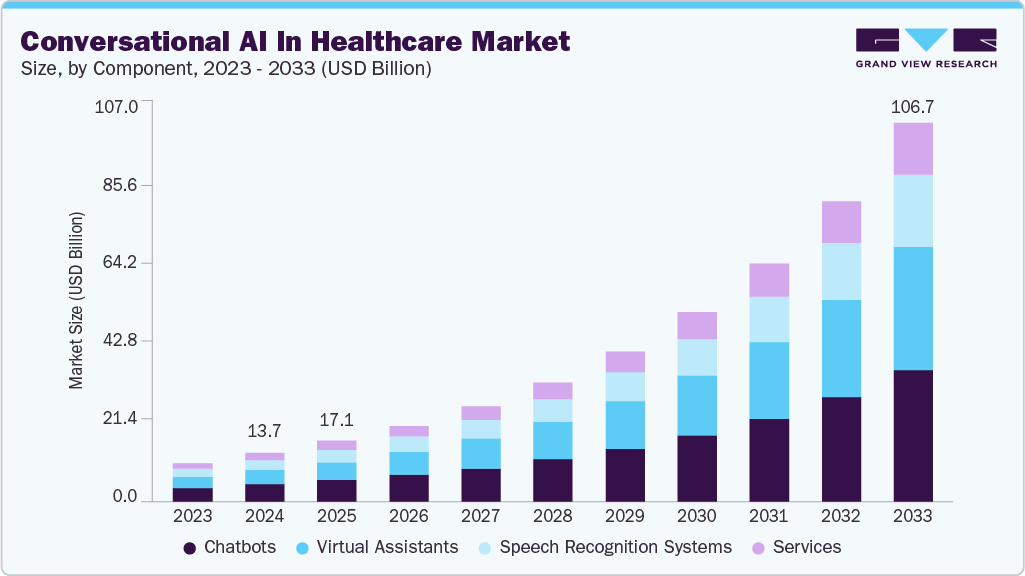 Source: Grand View Research, IR Documents, Primary Interviews, Paid DatabasesTo learn more about this report,
 Download Free Sample Report
Key Market Trends & Insights
- By component: Chatbots segment held the largest market share of around 35.0% in 2025.
- By technology: Speech recognition & generation segment led the market with a share of around 30.0% in 2025.
- By application: Patient engagement & support segment held the largest market share of around 29.0% in 2025.
- By end use: Hospitals & clinics segment held the largest market share of around 38.0% in 2025.
Regional Highlights
- Largest regional market: North America (50.0% revenue share, 2025)
- Fastest-growing regional market: Asia Pacific (highest CAGR, 2026-2033)
Market Size & Forecast
- Market size in 2025: USD 17.1 Billion
- Estimated market size in 2026: USD 21.4 Billion
- Projected market size by 2033: USD 106.7 Billion
- CAGR (2026-2033): 25.8%
Three ways to get this report
Buy it, customize it, or ask a question.Ask an Analyst
Analyst response in 1 business day
- AccessReport author, directly
- Reply timeWithin 1 working day
- No sales callDirect answer only
- FormatEmail reply
- CostFree, no cost
Get the Full Report
What the study covers
- FormatsPDF · Excel · Dashboard
- Timeline2026–2033 annual, 2025 base
- Coverage20+ countries, 5 regions
- Companies10+ key players profiled
Customize the Report
20% free customization
- IncludeCountries, segments, points
- TailorTo your product definition
- ExtendDeeper competitor detail
- OrA fully bespoke study
- Turnaround5–10 working days
In addition, cost efficiency & operational optimization, and the automation of administrative healthcare workflows are other factors further fueling market growth. The rapid adoption of telemedicine amplifies the need for conversational AI to support virtual patient interactions and care coordination. AI-powered chatbots enable symptom triage, follow-ups, and health education during remote consultations. Conversational AI enhances telehealth platforms by providing real-time assistance to patients and clinicians. Remote patient monitoring devices combined with AI-driven communication tools improve chronic disease management and adherence. The convenience and scalability of AI systems boost the penetration of telehealth globally.Healthcare providers leverage conversational AI to maintain continuity of care and reduce hospital readmissions outside physical settings. The increasing demand for home-based and decentralized healthcare drives the adoption of AI-enabled virtual care solutions. For instance, in April 2025, Belong. Life partnered with Equiva to integrate its conversational AI health mentors, Dave (cancer care expert) and Fred (general health and lifestyle coach), into Equiva’s in-hospital and home-based platforms. These AI companions provide real-time support by answering health questions, preparing patients for doctor visits, translating medical documents, guiding hospital discharge, and offering tailored emotional and behavioral coaching.
Furthermore, increasing adoption of voice-enabled AI assistants propels market growth. Voice-enabled AI assistants have transformed healthcare workflows by offering hands-free, real-time support for clinicians and patients. These AI tools streamline administrative tasks such as clinical note transcription, scheduling, and EHR retrieval. Voice assistants reduce provider workload, allowing more focus on patient care while minimizing errors and enhancing communication. For instance, in May 2025, SoundHound AI and Allina Health launched Alli, an AI-powered patient-access agent built on SoundHound's Amelia platform. The solution supports patient identification, appointment management, prescription refill requests, and provider searches, demonstrating the growing use of conversational AI to automate healthcare contact-center workflows.
Analyst Perspective
The conversational AI in healthcare market is expected to growing due to the adoption of conversational chatbots and virtual assistants, to drive patient engagement, optimize administrative workflows, and broaden access to healthcare information. Rising healthcare costs, and existing shortages of clinical staff are motivating healthcare providers to automate routine communication, including appointment scheduling, symptom checking, medication reminders, and patient triaging. Ongoing developments in NLP, speech recognition, generative AI and multilingual applications are further enhancing the quality and personalization of conversational healthcare solutions. Moreover, the ongoing investments in digital health infrastructure and the integration of conversational AI into EHRs, telehealth systems, and patient portals are also opening up new market opportunities. Meanwhile, data security, clinical fidelity, regulatory compliance, and the ethical use of AI technologies remain critical.
Component Insights
The chatbots component segment held the largest market share, at around 35.0%, in 2025. Chatbots enable patients to access medical information, schedule appointments, and receive real-time reminders without human intervention. Healthcare providers leverage these tools to reduce administrative burdens while improving accessibility and responsiveness. With natural language processing capabilities, chatbots can deliver personalized interactions, improving patient satisfaction.
In addition, chatbots are becoming integral to chronic disease management and preventive care by offering medication reminders, symptom tracking, and health education. For instance, in February 2025, the University Hospitals of Geneva (HUG) launched "confIAnce," Switzerland's first AI-powered medical chatbot, designed to provide reliable and verified general medical information to the public and healthcare professionals. It covers around 30 common chronic conditions, offering instant answers in multiple languages, alleviating burdens on primary care services.
The virtual assistants segment is expected to grow at the fastest CAGR during the forecast period. Virtual assistants are able to handle more complex tasks than chatbots, such as guiding patients through care pathways, providing personalized health recommendations, and supporting clinicians with real-time information. Their integration with electronic health records and clinical decision support systems allows for more accurate, context-aware interactions. This capability reduces physician workload while improving patient engagement and adherence to treatment plans. Growing reliance on digital health ecosystems strengthens the demand for AI-enabled virtual assistants.
Technology Insights
The speech recognition & generation segment held the largest revenue share of around 30.0% in 2025, as providers focus on improving clinical documentation and patient communication. Speech recognition tools convert spoken language into structured clinical notes, reducing the administrative burden on healthcare professionals. The demand for accurate, real-time transcription and communication tools is driving adoption across hospitals, clinics, and telehealth platforms. In addition, advancements in natural language processing and AI models are enabling more accurate speech-to-text and text-to-speech solutions tailored for healthcare settings. Integration with electronic health records and diagnostic systems ensures seamless data flow, enhancing decision-making and care coordination. For instance, in October 2024, Oracle Health introduced its Clinical AI Agent, an AI-powered clinical assistant integrated with Oracle Health EHR that uses voice and conversational capabilities to support documentation and other physician workflows. The solution demonstrates the increasing use of speech recognition and generative AI to reduce administrative workload in clinical setting.
The large language models (LLMs) and generative AI segment is anticipated to grow at the fastest CAGR from 2026 to 2033, due to its ability to process unstructured medical data and deliver context-aware insights. LLMs can synthesize clinical notes, research articles, and patient histories into actionable information to support evidence-based decision-making. Generative AI enhances patient interactions by delivering personalized explanations, treatment options, and educational content in natural language. The demand for advanced, adaptive AI models is propelling adoption in diagnostics, clinical support, and patient engagement.
Application Insights
The patient engagement & support segment held the largest market share of around 29.0% in 2025. Conversational AI tools facilitate appointment scheduling, medication reminders, and follow-up care, ensuring patients remain actively involved in their treatment plans. In addition, conversational AI enables scalable patient education and chronic disease management through tailored guidance and symptom monitoring. By offering real-time support, conversational AI improves accessibility for patients outside clinical settings. The focus on value-based care models further accelerates the adoption of patient-centric AI platforms.
The mental health support & therapy bots segment is projected to grow at the fastest CAGR from 2026 to 2033. Therapy bots are being integrated into broader mental health care strategies. They complement traditional therapy by offering continuous support between clinical sessions. Advancements in natural language processing enable these bots to deliver empathetic, context-aware responses, enhancing user trust and engagement. For instance, in July 2025, Slingshot AI launched Ash, an AI-powered therapy chatbot designed specifically for mental health, using clinical data and psychologist-designed prompts. The chatbot supports evidence-based therapies, including CBT, DBT, and ACT, offering 24/7 accessible, cost-effective mental health support, with safeguards to redirect users in crisis to human professionals.
End Use Insights
The hospitals & clinics segment held the largest market share of around 38.0% in 2025, due to the growing need to optimize clinical workflows and improve patient communication. Hospitals and clinics deploy conversational AI tools to manage appointment scheduling, triage patient inquiries, and streamline administrative tasks, reducing staff workload. In addition, hospitals and clinics are leveraging conversational AI to support telemedicine and remote care services, ensuring continuous communication with patients outside of physical visits.
Virtual assistants and chatbots assist clinicians with documentation, clinical decision support, and patient follow-ups, improving care coordination. For instance, in August 2025, Pieces Technologies launched Pieces in Your Pocket, a phone-based conversational AI assistant for inpatient physicians. The solution enables clinicians to capture brief voice interactions and generate patient progress-note content using contextual information from the patient record and prior documentation, supporting more efficient inpatient documentation workflows.
The AI-driven chatbots and virtual assistants respond immediately to health-related questions, symptom checks, and lifestyle guidance. These tools empower patients to make informed decisions and actively manage their health. Their availability across smartphones and digital platforms enhances accessibility, especially in underserved regions. The growing preference for self-service healthcare solutions strengthens the adoption of conversational AI among individuals.
The pharmaceutical & life sciences companies segment is expected to register the fastest CAGR of 28.1% over the forecast period, as drug developers adopt conversational AI to improve research productivity, clinical trial coordination, and stakeholder engagement. AI tools help researchers access scientific literature, summarize data, support trial recruitment, and answer healthcare inquiries. They are being used in medical information and patient support to streamline routine interactions. As pharmaceutical companies invest in AI for research and engagement, demand for conversational AI solutions is rising, while ensuring data privacy, regulatory compliance, and accuracy in responses remain essential.
Regional Insights
The North America conversational AI in healthcare market accounted for the largest revenue share of approximately 50.0% in 2025, supported by advanced healthcare IT infrastructure, widespread adoption of AI-enabled patient engagement tools, strong digital health investment, and the presence of major technology providers. Increasing integration of conversational AI with EHRs, telehealth platforms, contact centers, and patient portals is further supporting adoption across hospitals, clinics, payers, and other healthcare organizations.
 To learn more about this report, Download Free Sample Report
U.S. Conversational AI In Healthcare Market Trends
The conversational AI in healthcare industry in the U.S. held the largest revenue share in 2025, due to the advancements in medical technology, robust healthcare infrastructure, and an increasing use of AI in clinical diagnostics, patient monitoring, patient engagement, and the insurance sector, among others. For instance, in May 2025, Limbic introduced the Limbic Intake Agent, an innovative voice AI tool designed to assist behavioral health organizations with patient intake processes. It offers on-demand conversational support and guided activities tailored to the prescribed treatment plan and the patient’s current condition.
Europe Conversational AI In Healthcare Market Trends
The Europe conversational AI in the healthcare industry is expected to witness significant growth during the forecast period. This is attributed to the widespread adoption of AI technologies in healthcare and increasing investments by government and private organizations. Moreover, the European market experiences a significant degree of strategic initiatives, such as new product launches, mergers and acquisitions, and partnerships and collaborations by industry players. For instance, in August 2025, the U.S.-based Healthcare Outcomes Performance Company (HOPCo) acquired Dutch startup Caro Health. Caro Health’s AI-driven patient engagement and operational tools were integrated into HOPCo’s expanding digital health platform, strengthening HOPCo’s presence in Europe and advancing AI-powered healthcare innovation globally.
“We have been hugely impressed with Caro’s thoughtful approach to integrating Conversational AI into complex clinical workflows. The Caro team has clearly demonstrated that when partnering with physicians to combine best-in-class technology with deep clinical expertise, Conversational and Generative AI can enhance both the patient experience and operational workflows. This enables both physicians and administrators to focus on delivering patient care.
The UK conversational AI in healthcare market is expected to expand over the forecast period, supported by continued investment in digital health, artificial intelligence, and healthcare modernization. In January 2025, the UK government published its AI Opportunities Action Plan, outlining measures to strengthen AI infrastructure, expand computing capacity, develop AI talent, and accelerate adoption across the economy and public services. These initiatives are expected to create a more supportive environment for AI-enabled healthcare applications, including conversational technologies.
The conversational AI in healthcare market in Germany held the largest revenue share in 2025, driven by increasing investments in healthcare technology and a robust healthcare infrastructure. In addition, favorable government initiatives and insurance coverage, coupled with the expansion of telemedicine services, create a conducive environment for adopting conversational AI to improve healthcare communication.
Asia Pacific Conversational AI In Healthcare Market Trends
The Asia Pacific conversational AI in the healthcare industry is expected to grow at the fastest CAGR during the forecast period. Rapid digital transformation in healthcare and the rising prevalence of chronic diseases drive market growth. Rising smartphone penetration enables broad adoption of AI-powered virtual health assistants and chatbots for triage and health coaching. For instance, in May 2025, Malaysia’s KPJ Healthcare Berhad deployed an AI-powered chatbot across 30 specialist hospitals to improve patient experience and service delivery. Built using IBM Watsonx.ai and Watson Discovery, the chatbot handles routine inquiries, appointment scheduling, and specialist details 24/7, employing deep learning, machine learning, and NLP to provide accurate and timely information.
India conversational AI healthcare market growth is driven by rapid digitalization and smartphone penetration, enabling widespread AI adoption. The government’s support for digital health initiatives and telemedicine expansion enhances access to conversational AI solutions. For instance, the UNICEF DISHA chatbot uses AI-powered digital agents to support comprehensive primary health care in India by providing accessible health information, guidance, and services. Moreover, private sector investments and AI research collaborations further stimulate market innovation.
The conversational AI in healthcare market in Japan is expected to grow significantly over the forecast period. Increasing demand for personalized healthcare solutions and the growing adoption of artificial intelligence in healthcare contribute to market growth. In addition, technological advancements and growing government support and initiatives further fuel market growth.
Latin America Conversational AI in Healthcare Market Trends
The Latin America Conversational AI in healthcare industry is anticipated to grow at a significant CAGR over the forecast period. This is attributed to the growing awareness about AI technologies, increasing government spending, and growing advancements in healthcare infrastructure.
Middle East and Africa Conversational AI in Healthcare Market Trends
The Middle East and Africa Conversational AI in healthcare industry are expected to grow at a significant CAGR over the forecast period. The market is characterized by a dynamic landscape driven by the growing adoption of smart medical devices, increasing healthcare expenditures, and supportive government policies. Significant integration of AI into healthcare technology across the region further contributes to market growth. For instance, in April 2025, Scale AI collaborated with the Qatar government to develop AI agents for healthcare. This deal includes developing AI voice, chat, and email agents for contact centers.
Key Conversational AI In Healthcare Market Company Insights
Key players operating in the conversational AI in healthcare market are undertaking various initiatives to strengthen their market presence and increase the reach of their products and services. Strategies such as new product launches and partnerships play a key role in propelling market growth.
Key Conversational AI In Healthcare Companies
The following key companies have been profiled for this study on the conversational AI in healthcare market.
-
Abridge AlAI, Inc.
-
Agora
-
Authenticx
-
Corti
-
Enlitic, Inc.
-
Fireflies
-
Google
-
Hyro
-
IBM
-
LivePerson
-
Mediktor
-
Notable
-
Nuance (Microsoft)
-
NVIDIA Corporation
-
Oncora Medical.
-
Rasa Technologies Inc.
-
UST
Recent Developments
-
In June 2025, Wysa launched Wysa Gateway in the U.S., an AI-powered chatbot designed to streamline mental health patient intake by automating clinical screenings.
-
In May 2025, OpenXcell launched MediMind, an intelligent AI healthcare chatbot designed to enhance medical care. MediMind supports patients by analyzing symptoms, providing personalized health management plans, and connecting users to healthcare providers. It offers 24/7 accessible support through voice, text, or images, emphasizing data privacy with HIPAA and GDPR compliance.
-
In February 2025, VoiceCare AI launched a pilot with Mayo Clinic to apply AI-powered voice agents to administrative workflows, including patient pre-authorization and benefit confirmation. The pilot highlights the growing use of conversational and agentic AI to automate healthcare back-office communications and reduce administrative workload.
-
In November 2024, Rogers Behavioral Health collaborated with Limbic to deploy Limbic Access, an AI-powered conversational screening tool that provides prospective patients with an additional digital pathway into mental health treatment. The solution supports initial screening and guides users toward appropriate next steps in the care process.
Conversational AI In Healthcare Market Report Scope
Report Attribute
Details
Market size in 2025
USD 17.1 billion
Estimated market size in 2026
USD 21.4 billion
Projected market size by 2033
USD 106.7 billion
Growth rate
CAGR of 25.8% from 2026 to 2033
Base year for estimation
2025
Historical data
2021 - 2024
Forecast period
2026 - 2033
Quantitative units
Revenue in USD billion, and CAGR from 2026 to 2033
Report coverage
Revenue forecast, company ranking, competitive landscape, growth factors, and trends
Segments covered
Component, technology, application, end use, region
Regional scope
North America; Europe; Asia Pacific; Latin America; MEA
Country scope
U.S.; Canada; Mexico; Germany; UK; France; Italy; Spain; Denmark; Sweden; Norway; China; Japan; India; South Korea; Australia; Thailand; Brazil; Argentina; South Africa; Saudi Arabia; UAE; Kuwait
Key companies profiled
Rasa Technologies Inc.; Corti; Enlitic, Inc.; IBM; UST; Authenticx; LivePerson; Hyro; Notable; Oncora Medical; NVIDIA Corporation; Mediktor; Nuance (Microsoft); Fireflies; Abridge AI, Inc.; Agora; Google
Customization scope
Free report customization (equivalent to 8 analyst working days) with purchase. Addition or alteration to country, regional & segment scope.
Pricing and purchase options
Avail of customized purchase options to meet your exact research needs. Explore purchase options
Global Conversational AI In Healthcare Market Report Segmentation
This report forecasts revenue growth at the global, regional, and country levels and provides an analysis of the latest industry trends and opportunities across each sub-segment from 2021 to 2033. For the purpose of this study, Grand View Research has segmented the global Conversational AI in healthcare market report based on component, technology, application, end use, and region:
-
Component Outlook (Revenue, USD Billion, 2021 - 2033)
-
Chatbots
-
Virtual Assistants
-
Speech Recognition Systems
-
Services
-
-
Technology Outlook (Revenue, USD Billion, 2021 - 2033)
-
Speech Recognition & Generation
-
Natural Language Processing (NLP) & Understanding (NLU)
-
Machine Learning & Deep Learning Models
-
Large Language Models (LLMs) & Generative AI
-
Dialogue Management & Orchestration
-
Others
-
-
Application Outlook (Revenue, USD Billion, 2021 - 2033)
-
Patient Engagement & Support
-
Mental Health Support & Therapy Bots
-
Medical Diagnosis & Clinical Decision Support
-
Remote Patient Monitoring
-
Telemedicine & Virtual Consultations
-
Administrative & Workflow Automation
-
Pharmaceutical & Drug Information Assistance
-
Medical Training & Education
-
Others
-
-
End Use Outlook (Revenue, USD Billion, 2021 - 2033)
-
Hospitals & Clinics
-
Patients & Individuals
-
Healthcare Payers & Insurance Companies
-
Pharmaceutical & Life Sciences Companies
-
Others
-
-
Regional Outlook (Revenue, USD Billion, 2021 - 2033)
-
North America
-
U.S.
-
Canada
-
Mexico
-
-
Europe
-
Germany
-
UK
-
France
-
Italy
-
Spain
-
Denmark
-
Sweden
-
Norway
-
-
Asia Pacific
-
China
-
Japan
-
India
-
South Korea
-
Australia
-
Thailand
-
-
Latin America
-
Brazil
-
Argentina
-
-
Middle East and Africa
-
South Africa
-
Saudi Arabia
-
UAE
-
Kuwait
-
-
Frequently Asked Questions About This Report
The chatbots segment accounted for the largest revenue share of around 35.0% in 2025.
Key players in the market include Rasa Technologies Inc.; Corti; Enlitic, Inc.; IBM; UST; Authenticx; LivePerson; Hyro; Notable; Oncora Medical; NVIDIA Corporation; Mediktor; Nuance (Microsoft); Fireflies; Abridge AI, Inc.; Agora; Google and others.
North America dominated with an approximately 50.0% revenue share in 2025.
The global Conversational AI in healthcare market size was valued at USD 17.1 billion in 2025 and is estimated at USD 21.4 billion for 2026.
The global Conversational AI in healthcare market is expected to grow at a CAGR of 25.8% from 2026 to 2033, reaching USD 106.7 billion.
About the Author(s)
Healthcare IT Research Team
Healthcare · Healthcare ITThis report was authored by the healthcare it research team at Grand View Research - comprising two research analysts, one senior research analyst, and one industry expert - with specialized expertise in the healthcare it segment of the healthcare industry. All findings are based on proprietary healthcare databases, executive interviews, and regulatory analysis, subject to internal peer review prior to publication.
Last Updated:
Speak to Analyst

Customize this report to your needs - add regions, segments, or data points, with 20% free customization.
Or view our licence options:


ISO 9001:2015 & 27001:2022 Certified
We are GDPR and CCPA compliant! Your transaction & personal information is safe and secure. For more details, please read our privacy policy.


