
- Home
- »
- Next Generation Technologies
- »
-
AI Orchestration Market Size & Share, Industry Report, 2033GVR Report cover

AI Orchestration Market (2025 - 2033) Size, Share & Trends Analysis Report By Component, By Application, By Deployment, By End Use, By Region And Forecasts
Market Size, 2024
$9.8BMarket Estimate, 2026
$11.7BMarket Forecast, 2033
$58.9BCAGR, 2025–2033
22.4%AI Orchestration Market Summary
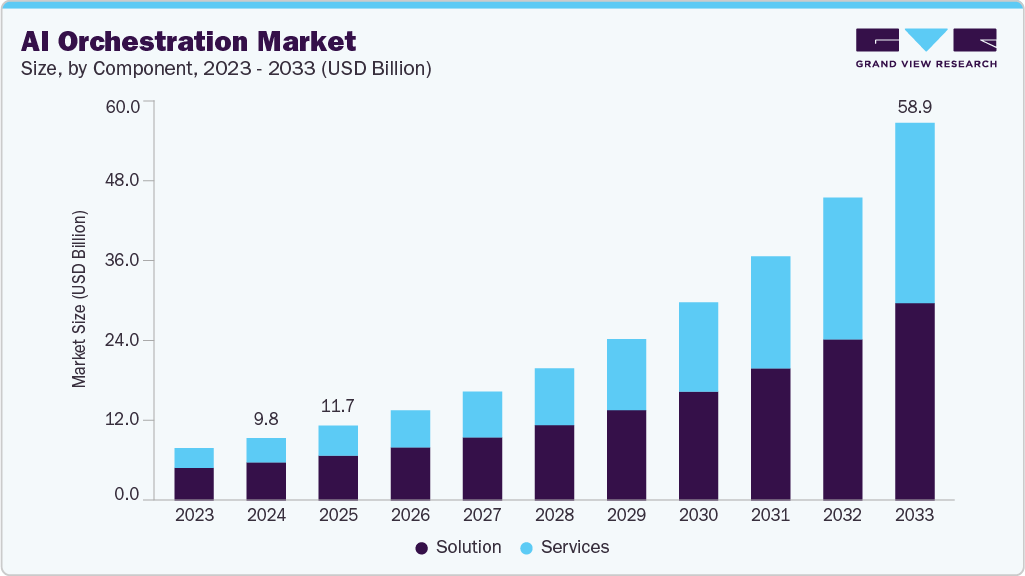
The global AI orchestration market size was estimated at USD 9.76 billion in 2024 and is projected to reach USD 58.92 billion by 2033, growing at a CAGR of 22.4% from 2025 to 2033. The market growth is primarily driven by the rising adoption of multi-agent AI systems, growing demand for automated workflow management, increased integration of AI across cloud and edge environments, and expanding enterprise focus on scalable and governed AI deployment.
 Source: Grand View Research, IR Documents, Primary Interviews, Paid DatabasesTo learn more about this report,
 Download Free Sample Report
 Key Market Trends & Insights
- North America AI orchestration dominated the global market with the largest revenue share of over 37% in 2024.
- The AI orchestration market in U.S. led the North America market and held the largest revenue share in 2024.
- By component, solution segment led the market and held the largest revenue share of around 61% in 2024.
- By application, customer service automation segment led the market and held the largest revenue share of over 24% in 2024.
- By end use, the healthcare segment is expected to grow at the fastest cagr of around 25% from 2025 to 2033.
Market Size & Forecast
- 2024 Market Size: USD 9.76 Billion
- 2033 Projected Market Size: USD 58.92 Billion
- CAGR (2025-2033): 22.4%
- North America: Largest market in 2024
- Asia Pacific: Fastest growing market
GVR research-powered AIAsk Prism AI about the AI orchestration marketGet cited answers from GVR research on market growth, segments, regulations and forecasts.Start with✓ Source-linked answers ✓ Market-specific context ✓ Traceable figuresExplore Prism AI ↗
The increasing demand for seamless automation and coordination across complex AI workflows is fueling the growth of the global AI orchestration industry. Enterprises are investing in orchestration platforms to unify data pipelines, model deployment, and workflow execution, enhancing efficiency and decision-making speed. This trend is reinforced by the need to manage diverse AI models and applications across departments and cloud environments. Organizations are also prioritizing real-time data integration and monitoring to ensure transparency and governance in AI operations. As a result, AI orchestration is becoming a critical enabler of enterprise-wide digital transformation and scalability.The AI orchestration industry is experiencing significant growth driven by the adoption of multi-agent systems and intelligent automation frameworks. Companies are increasingly leveraging agent-based orchestration to connect multiple AI models and automate complex business processes with minimal human intervention. This approach enhances operational agility, enabling faster response to dynamic business needs and market changes. Businesses are focusing on optimizing resource utilization and reducing time-to-value through intelligent coordination of AI tasks. Consequently, multi-agent orchestration is emerging as a strategic differentiator for enterprises seeking efficiency and innovation.
 To learn more about this report, Download Free Sample Report
 The rising need for AI governance and responsible automation is driving greater investment in orchestration solutions that emphasize transparency and compliance. Enterprises are increasingly aware of the risks associated with uncontrolled AI deployment, such as data bias, security issues, and regulatory challenges. Orchestration platforms are evolving to include audit trails, explainability tools, and centralized policy enforcement to mitigate these risks. Businesses are embedding governance frameworks into every layer of their AI systems to ensure accountability and ethical use. This trend underscores the strategic shift toward trusted and compliant AI operations.
Market Dynamics
The AI orchestration market is being significantly driven by the rapid enterprise adoption of multi-agent AI systems, autonomous AI workflows, and generative AI orchestration platforms across industries, including BFSI, healthcare, retail, manufacturing, and telecommunications. Organizations are increasingly deploying large language models (LLMs), AI co-pilots, and intelligent automation solutions that require centralized orchestration to manage AI agents, data pipelines, APIs, governance frameworks, and real-time decision-making processes. AI orchestration platforms enable enterprises to coordinate complex AI workloads, optimize AI model deployment, and enhance interoperability across cloud-native AI infrastructure, MLOps platforms, and enterprise applications. The rising demand for scalable AI automation, improved operational efficiency, and enterprise AI governance is accelerating global investments in AI workflow orchestration solutions.
Enterprises are prioritizing AI-driven digital transformation strategies that integrate predictive analytics, machine learning operations, and autonomous decision intelligence into critical business operations. AI orchestration software supports automated AI lifecycle management, streamlined data orchestration, and improved AI model monitoring across hybrid and multi-cloud environments. Technology providers are introducing advanced orchestration capabilities that support agentic AI architectures, low-code AI automation, and real-time analytics for enterprise-scale AI deployments. The growing adoption of generative AI technologies and intelligent process automation is expected to drive substantial growth opportunities in the global AI orchestration market during the forecast period.
A significant restraint affecting the AI orchestration market is the increasing complexity of AI governance, data privacy regulations, and integration within fragmented enterprise IT ecosystems. Organizations implementing AI orchestration solutions frequently encounter challenges related to data security, compliance management, model transparency, and interoperability among legacy systems, cloud platforms, and third-party AI tools. Regulatory frameworks for AI usage, data localization, and responsible AI deployment are becoming more stringent in North America, Europe, and Asia Pacific, resulting in heightened operational and compliance burdens for enterprises. These factors hinder the seamless adoption of enterprise AI orchestration platforms, especially in highly regulated sectors such as healthcare, banking, and government.
Integrating AI orchestration software with existing enterprise infrastructure demands significant investment in skilled personnel, cloud resources, cybersecurity measures, and AI lifecycle management capabilities. Many organizations face persistent challenges due to fragmented data environments, inconsistent AI governance policies, and difficulties managing multi-model AI ecosystems at scale. The absence of standardized orchestration frameworks and compatibility issues among AI vendors further complicate adoption and extend deployment timelines. Consequently, concerns regarding implementation complexity, regulatory compliance, and enterprise data governance continue to limit the growth potential of the global AI orchestration market.
The emergence of agentic AI, autonomous enterprise agents, and industry-specific AI orchestration platforms is creating significant growth opportunities in the AI orchestration market. Enterprises are increasingly seeking domain-specific orchestration solutions tailored for healthcare diagnostics, financial risk analysis, supply chain automation, cybersecurity operations, and customer experience management. AI orchestration vendors are developing intelligent coordination platforms that manage multiple AI agents, orchestrate real-time workflows, and enable autonomous task execution across enterprise ecosystems. The increasing adoption of vertical AI applications and industry-focused AI automation strategies is expected to create substantial demand for advanced orchestration technologies.
Furthermore, the rapid expansion of cloud AI infrastructure, edge AI deployments, and hybrid AI environments is creating new revenue streams for AI orchestration solution providers. Organizations are investing in orchestration frameworks that enable scalable deployment of generative AI, intelligent workload balancing, AI observability, and cross-platform automation. Emerging trends, including AI factories, decentralized AI ecosystems, and autonomous business operations, are accelerating innovation in orchestration technologies and enterprise AI management platforms. As organizations prioritize operational agility, AI scalability, and intelligent automation, the AI orchestration market is projected to experience robust long-term growth across global industries.
Market Concentration & Characteristics
The AI orchestration market shows a moderately concentrated competitive structure with major cloud computing providers, enterprise AI platforms, and emerging AI orchestration solution providers. Leading technology companies are investing in multi-agent AI systems, generative AI orchestration, AI workflow automation, and AI lifecycle management to strengthen their market position. The market is rapidly innovating due to advancements in large language models (LLMs), agentic AI architectures, autonomous AI workflows, and real-time AI governance platforms. Growing enterprise demand for scalable AI orchestration platforms, cloud-native AI infrastructure, and intelligent automation solutions is increasing competitive intensity globally.
 To learn more about this report, Download Free Sample Report
 The market shows high innovation intensity, medium-to-high merger and acquisition (M&A) activity, and strong regulatory influence linked to enterprise AI deployment and responsible AI governance. Regulatory developments on AI compliance, data privacy, AI transparency, cybersecurity governance, and ethical AI implementation significantly affect the adoption strategies of AI orchestration vendors and enterprise users. Substitute availability remains low as organizations increasingly need centralized AI orchestration software, MLOps platforms, AI agent management systems, and hybrid cloud AI orchestration solutions to manage complex AI workloads. End-user concentration is moderately high due to strong adoption of AI orchestration technologies across BFSI, healthcare, telecommunications, retail, manufacturing, and government and defense sectors.
Component Insights
The solution segment dominated the market with a share of around 61% in 2024, fueled by the accelerating adoption of AI-driven automation and intelligent orchestration platforms across enterprises. Organizations are increasingly investing in scalable, integrated solutions to enhance operational efficiency, boost productivity, and ensure faster decision-making. The rapid shift toward cloud-based models is further propelling growth by delivering agility, real-time data insights, and cost optimization. Businesses are leveraging these solutions to unify workflows, eliminate silos, and achieve higher levels of process intelligence. As digital transformation intensifies across sectors, the Solution segment stands at the forefront of market expansion, driving measurable business outcomes and long-term competitive advantage.
The services segment is expected to register a significant CAGR from 2025 to 2033, owing to the rising demand for consulting, implementation, integration, and managed support services across enterprises. As organizations increasingly adopt automation and AI solutions, the need for specialized expertise to customize and optimize these deployments is accelerating. Service providers are playing a crucial role in enabling seamless adoption, ensuring interoperability, and driving measurable ROI from digital transformation initiatives. In addition, the growing emphasis on continuous monitoring, training, and post-deployment support is further strengthening the services ecosystem. This ongoing reliance on professional and managed services positions the segment as a major growth catalyst in the orchestration and automation market landscape.
Application Insights
The customer service automation segment holds the largest share in the market in 2024, fueled by the widespread deployment of AI chatbots, virtual assistants, and intelligent ticketing systems that enhance customer engagement and reduce operational costs. Enterprises are leveraging automation to deliver faster, personalized, and omnichannel support experiences, improving customer satisfaction and retention rates. The integration of natural language processing (NLP) and machine learning technologies is enabling more context-aware and human-like interactions. Moreover, automation tools are helping organizations manage high service volumes efficiently while freeing human agents to focus on complex queries. As customer experience becomes a key differentiator, the demand for advanced service automation solutions continues to surge across industries.
The security operations segment is expected to grow at the fastest CAGR in the coming years, driven by the rising frequency and sophistication of cyber threats that demand real-time detection, response, and mitigation. Organizations are increasingly deploying AI- and automation-driven security orchestration, automation, and response (SOAR) platforms to enhance incident management efficiency and reduce response times. The growing adoption of cloud infrastructure and remote work models has expanded the attack surface, further fueling the need for automated security operations. In addition, regulatory compliance requirements and the shortage of skilled cybersecurity professionals are accelerating investment in intelligent security automation. As a result, this segment is emerging as a strategic priority for enterprises aiming to build resilient, proactive, and adaptive security frameworks.
Deployment Insights
The on-premises segment holds the highest share in the market in 2024, as enterprises continue to prioritize data sovereignty, security, and regulatory compliance across critical operations. A growing trend within this segment is the shift toward hybrid infrastructure, where organizations integrate on-premises systems with cloud platforms to enhance scalability while maintaining strict data control. Companies are increasingly modernizing legacy architectures through virtualization, containerization, and AI-driven automation to boost agility and performance. This hybridization allows businesses to optimize costs, improve workload management, and ensure business continuity. Consequently, the on-premises segment remains a key pillar in enterprise IT strategies, evolving toward a more secure, connected, and intelligent operational framework.
The cloud segment is expected to grow at a significant CAGR in the coming years, primarily driven by the rapid adoption of scalable, cost-efficient, and flexible deployment models across enterprises. Organizations are increasingly migrating to cloud-based platforms to enhance agility, enable real-time data access, and support remote or distributed work environments. The integration of AI, automation, and analytics within cloud ecosystems is further accelerating demand, allowing businesses to optimize workflows and improve decision-making. Moreover, the expansion of multi-cloud and hybrid cloud strategies is empowering companies to balance performance, security, and compliance requirements effectively. As digital transformation initiatives intensify, the cloud segment continues to be a central enabler of innovation, operational efficiency, and business resilience.
End Use Insights
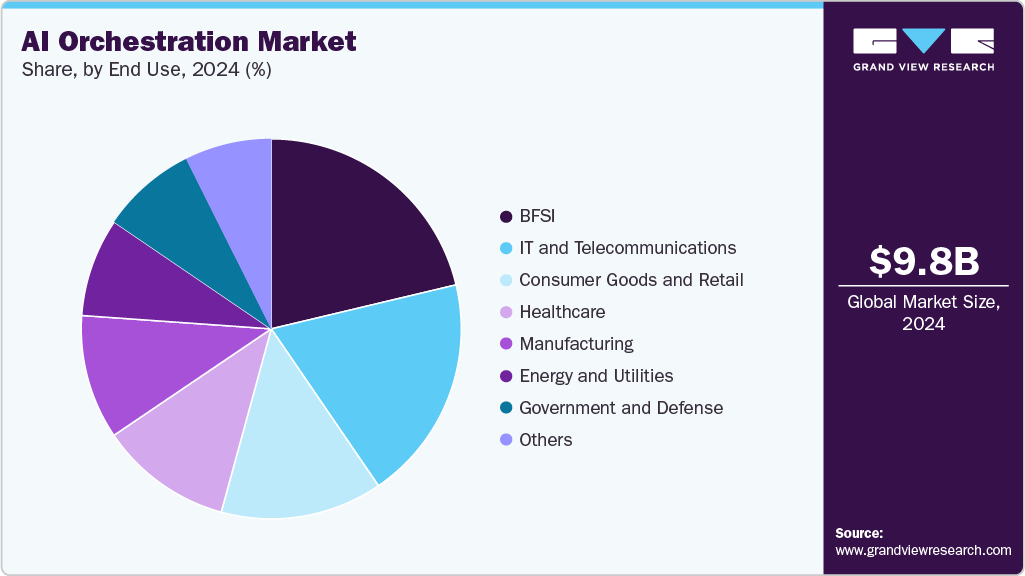
The BFSI segment accounted for the largest share in the market in 2024, driven by the extensive adoption of automation and AI technologies to enhance operational efficiency, risk management, and customer experience. Financial institutions are leveraging intelligent orchestration and workflow automation to streamline processes such as loan approvals, fraud detection, compliance monitoring, and customer onboarding. The sector’s strong focus on data security and regulatory compliance is also encouraging the deployment of advanced analytics and AI-powered automation solutions. In addition, the growing shift toward digital banking and personalized financial services is fueling further investment in cloud-based automation platforms. As a result, the BFSI segment continues to lead the market, setting the benchmark for digital innovation and intelligent process transformation.
 To learn more about this report, Download Free Sample Report
 The healthcare segment is projected to register a strong CAGR in the coming years, driven by the growing adoption of automation, AI, and data analytics to enhance patient care, streamline administrative workflows, and optimize clinical operations. Healthcare providers are increasingly deploying intelligent orchestration platforms to manage electronic health records (EHR), automate appointment scheduling, and support real-time diagnostics. The rising demand for telemedicine, remote patient monitoring, and AI-driven decision support systems is further accelerating digital transformation across the sector. Moreover, automation helps reduce operational costs and improve compliance with stringent healthcare regulations. As healthcare systems worldwide move toward connected and data-driven ecosystems, automation is emerging as a key enabler of efficiency, accuracy, and personalized care delivery.
Regional Insights
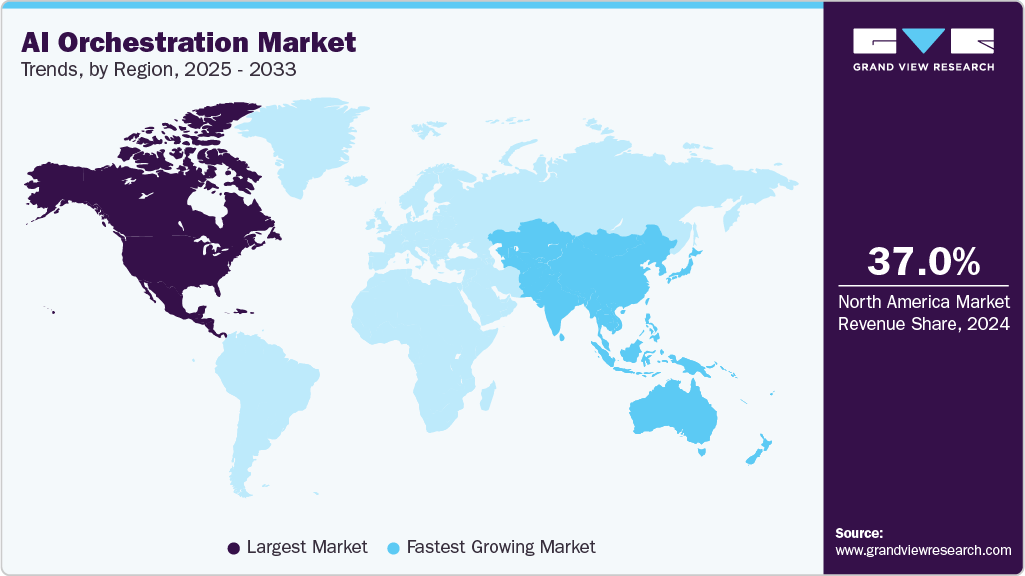
North America AI Orchestration market dominated the market with a share of over 37% in 2024, driven by early adoption of AI technologies and advanced automation frameworks. Enterprises across sectors such as finance, healthcare, and retail are heavily investing in AI orchestration to streamline workflows and enhance decision-making efficiency. Strong cloud infrastructure and government support for AI innovation are further accelerating market maturity. The region continues to focus on integrating AI orchestration into enterprise-wide systems to improve scalability, governance, and operational performance.
 To learn more about this report, Download Free Sample Report
 U.S. AI Orchestration Market Trends
The U.S. AI Orchestration market dominated the market with a share of over 71% in 2024,reflecting its leadership in enterprise AI innovation and adoption. Major technology companies and startups are actively developing orchestration tools to optimize multi-model AI operations and cross-platform automation. The growing use of AI orchestration in sectors like defense, BFSI, and manufacturing is fueling large-scale digital transformation initiatives. In addition, the U.S. market benefits from a strong investment ecosystem supporting AI governance, interoperability, and responsible automation.
Europe AI Orchestration Market Trends
The Europe AI Orchestration market is projected to witness substantial growth, registering a strong CAGR during the forecast period from 2025 to 2033, supported by regulatory frameworks that promote trustworthy and transparent AI deployment. European enterprises are increasingly adopting orchestration solutions to manage compliance, data protection, and ethical AI implementation. The region’s focus on sustainability and digital resilience is driving demand for AI-driven automation across industries such as logistics, automotive, and public services. Moreover, collaborations between technology vendors and research institutions are fostering innovation in scalable AI orchestration platforms.
Asia Pacific AI Orchestration Market Trends
Asia Pacific AI Orchestration market is expected to grow at the fastest CAGR of over 5% from 2025 to 2033, propelled by rapid digitalization and expanding AI investments across emerging economies. Countries such as China, Japan, India, and South Korea are adopting orchestration tools to accelerate smart manufacturing, financial automation, and urban infrastructure modernization. Increasing government support for AI innovation and the rise of cloud-based enterprises are creating strong growth opportunities. The region’s focus on operational efficiency, cost optimization, and large-scale AI deployment positions it as a global leader in future orchestration advancements.
Key AI Orchestration Company Insights
Some of the key companies in the AI Orchestration industry include International Business Machines (IBM), Microsoft Corporation, Google LLC, Amazon Web Services, Inc. (AWS), and SAP SE, and others. Organizations are actively working to expand their customer base and strengthen their market position. To achieve this, leading players are implementing strategic initiatives such as mergers, acquisitions, collaborations, and partnerships with other prominent companies to enhance their technological capabilities and global presence.
-
IBM is a prominent player in the AI orchestration market, offering advanced capabilities through its Watsonx platform. The company enables enterprises to design, train, and govern AI models efficiently while maintaining strong data security and compliance. IBM specializes in integrating AI with automation to optimize decision-making and streamline business operations. Its enterprise-grade infrastructure supports large-scale deployment across diverse industries. With a strong focus on trust, governance, and transparency, IBM continues to drive innovation in enterprise AI orchestration.
-
AWS is a player offering comprehensive solutions through its SageMaker and Bedrock platforms. The company enables organizations to develop, deploy, and manage generative and predictive AI models with high scalability. AWS specializes in providing flexible AI infrastructure that supports automation, integration, and governance across industries. Its services are designed to reduce complexity in AI model management while accelerating innovation. With strong cloud expertise and enterprise-grade reliability, AWS continues to shape the future of AI orchestration.
Key AI Orchestration Companies:
The following are the leading companies in the AI orchestration market. These companies collectively hold the largest market share and dictate industry trends.
- International Business Machines (IBM)
- Microsoft Corporation
- Google LLC
- Amazon Web Services, Inc. (AWS)
- SAP SE
- Salesforce, Inc.
- Adobe Inc.
- UiPath, Inc.
- Workato, Inc.
- Aisera, Inc.
- Kore.ai, Inc.
- Coforge Limited
Competitive Benchmarking
Operating Strategies
Competitive Edge
Weaknesses
Mature Players: International Business Machines (IBM), Microsoft Corporation, Google LLC, SAP SE.
- Increasing investments in agentic AI orchestration platforms are enabling enterprises to automate complex multi-agent workflows and decision-making processes.
- Growing focus on generative AI orchestration and LLM management capabilities is supporting large-scale deployment of enterprise AI applications.
- Strong cloud infrastructure ecosystems and global enterprise customer bases provide significant advantages in AI orchestration deployments.
- Advanced portfolios combining AI orchestration, generative AI, machine learning, and cloud services enable comprehensive enterprise solutions.
- High infrastructure and operational costs associated with large-scale AI deployments may impact profitability and pricing flexibility.
- Increasing complexity of managing diverse AI models, data pipelines, and orchestration frameworks can create implementation challenges.
Emerging Players: Salesforce, Inc., UiPath, Inc., Workato, Inc., Aisera, Inc., Kore.ai, Inc.
- Growing focus on multi-agent AI frameworks and autonomous workflow orchestration is enabling emerging vendors to address rapidly evolving enterprise requirements.
- Increasing development of LLMOps, AI observability, and model monitoring solutions is supporting efficient management of generative AI applications.
- Specialized expertise in AI orchestration, agent management, and generative AI workflows allows emerging players to address niche enterprise needs.
- Agile product development cycles enable faster innovation in response to evolving AI ecosystem requirements.
- Dependence on partnerships with cloud infrastructure providers may increase operational and competitive risks.
- Rapid technological evolution in the AI orchestration market requires continuous innovation and investment to maintain competitiveness.
Recent Developments
-
In October 2025, DXC Technology introduced Xponential, a structured blueprint designed to accelerate enterprise AI adoption and outcomes. The framework integrates people, processes, and technology with strong governance and security to help organizations scale AI initiatives efficiently. Built on five key pillars-Insight, Accelerators, Automation, Approach, and Process-Xponential supports responsible AI implementation and faster business value realization. Early deployments across industries have shown measurable gains, including improved automation, fewer service requests, and better decision-making efficiency.
-
In May 2025, Alteryx introduced a unified platform for enterprise analytics and AI orchestration called Alteryx One. The platform combines analytics, AI-driven workflow automation, low-code data preparation, and centralized governance within a single environment. Its AI Control Center enables organizations to manage security, licensing, and AI interactions, including those involving large language models. With enhanced integration to cloud platforms such as Snowflake and Databricks, the solution simplifies data preparation and streamlines enterprise-wide analytics operations.
-
In January 2025, ServiceNow introduced its AI Agent Studio and AI Agent Orchestrator to help enterprises build and manage intelligent agents at scale. The AI Agent Studio enables users to create custom agents using a no-code, natural language interface, while the Orchestrator coordinates multiple agents across workflows and systems for seamless automation. These tools leverage ServiceNow’s Workflow Data Fabric to connect structured and unstructured enterprise data, driving smarter, faster decision-making across business functions. Available from March 2025 for Pro Plus and Enterprise Plus customers at no extra cost, the launch reinforces ServiceNow’s vision of embedding agentic AI into core enterprise operations.
-
In October 2024, Cognizant introduced a multi-agent orchestration capability within its Neuro AI Platform to accelerate enterprise adoption of generative AI solutions. Enhancement enables organizations to quickly identify, prototype, and scale AI-driven decision-making use cases by integrating data, models, and workflows efficiently. The platform empowers business users to move beyond predictive analytics and create outcome-focused decision systems without requiring deep technical expertise. Supported by several patents and successful pilots across industries like pharmaceuticals, agriculture, and finance, the solution strengthens Cognizant’s position in enterprise AI transformation.
AI Orchestration Market Report Scope
Report Attribute
Details
Market size value in 2025
USD 11.69 billion
Revenue forecast in 2033
USD 58.92 billion
Growth rate
CAGR of 22.4% from 2025 to 2033
Base year for estimation
2024
Historical data
2021 - 2023
Forecast period
2025 - 2033
Quantitative units
Revenue in USD million/billion, and CAGR from 2025 to 2033
Report coverage
Revenue forecast, company ranking, competitive sector, growth factors, and trends
Segment scope
Component, application, deployment, end use, region
Region scope
North America; Europe; Asia Pacific; Latin America; Middle East & Africa
Country scope
U.S.; Canada; Mexico; Germany; UK; France; China; Japan; India; Australia; South Korea; Brazil; KSA; UAE; South Africa
Key companies profiled
International Business Machines (IBM); Microsoft Corporation; Google LLC; Amazon Web Services, Inc. (AWS); SAP SE; Salesforce, Inc.; Adobe Inc.; UiPath, Inc.; Workato, Inc.; Aisera, Inc.; Kore.ai, Inc.; Coforge Limited
Customization scope
Free report customization (equivalent up to 8 analysts’ working days) with purchase. Addition or alteration to country, regional & segment scope
Pricing and purchase options
Avail customized purchase options to meet your exact research needs. Explore purchase options
Global AI Orchestration Market Report Segmentation
This report forecasts revenue growth at global, regional, and country levels and provides an analysis of the latest industry trends and opportunities in each of the sub-segments from 2021 to 2033. For this study, Grand View Research has segmented the global AI orchestration market in terms of component, application, deployment, end use, and region.
-
Component Outlook (Revenue, USD Million, 2021 - 2033)
-
Solution
-
Services
-
-
Application Outlook (Revenue, USD Million, 2021 - 2033)
-
Customer Service Automation
-
Sales & Revenue Automation
-
Marketing Automation
-
IT Service Management
-
Security Operations
-
HR & Employee Service Desk
-
Others
-
-
Deployment Outlook (Revenue, USD Million, 2021 - 2033)
-
Cloud
-
On-premises
-
-
End Use Outlook (Revenue, USD Million, 2021 - 2033)
-
BFSI
-
Consumer Goods and Retail
-
Energy and Utilities
-
Government and Defense
-
Healthcare
-
IT and Telecommunications
-
Manufacturing
-
Others
-
-
Regional Outlook (Revenue, USD Million, 2021 - 2033)
-
North America
-
U.S.
-
Canada
-
Mexico
-
-
Europe
-
UK
-
Germany
-
France
-
-
Asia Pacific
-
China
-
Japan
-
India
-
Australia
-
South Korea
-
-
Latin America
-
Brazil
-
-
Middle East & Africa (MEA)
-
KSA
-
UAE
-
South Africa
-
-
Delivered Customizations
This report has been delivered with the following In-depth customizations
Client Objective
Custom Research Modules Delivered
Strategic Value / Business Impact
AI Orchestration Market Expansion & Enterprise AI Adoption Strategy
- Enterprise adoption analysis of AI orchestration platforms across BFSI, healthcare, retail, manufacturing, telecommunications, and government sectors.
- Benchmark assessment of multi-agent AI systems, agentic AI platforms, generative AI orchestration solutions, and LLMOps frameworks.
- Regional opportunity mapping for enterprise AI automation, intelligent workflow orchestration, and cloud-native AI deployments.
- Evaluation of AI governance regulations, data privacy requirements, responsible AI frameworks, and compliance standards impacting AI orchestration adoption.
- Identified high-growth opportunities in agentic AI, generative AI orchestration, and enterprise workflow automation solutions.
- Supported strategic expansion into autonomous business operations, AI-powered decision intelligence, and intelligent process automation markets.
- Improved product innovation planning and AI deployment optimization strategies for orchestration platform providers.
- Strengthened competitive positioning within next-generation enterprise AI ecosystems and intelligent automation environments.
AI Orchestration Technology Benchmarking & Competitive Intelligence
- Advanced assessment of AI orchestration software, AI agent management platforms, and enterprise workflow automation technologies.
- Product benchmarking and feature comparison of LLM orchestration platforms, AI observability solutions, multi-agent frameworks, and AI governance capabilities.
- Pricing analysis, cloud deployment trends, AI infrastructure adoption assessment, and hybrid/multi-cloud orchestration ecosystem evaluation.
- Competitor strategy analysis, strategic partnerships, R&D investment assessment, and innovation benchmarking in AI orchestration technologies.
- Enabled differentiation through advanced AI agent coordination, autonomous workflow management, and enterprise AI governance capabilities.
- Supported pricing optimization and product roadmap development for AI orchestration vendors and cloud service providers.
- Identified emerging opportunities in AI copilots, autonomous agents, predictive decision intelligence, and industry-specific AI automation solutions.
- Enhanced long-term commercialization planning and innovation strategies within the global AI orchestration market.
Frequently Asked Questions About This Report
The global AI orchestration market size was estimated at USD 9.76 billion in 2024 and is expected to reach USD 11.69 billion in 2025.
The global AI orchestration market is projected to grow at a compound annual growth rate (CAGR) of 22.4% from 2025 to 2033, reaching a value of USD 58.92 billion by 2033.
North America dominated the AI orchestration market, accounting for over 37% of the share in 2024, and is expected to retain its leadership position, driven by the rapid enterprise adoption of AI-driven automation, the strong presence of major technology vendors, and expanding investments in cloud and edge infrastructure to enhance intelligent workflow capabilities.
Some key players operating in the AI orchestration market include International Business Machines (IBM), Microsoft Corporation, Google LLC, Amazon Web Services, Inc. (AWS), SAP SE, Salesforce, Inc., Adobe Inc., UiPath, Inc., Workato, Inc., Aisera, Inc., Kore.ai, Inc., and Coforge Limited.
Key factors that are driving the market growth include the rising demand for data privacy and low-latency processing, the integration of dedicated AI accelerators and neural processing units in consumer devices, the increasing adoption of edge computing for real-time decision-making, and the growing use of AI-enabled features across smartphones, wearables, and automotive applications.
About the Author(s)
Next Generation Technologies Research Team
Technology · Next Generation TechnologiesThis report was authored by the next generation technologies research team at Grand View Research - comprising two research analysts, one senior research analyst, and one industry expert - with specialized expertise in the next generation technologies segment of the technology industry. All findings are based on proprietary technology databases, executive interviews, and regulatory analysis, subject to internal peer review prior to publication.
Last Updated:
Speak to Analyst

Customize this report to your needs - add regions, segments, or data points, with 20% free customization.
Or view our licence options:


ISO 9001:2015 & 27001:2022 Certified
We are GDPR and CCPA compliant! Your transaction & personal information is safe and secure. For more details, please read our privacy policy.


